# Essential Tips Every Young Driver Should Know Before Hitting the Road
Learning to drive represents one of the most significant milestones in a young person’s life, offering unprecedented freedom and independence. However, this newfound mobility comes with substantial responsibility. Recent statistics reveal that drivers aged 17-24 account for only 7% of UK licence holders yet are involved in 16% of fatal and serious collisions. The transition from learner to confident, competent driver requires more than simply passing your practical test—it demands a comprehensive understanding of vehicle dynamics, road safety principles, and defensive driving techniques that extend far beyond basic instruction.
The early months following test success represent the highest risk period for novice drivers. Research demonstrates that one in five newly qualified drivers experience a collision within their first year on the road. These sobering figures underscore the critical importance of thorough preparation, continued learning, and the development of safe driving habits that will serve you throughout your motoring lifetime. Understanding the technical aspects of vehicle operation, mastering hazard perception skills, and cultivating situational awareness can dramatically reduce your accident risk and transform you from a merely adequate driver into an exceptional one.
Pre-drive vehicle safety checks: the POWDERY mnemonic system
Before every journey, competent drivers perform systematic vehicle safety checks to ensure their car is roadworthy and safe to operate. The POWDERY mnemonic provides a comprehensive framework for remembering essential pre-drive inspections: Petrol, Oil, Water, Damage, Electrics, Rubber, and Yourself. These checks take merely five minutes but can prevent mechanical failures, costly breakdowns, and potentially life-threatening situations on the road. Developing this routine as an automatic habit from the beginning of your driving career establishes professional standards that distinguish safe, responsible motorists from negligent ones.
Many young drivers underestimate the importance of regular vehicle maintenance, assuming that if the car starts, it must be safe to drive. This dangerous misconception has resulted in countless preventable accidents. Tyre blowouts, brake failures, and visibility issues caused by worn wiper blades or insufficient screenwash contribute significantly to collision statistics. Understanding your legal responsibilities as a driver means recognising that you—not your parents, not the garage, not your instructor—bear ultimate accountability for ensuring your vehicle meets legal safety standards before you turn the ignition key.
Tyre pressure monitoring and tread depth assessment using the 20p test
Tyres represent your vehicle’s only contact point with the road surface, making their condition absolutely critical to safe vehicle control. Under-inflated tyres increase fuel consumption by up to 3%, reduce handling precision, extend braking distances, and are more prone to dangerous blowouts at motorway speeds. Check your tyre pressures weekly using a reliable gauge, comparing readings against the manufacturer’s specifications found in your vehicle handbook or on a plate inside the driver’s door frame. Remember that recommended pressures differ for front and rear tyres and may require adjustment when carrying heavy loads or travelling at sustained high speeds.
The legal minimum tread depth across the central three-quarters of the tyre is 1.6mm, but tyre safety experts recommend replacement at 3mm for optimal wet-weather performance. The simple 20p test provides a quick assessment method: insert a 20p coin into the main tread grooves, and if the outer band remains visible, your tyres have fallen below the legal limit. Inspect all four tyres regularly for cuts, bulges, or embedded objects that compromise structural integrity. Many young drivers fail to realise that driving on illegal tyres carries penalties of up to £2,500 and three penalty points per tyre, meaning you could lose your licence entirely for this single offence.
Fluid level verification: engine oil, coolant, and windscreen washer
Engine oil lubricates moving components, prevents excessive wear, and helps dissipate heat generated by combustion. Check oil levels weekly when the engine is cold and the vehicle is on level ground. Remove the dipstick, wipe it clean, reinsert it fully, then withdraw it again to obtain an accurate reading. The oil level should sit between the minimum and maximum markers. If levels consistently drop between checks, your vehicle may have a leak or be burning oil—both conditions requiring immediate professional attention
to prevent catastrophic engine damage. Coolant (or antifreeze) regulates engine temperature, preventing overheating in summer and freezing in winter. Check the expansion tank markings and top up only with the correct mixture specified in your handbook—never open a hot radiator cap, as pressurised steam can cause severe burns. Windscreen washer fluid is equally important for visibility: plain water is inadequate, especially in winter, as it can freeze and smear road grime rather than clearing it. Use a quality screenwash additive all year round to break down insects, salt, and oil, ensuring a clear view of the road ahead.
Brake system responsiveness testing and warning light diagnostics
Your braking system is your primary safety net, so you must treat even minor changes in pedal feel as serious. Before setting off, apply firm pressure to the brake pedal with the engine running—the pedal should feel solid and not sink slowly to the floor. As you move off at low speed in a safe area, perform a gentle brake test to confirm the car stops in a straight line without pulling to one side or producing grinding noises. Any sponginess, vibration, or metallic sounds indicate worn pads, warped discs, or air in the system, all of which require prompt professional inspection.
Modern vehicles are equipped with sophisticated brake warning systems, including ABS (anti-lock braking system) and ESC (electronic stability control) indicators. When you turn the ignition on, these warning lights should briefly illuminate as part of a self-check, then extinguish once the engine is running. If any brake-related light remains on—particularly the red brake system warning or ABS symbol—you must not ignore it. Continuing to drive with illuminated warning lights is comparable to flying a plane with a flashing engine alarm; you might stay airborne for a while, but the risk of sudden failure is unacceptably high.
Mirror adjustment protocol: eliminating blind spots with the SEE method
Correct mirror adjustment is fundamental to safe lane positioning and hazard perception. Many young drivers inadvertently set their side mirrors too far inward, duplicating the view from the interior mirror and leaving large blind spots at the vehicle’s rear quarters. To minimise these blind zones, sit in your normal driving position and adjust the interior mirror to frame the rear window. Then set each door mirror so that the side of your car is just out of view, expanding your field of vision into adjacent lanes rather than simply showing more of your own bodywork.
Once your mirrors are correctly positioned, apply the SEE method—Search, Evaluate, Execute—to every manoeuvre. You search using regular mirror checks (interior, then door mirrors) and brief over-the-shoulder glances before changing speed or direction. You evaluate what other road users are doing, assessing closing speeds, signal intentions, and potential conflicts. Finally, you execute your action smoothly, signalling in good time and maintaining a safe gap. Think of SEE as your mental driving software: when it runs in the background on every journey, blind spot surprises and last-second reactions become rare exceptions rather than daily occurrences.
Mastering defensive driving techniques for hazard perception
Passing the hazard perception test is only the beginning; real-world defensive driving demands that you anticipate problems long before they fully develop. Rather than assuming other road users will always follow the rules, defensive drivers adopt a mindset of cautious expectation: they plan for the cyclist to wobble, the pedestrian to step into the road, and the driver ahead to brake sharply. This proactive approach reduces your reliance on lightning-fast reactions and instead creates generous time and space buffers around your vehicle, significantly lowering the chance of collisions.
Developing strong hazard perception skills is particularly vital for young drivers, whose inexperience often limits their ability to recognise subtle danger cues. Studies by the Transport Research Laboratory have shown that experienced drivers can detect hazards up to two seconds earlier than novices, a difference that can be the margin between a safe stop and a serious crash. By deliberately practising structured defensive driving systems, you train your brain to process traffic patterns more efficiently and respond calmly under pressure, even when the unexpected occurs.
The smith system: five keys to space cushion management
The Smith System is a proven defensive driving framework used by professional drivers worldwide to maintain safe space cushions. Its five core principles are simple but powerful when applied consistently. First, Aim High in Steering: look well ahead of your vehicle, not just at the car directly in front, so you can predict traffic flow and avoid sudden braking. Second, Get the Big Picture: use your mirrors and peripheral vision to understand how vehicles, pedestrians, and road features interact around you, rather than focusing on a single hazard.
Third, Keep Your Eyes Moving: avoid fixating on any object for more than a couple of seconds by constantly scanning mirrors, instruments, and the road ahead. Fourth, Leave Yourself an Out: always maintain an escape route—either a clear lane, a safe shoulder, or extra braking distance—so you are not boxed in by other vehicles. Finally, Make Sure They See You: use your lights, horn (sparingly), and clear positioning to ensure you are visible and predictable to others. When you apply these five keys, you transform congested roads from a chaotic threat into a manageable, predictable environment.
Commentary driving practice for enhanced situational awareness
Commentary driving involves verbalising what you see, what you expect to happen, and how you intend to respond—essentially turning your internal thought process into a running narrative. At first this may feel unnatural, but it is one of the most effective ways to sharpen situational awareness and hazard perception. You might say, “Pedestrian near the crossing ahead, car behind quite close, road narrowing after the parked van, reducing speed and checking mirrors.” This continuous commentary trains you to observe more detail and to link observations with appropriate actions.
You can practise commentary driving with a parent, instructor, or even alone by speaking quietly to yourself. The key is honesty: admit when you have missed something or reacted late, then adjust your focus accordingly. Over time, you will notice patterns—perhaps you often overlook cyclists on your nearside or misjudge closing speeds on rural roads. Spotting these trends allows you to target specific weaknesses, turning commentary driving into a personal coaching tool that accelerates your development into a safer, more confident young driver.
Scanning patterns: the 12-15 second rule for forward planning
Many novice drivers concentrate almost exclusively on the immediate few metres in front of their bonnet, leaving them perpetually surprised by developing hazards. The 12–15 second scanning rule counters this by encouraging you to look far enough ahead that problems never feel sudden. In urban areas, this might mean scanning to the next set of traffic lights; on faster roads, it could be the next bend, junction, or visible cluster of brake lights. By constantly projecting your attention this far ahead, you buy yourself valuable reaction time and reduce the need for harsh braking or abrupt steering.
Practically, this scanning should follow a repeating pattern: far ahead, mid-distance, close to the vehicle, then mirrors and instrument check, before repeating. Imagine your vision sweeping the road like a radar beam rather than staring at a single point. Ask yourself, “What can I see? What can’t I see? What might reasonably appear?” This habit turns forward planning into second nature, helping you adapt speed early for hazards such as hidden junctions, sharp bends, or stationary traffic over brows and the crests of hills.
Identifying high-risk road users: cyclists, pedestrians, and HGV blind zones
Certain road users are statistically more vulnerable and require heightened attention from every young driver. Cyclists often travel at varying speeds and can be difficult to see, especially in poor light or rain. Look for tell-tale signs such as cycle lanes, parked bikes, or groups waiting at junctions, and always allow at least 1.5 metres of clearance when overtaking at up to 30 mph, increasing this at higher speeds. Avoid squeezing past cyclists on narrow roads—instead, hold back until it is genuinely safe to pass, even if impatient drivers behind you are pressuring you to move.
Pedestrians present particular risks near schools, pubs, bus stops, and residential areas where children may step into the road without warning. Reduce speed and cover the brake when you see people on the pavement facing away from you or looking at their phones. Heavy Goods Vehicles (HGVs) and buses have extensive blind spots on both sides and immediately behind the vehicle; if you cannot see the driver in their mirrors, they probably cannot see you either. Never linger alongside large vehicles at junctions or roundabouts, as a seemingly minor steering adjustment from them can result in a serious side-swipe collision.
Understanding UK road signage categories and priority rules
UK road signs form a visual language that communicates legal requirements, warnings, and guidance at a glance. For young drivers, mastering this language is not only essential for passing the theory test but also for making safe, lawful decisions in fast-changing traffic environments. Signs are grouped into categories—regulatory, warning, and informational—each with distinctive shapes and colours to aid quick recognition, even when partially obscured or glimpsed at speed. By learning how these categories work together, you can decode complex junctions and priority systems without hesitation.
Priority rules dictate who should proceed first at junctions, roundabouts, and narrow sections of road. While many situations are controlled by clear markings and signs, others rely on an understanding of convention and courtesy. Failing to recognise priority signs or misreading right-of-way is a common cause of collisions among new drivers, particularly at mini-roundabouts and unmarked rural crossroads. Developing a thorough knowledge of road signage and priority rules enables you to approach these situations calmly and assertively, reducing uncertainty and last-minute decision-making.
Regulatory signs: speed limits, box junctions, and yellow line restrictions
Regulatory signs tell you what you must or must not do, and ignoring them is a criminal offence. Speed limit signs are typically circular with a red border; where no sign is present, you must apply the national speed limits based on road type and the presence of street lighting. Remember that the posted limit is a maximum, not a target—driving at an appropriate speed for the road, traffic, and weather conditions is a hallmark of a skilled young driver. Average speed cameras and increasing enforcement mean that habitual speeding is likely to result in penalty points and higher insurance premiums, particularly on telematics policies.
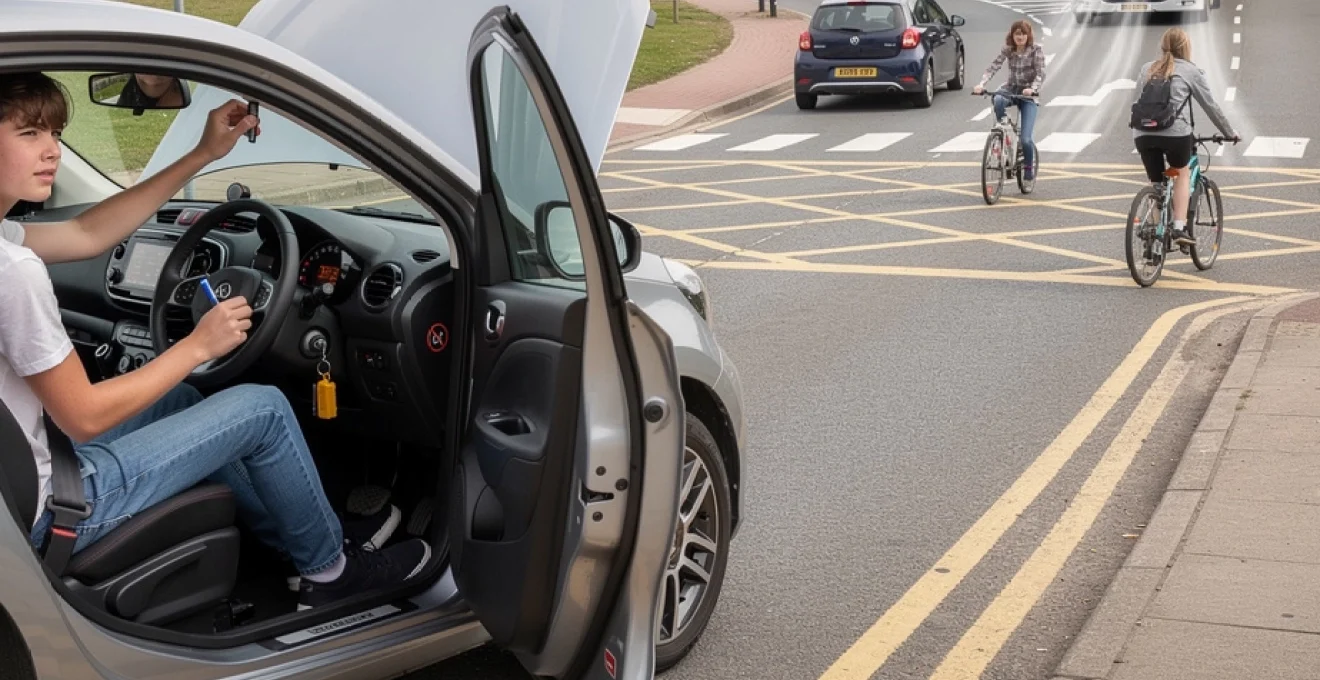
Box junctions, marked by criss-cross yellow lines, are designed to keep key junctions clear and prevent gridlock. You must not enter a box junction unless your exit is clear, except when turning right and blocked by oncoming traffic. Yellow line parking restrictions can be confusing: a single yellow line usually indicates restricted parking during certain hours shown on nearby plates, while double yellow lines usually mean no waiting at any time. Misunderstanding these signs can quickly lead to fines or vehicle towing, so taking time to revisit the Highway Code pays dividends in both safety and cost.
Warning triangle signs: decoding advance hazard information
Triangular signs with red borders provide advance warning of hazards, often giving you the few extra seconds needed to adjust your speed and positioning. These might indicate sharp bends, crossroads, steep hills, pedestrian crossings, or merging traffic. Whenever you see a warning triangle, ask yourself, “What specific hazard is being flagged, and how should I prepare?” For example, a warning for a concealed junction suggests you should reduce speed and be ready for vehicles emerging suddenly from side roads.
Some warning signs include supplementary plates detailing distances (such as “300 yards”) or additional information like “Oncoming vehicles in middle of road.” Treat these as early intelligence about the road ahead. In rural areas especially, warning signs about animals, mud on the road, or uneven surfaces should prompt you to increase following distance and moderate your speed, even if the road looks clear. Think of warning triangles as the road’s way of whispering, “Something tricky is coming up—get ready now, not at the last second.”
Navigating roundabouts: lane discipline and right-of-way protocol
Roundabouts can be intimidating for new drivers, yet they are central to UK road design and, once understood, are often safer and more efficient than traditional junctions. The basic rule is simple: give way to traffic from your right already on the roundabout, unless signs or road markings indicate otherwise. Before you reach the roundabout, use the information available—direction signs, lane arrows, and road markings—to choose the correct approach lane. As a general guide, use the left lane for turning left or going straight ahead, and the right lane for turning right or taking exits beyond 12 o’clock, unless local signage states otherwise.
Good lane discipline continues on the roundabout. Maintain a steady, appropriate speed, avoid cutting across lanes, and signal your intentions clearly. Signal left after you pass the exit before the one you intend to take, checking your mirrors and blind spot for cyclists or motorcyclists who may be alongside you. Mini-roundabouts demand extra care: vehicles should not overrun the central markings unnecessarily, and tight turning circles can make large vehicles swing wide. Staying calm, planning your lane position early, and resisting pressure from impatient drivers behind you are key to navigating roundabouts safely and confidently.
Advanced stop lines for cyclists and pedestrian crossing regulations
Advanced stop lines (ASLs), often seen at traffic-light-controlled junctions, create a dedicated space for cyclists ahead of motor vehicles. When the lights are red, drivers must stop at the first (rear) line, leaving the box clear for cyclists. Entering the cycle box when the light is red is an offence unless you have already crossed the first line when the signal changed. For young drivers, respecting ASLs is not only a legal requirement but a crucial part of sharing the road safely with more vulnerable users who rely on that space to position themselves visibly.
Pedestrian crossings—zebra, pelican, puffin, toucan, and equestrian—each have specific rules governing driver behaviour. Regardless of type, your priority is to approach crossings at a speed that allows you to stop safely if someone steps out. At zebra crossings, you must give way once pedestrians have begun to cross; at signal-controlled crossings, you must obey the lights but also remain alert to late crossers when the signal changes. Never overtake another vehicle near or at a pedestrian crossing, as they may be stopping for someone you cannot see. Understanding and respecting crossing regulations is fundamental to protecting some of the most vulnerable people you will encounter on the road.
Vehicle control dynamics: steering, braking, and acceleration coordination
Safe vehicle control is about more than simply turning the wheel, pressing pedals, and hoping the car responds. It involves understanding how steering, braking, and acceleration interact to affect grip, stability, and stopping distances. Modern cars are equipped with driver aids such as ABS and stability control, but these systems are not magic shields; they can only work within the limits of tyre grip and physics. As a young driver, learning to drive smoothly—rather than aggressively—gives these systems the best chance to support you and significantly reduces wear on brakes, tyres, and suspension.
Think of your inputs as connected rather than separate. Harsh steering while braking heavily, for example, can overload the front tyres and reduce their ability to grip, especially in wet or icy conditions. Conversely, easing off the brake slightly as you steer into a bend (a technique known as trail braking, taught in advanced courses) can help settle the car, but it requires practice and should never be attempted at high speed on public roads. Your immediate goal is consistency: progressive braking, measured steering, and gentle acceleration that keeps weight transfer balanced and predictable.
Motorway driving protocol: lane discipline and smart motorway navigation
Motorways may seem daunting at first, but statistically they are among the safest roads in the UK due to controlled access and consistent traffic flow. The primary challenge for young drivers lies in speed management, lane discipline, and safe merging. Joining a motorway via a slip road requires you to build up speed to match the flow of traffic, check mirrors and blind spots, and merge smoothly without forcing other drivers to brake sharply. Remaining in the left-hand lane unless overtaking—the so-called “keep left unless overtaking” rule—is a key part of good motorway etiquette and is increasingly enforced.
Smart motorways, which use variable speed limits and active lane management, add an extra layer of complexity. Overhead gantries may display changing speed limits, red “X” lane closures, or warnings about hazards ahead. You must obey these instructions as they are legally enforceable; ignoring a red “X” can result in significant fines and penalty points. When you see a lower speed limit or warning sign, ease off the accelerator early rather than braking late, helping to smooth traffic flow and reduce the risk of sudden queues. Treat the motorway as a high-speed conveyor belt: your job is to join, travel, and leave with minimal disruption to others, always maintaining safe following distances and clear escape routes.
Insurance requirements and telematics black box technology for new drivers
For young drivers in the UK, understanding car insurance rules is just as important as knowing the Highway Code. It is illegal to drive without at least third-party insurance, and penalties can include hefty fines, penalty points, and even vehicle seizure. New drivers often face higher premiums due to their elevated risk profile, but you can reduce costs by choosing an appropriate vehicle, building a clean driving record, and considering telematics (black box) insurance policies. These policies monitor your driving behaviour—speed, braking, time of day, and cornering—and reward safe habits with lower premiums over time.
While the idea of a black box might feel intrusive at first, it can be a powerful ally in developing safer driving habits. Knowing that harsh acceleration, late-night driving, or frequent speeding can affect your insurance encourages you to adopt a smoother, more defensive style behind the wheel. In some cases, telematics data has even been used to support drivers after collisions, providing objective evidence of speed and behaviour. Ultimately, viewing your insurance not merely as a legal obligation but as part of a wider commitment to responsible driving helps you protect both your wallet and your long-term driving privileges.