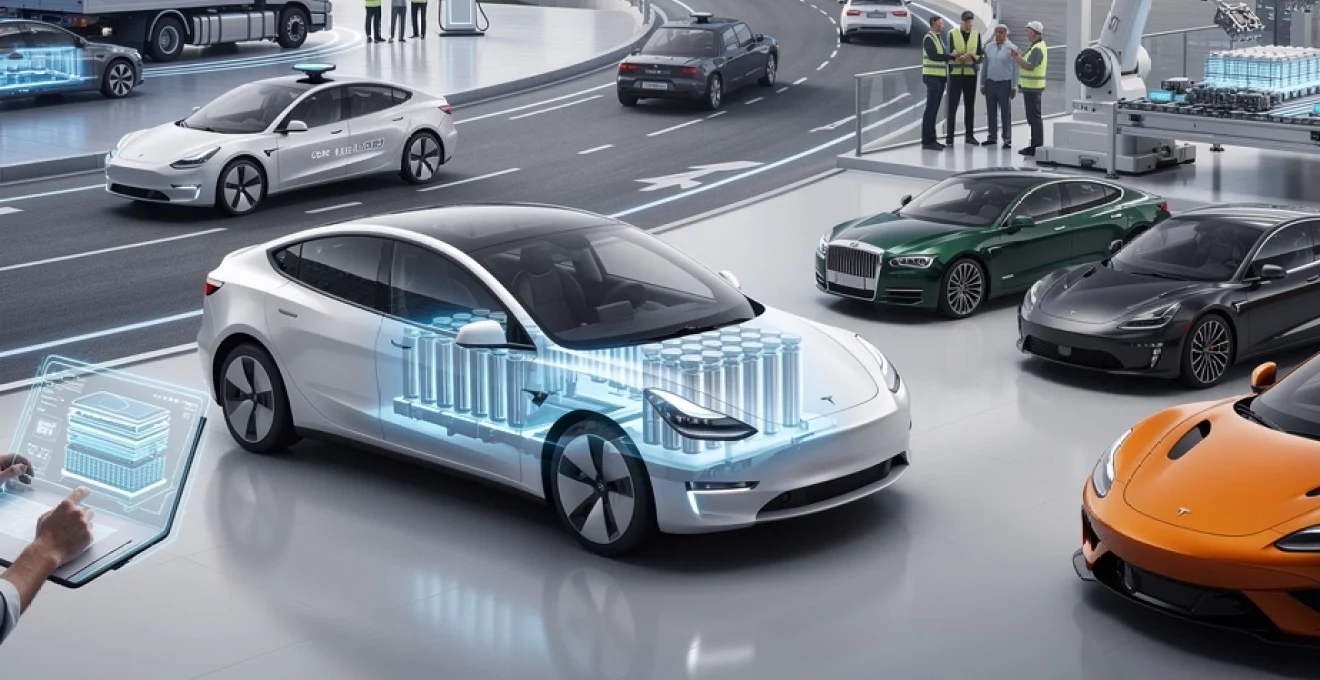
The automotive industry stands at a pivotal crossroads, where traditional manufacturing meets cutting-edge technology, and sustainability concerns drive unprecedented innovation. From revolutionary battery breakthroughs to autonomous driving milestones, the sector continues to reshape itself at breakneck speed. Major manufacturers are investing billions in electrification whilst navigating supply chain challenges, regulatory pressures, and shifting consumer expectations.
Recent developments have highlighted the industry’s remarkable adaptability, with established brands like Tesla maintaining their technological edge whilst newcomers such as BYD challenge conventional market hierarchies. The integration of artificial intelligence, advanced materials science, and sustainable manufacturing processes has created opportunities that seemed impossible just a decade ago. These transformative changes extend beyond mere product development, fundamentally altering how vehicles are conceived, manufactured, and integrated into our daily lives.
Electric vehicle market disruption and battery technology breakthroughs
The electric vehicle revolution has accelerated beyond most industry predictions, with battery technology serving as the primary catalyst for this transformation. Manufacturers worldwide are racing to develop more efficient, longer-lasting, and cost-effective energy storage solutions that could make electric vehicles competitive with traditional combustion engines across all market segments.
Tesla model Y refresh and 4680 battery cell integration
Tesla’s refreshed Model Y represents a significant leap forward in electric vehicle engineering, particularly with its integration of the company’s revolutionary 4680 battery cells. These larger cylindrical cells promise to deliver approximately 16% more range compared to the previous generation whilst reducing manufacturing costs by an estimated 14%. The new battery architecture allows for more efficient thermal management and faster charging capabilities, with peak charging speeds reaching 250kW under optimal conditions.
The refreshed Model Y incorporates substantial design improvements that extend beyond the battery system. A new front lightbar, inspired by the Cybertruck’s distinctive aesthetic, creates a more cohesive visual identity across Tesla’s product line. Interior enhancements include an upgraded infotainment system running through a 15.4-inch central display, complemented by an additional eight-inch rear passenger screen. Perhaps most significantly, Tesla has abandoned the controversial steering wheel indicator switches in favour of conventional stalks, addressing one of the most criticised aspects of recent Tesla models.
BYD blade battery technology in european market expansion
BYD’s aggressive European expansion strategy centres around its innovative Blade Battery technology, which utilises lithium iron phosphate (LFP) chemistry in an ultra-thin, blade-like configuration. This design approach maximises energy density whilst enhancing safety characteristics, with the batteries demonstrating exceptional resistance to thermal runaway even under extreme stress conditions. The technology has proven particularly effective in BYD’s Atto series, where it delivers competitive range figures whilst maintaining cost advantages over traditional nickel-based chemistries.
The Chinese manufacturer’s European strategy involves establishing local partnerships and potentially building manufacturing facilities to circumvent import tariffs and reduce delivery times. BYD’s success with models like the Dolphin Surf, priced under £19,000, demonstrates how advanced battery technology can enable affordable electric mobility without compromising on essential features such as rapid charging capabilities and practical driving range.
Mercedes EQS Solid-State battery development timeline
Mercedes-Benz has committed to introducing solid-state battery technology across its EQS lineup by 2028, promising to revolutionise electric vehicle performance metrics. These next-generation batteries could deliver energy densities exceeding 400Wh/kg, potentially enabling ranges of over 600 miles on a single charge. Solid-state technology eliminates liquid electrolytes, reducing fire risks and enabling faster charging cycles without the degradation issues associated with current lithium-ion systems.
The development timeline represents one of the most ambitious battery technology roadmaps in the industry, with Mercedes partnering with leading battery manufacturers to overcome remaining manufacturing challenges. Early prototypes suggest that solid-state batteries could charge from 10% to 80% capacity in under ten minutes, fundamentally changing how consumers interact with electric vehicles and reducing range anxiety concerns.
Volkswagen ID.7 platform scalability and PowerCo manufacturing
Volkswagen’s ID.7 platform demonstrates the company’s commitment to scalable electric vehicle architecture, with the modular MEB+ system supporting multiple vehicle types whilst maintaining manufacturing efficiency. The platform’s flexibility allows for battery pack
configurations ranging from compact sedans to large SUVs without extensive re-engineering. For consumers, this translates into a wider selection of electric vehicles built on the same proven underpinnings, lowering development costs and, ultimately, retail prices. The ID.7 benefits from improved aerodynamics and powertrain efficiency, helping it achieve real-world ranges that make it a credible alternative to traditional long-distance cruisers.
Central to this strategy is PowerCo, Volkswagen’s dedicated battery manufacturing subsidiary, which is scaling up gigafactory capacity in Europe and North America. By vertically integrating cell production, VW aims to reduce its dependence on external suppliers and mitigate exposure to volatile raw material prices. Standardised cell formats, similar in principle to Tesla’s 4680 approach, allow the group to use common building blocks across brands like Skoda, Audi, and Cupra. As these facilities ramp up, we can expect more competitive pricing and faster model rollouts across the wider ID family and beyond.
Autonomous driving technology advances and regulatory frameworks
Autonomous driving has moved from experimental prototypes to limited commercial deployment in just a few years, yet it’s still far from ubiquitous. The latest car news shows a clear shift from pure technology demonstrations toward regulated, revenue-generating services. Automakers and tech firms alike are learning that safe self-driving cars require more than clever code; they also demand robust legal frameworks, resilient infrastructure, and public trust.
At the same time, governments are racing to update rules that were written for human drivers in analogue vehicles. This creates a complex patchwork of regulations, where a feature permitted in one city may be restricted or banned in another. For drivers, fleet operators and investors, understanding this evolving regulatory landscape is just as important as tracking the next neural network breakthrough or sensor upgrade.
Waymo one commercial deployment in phoenix and san francisco
Waymo One has become a bellwether for commercial robotaxi services, particularly in Phoenix and San Francisco. In Phoenix, where the company enjoys relatively favourable weather and suburban road layouts, fully driverless trips have been running at scale, with tens of thousands of rides completed without a safety driver. The service operates much like a traditional ride-hailing app, with users summoning vehicles via smartphone and tracking journeys in real time.
San Francisco presents a tougher challenge, with dense traffic, complex junctions and unpredictable human behaviour. Even so, Waymo has expanded its operational design domain to include night-time operation and busy downtown areas, albeit with stricter safety envelopes. Regulators in California have imposed stringent reporting requirements: any collision, disengagement, or serious safety event must be logged and disclosed. For you as a potential user or investor, this transparency provides valuable insight into how self-driving cars perform in the real world rather than in controlled tests.
Tesla full Self-Driving beta neural network architecture updates
Tesla’s Full Self-Driving (FSD) Beta continues to evolve through frequent over-the-air updates, underpinned by a constantly refined neural network architecture. Recent versions have shifted more decision-making into a unified “end-to-end” model, where raw camera inputs are processed directly into steering, acceleration and braking commands. In practice, this reduces the number of hand-coded rules and makes the system more adaptable, a bit like teaching a human to drive by experience rather than by reading a rulebook.
According to Tesla, the latest architecture uses a massive video-based training dataset, drawing from billions of miles driven by customer vehicles. This neural network learns to predict not only the motion of surrounding objects, but also likely intent, such as a pedestrian hesitating at a crossing or a cyclist preparing to merge. While the system still legally requires driver supervision and is classified below Level 3 autonomy in most markets, each software iteration narrows the gap between today’s advanced driver-assistance and tomorrow’s hands-off, eyes-off driving on defined routes.
Ford BlueCruise level 3 automation highway testing
Ford’s BlueCruise has already offered hands-free driving on pre-mapped highways in North America, but the company is now testing functionalities that edge closer to true Level 3 automation. In controlled pilot programmes, selected fleets are trialling scenarios where the vehicle can take full responsibility for driving under specific conditions, such as steady-state motorway traffic with good weather and clear lane markings. In these situations, the driver can briefly divert their attention, though they must be able to resume control when prompted.
From a technical standpoint, BlueCruise combines high-definition maps, forward-facing radar, lidar-like camera perception and real-time traffic data to maintain safe distances and handle lane changes. Ford places particular emphasis on driver monitoring, using an infrared camera to ensure the person behind the wheel remains able to re-engage. If successful, these Level 3 tests could give Ford an important foothold in the premium driver-assistance space, offering a compelling alternative to systems like Mercedes Drive Pilot and Tesla FSD for highway commuters.
UK connected and automated mobility roadmap 2030 implementation
The UK’s Connected and Automated Mobility (CAM) Roadmap to 2030 outlines how the country intends to integrate autonomous vehicles into its broader transport strategy. Rather than focusing solely on private cars, the roadmap includes shuttles, delivery robots and freight convoys, reflecting a holistic view of future mobility. Key milestones include large-scale trials on public roads, updates to the Highway Code, and the establishment of a new safety regulator for self-driving technologies.
Implementation is progressing through a mix of public funding and industry-led pilot schemes in cities like Coventry, Milton Keynes and London. For example, you might soon see low-speed autonomous pods operating on dedicated lanes or business parks, gathering data that feeds into national safety standards. By 2030, the UK aims to have a robust legal framework in place that allows commercial deployment of Level 4 services, provided they meet strict safety, cybersecurity and data governance criteria. This cautious but proactive approach could help the UK avoid both over‑regulation and the kind of regulatory whiplash seen in some US states.
Sustainable fuel alternatives and hydrogen infrastructure development
While battery-electric vehicles dominate the latest car news, sustainable fuel alternatives remain crucial for segments that are difficult to electrify, such as heavy trucks, long-haul coaches and certain performance cars. Synthetic e-fuels, advanced biofuels and hydrogen each offer pathways to lower lifecycle emissions without completely abandoning the internal combustion engine. The reality is that many regions lack the charging infrastructure or grid capacity to electrify every vehicle at once, so a diversified approach can smooth the transition.
Hydrogen fuel-cell vehicles, in particular, have seen renewed interest as governments commit funding to national hydrogen strategies. Europe, Japan and South Korea are investing billions in electrolysers, storage facilities and refuelling networks, often linked to surplus renewable energy. Think of hydrogen stations as today’s EV fast chargers: sparse at first, but gradually forming corridors along major freight and passenger routes. For fleet operators who value quick refuelling and long range, this emerging hydrogen infrastructure could prove game-changing.
Supply chain resilience and semiconductor crisis recovery strategies
The semiconductor shortage that disrupted the automotive industry between 2020 and 2023 exposed just how fragile global supply chains had become. Production stoppages, months-long waiting lists and stripped-back vehicle specifications forced manufacturers to rethink their reliance on just‑in‑time logistics and single-source chip suppliers. Today, improving supply chain resilience is as much a strategic priority as launching the next electric SUV or autonomous driving feature.
Automakers are diversifying their sourcing by signing long-term contracts with multiple chip vendors, investing in buffer inventories, and in some cases co‑funding new fabrication plants. We are also seeing a shift toward more modular electronics architectures, where fewer, more powerful chips replace dozens of smaller control units scattered around the car. This not only reduces complexity but also makes it easier to switch suppliers or redesign components when disruptions occur.
For you as a buyer, the payoff is fewer surprise delays and more consistent feature availability across trim levels. However, the lessons from the semiconductor crisis extend beyond chips. Carmakers are mapping critical raw materials, from lithium and cobalt to rare earths for motors, and exploring recycling as a way to reclaim high‑value components. In effect, the industry is moving from linear, fragile supply chains to more circular and resilient ecosystems that can better withstand geopolitical shocks and natural disasters.
Luxury automotive market consolidation and brand positioning shifts
The luxury car market is undergoing its own quiet revolution as established marques adapt to electrification, changing demographics and stricter emissions rules. Rather than simply dropping electric motors into existing models, brands are rethinking what “luxury” means in an era of climate accountability and digital-first customer experiences. Space, silence and seamless connectivity are becoming as important as cylinder count or top speed.
Consolidation within parent groups, joint battery ventures and shared platforms are helping high-end manufacturers manage the immense cost of this transition. Yet each brand still needs a distinct identity, whether that’s performance-focused hybrid powertrains, ultra-refined all‑electric grand tourers, or limited-run halo cars showcasing advanced aerodynamics. The latest moves from Bentley, Rolls‑Royce, McLaren and Aston Martin offer a glimpse of how different strategies are playing out at the top of the market.
Bentley flying spur hybrid powertrain integration
The Bentley Flying Spur Hybrid illustrates how plug-in technology can be woven into a traditional luxury limousine without diluting its character. Combining a turbocharged V6 with an electric motor and sizable battery pack, the car delivers whisper‑quiet electric driving for city centres while retaining the effortless torque and refinement expected on long motorway journeys. In electric‑only mode, owners can cover typical urban commutes with zero tailpipe emissions, a growing consideration in low‑emission zones.
Crucially, Bentley has tuned the hybrid system to preserve the marque’s signature wafting ride and near‑silent cabin. Transitions between electric and combustion power are designed to be almost imperceptible, much like a high‑end audio system cross‑fading between tracks. For customers, the benefit is twofold: reduced CO2 emissions and lower fuel bills, delivered without sacrificing handcrafted interiors, bespoke options and the sense of occasion that defines the Flying Spur nameplate.
Rolls-royce spectre all-electric transition strategy
Rolls‑Royce’s Spectre marks the beginning of the brand’s all‑electric journey, with a commitment to phase out internal combustion engines by the early 2030s. Rather than chasing acceleration figures alone, the Spectre focuses on serenity, wafting power delivery and near‑total cabin isolation. Electric motors are inherently well suited to this mission, providing instant torque with no gear changes and the ability to fine‑tune power delivery in milliseconds.
The company positions electrification as a natural evolution of its long‑standing pursuit of refinement, rather than a concession to regulation. Battery packs are integrated low in the chassis to improve ride comfort and stability, while advanced sound engineering ensures that any remaining road noise is carefully managed. For ultra‑high‑net‑worth buyers, the message is clear: you are not trading down to a compromise “eco” model, but stepping into the next chapter of the Rolls‑Royce experience.
Mclaren artura V6 hybrid performance metrics
McLaren has approached electrification from the opposite direction, using hybrid technology in the Artura to push performance boundaries while meeting stricter emissions limits. Its compact twin‑turbo V6 pairs with an electric motor and battery to deliver supercar acceleration, with 0–62mph times that rival or surpass many V8‑powered predecessors. At the same time, the Artura can glide silently through city streets on electric power alone for short distances.
The hybrid system enables torque infill during gear changes, smoothing acceleration and reducing lag, much like a professional sprinter getting a brief push off the blocks. Lightweight construction, including a new carbon-fibre tub designed for electrification, helps keep mass in check despite the added battery. For enthusiasts, the Artura demonstrates that “hybrid” need not be shorthand for compromise; instead, it can enhance both performance and everyday usability in a single package.
Aston martin valhalla active aerodynamics technology
The Aston Martin Valhalla represents a different dimension of innovation, focusing on active aerodynamics to complement its hybrid powertrain. Using moveable wings, vanes and underbody elements, the car can dynamically adjust downforce and drag in response to speed, cornering forces and driver-selected modes. Imagine a tailored suit that alters its fit as you move, ensuring optimum comfort and performance at all times – that’s the philosophy behind Valhalla’s aero package.
At high speeds on track, the system maximises downforce to boost grip and stability, while on straight motorway stretches it can trim drag to improve efficiency and top speed. Sensors and onboard computers process inputs hundreds of times per second, coordinating aero adjustments with suspension settings and power delivery. This integration of active aerodynamics and hybrid propulsion showcases where the cutting edge of the luxury performance segment is headed, blending race‑derived technology with road‑going usability in a way that would have seemed science fiction only a few years ago.