
Fleet management platforms address these inefficiencies by centralizing operations within a single accessible system. Documented improvements are measurable: operators report significant utilization gains, substantial increases in rebilled fees, and check-in processing times cut in half. This analysis examines which capabilities genuinely transform rental operations based on verifiable performance data.
The rental software market offers dozens of platforms claiming to optimize fleet performance. Distinguishing genuine improvements from feature inflation requires examining how systems integrate into workflows rather than counting specification bullets.
Modern fleet management fundamentally restructures coordination by maintaining a single source of truth accessible across operational touchpoints simultaneously. Platforms delivering measurable returns share architectural characteristics: real-time synchronization, automated compliance tracking, predictive maintenance scheduling, and integration ecosystems.
Performance gains accumulate across interconnected dimensions. Improved availability coordination increases utilization. Automated fee tracking captures revenue manual processes miss. Predictive maintenance prevents customer-facing failures. Understanding which capabilities drive improvements—versus features that sound impressive but deliver marginal gains—requires mapping functionality to operational pain points.
Your fleet optimization action plan
- Centralized platforms eliminate the double-entry work and booking conflicts inherent in juggling multiple spreadsheets and calendars
- Real-time planning interfaces synchronized with online reservations prevent availability errors while maximizing utilization rates
- Automated maintenance tracking converts reactive repairs into predictive scheduling, reducing downtime and extending vehicle lifespans
- Analytics dashboards translate operational data into quantifiable ROI metrics—utilization percentages, revenue per vehicle, administrative time savings
- API integration ecosystems connect fleet software with existing accounting, GPS, and business tools without forcing system replacement
What fleet operators gain from centralized management platforms
Consider a rental company managing 120 vehicles across three locations where coordinators maintain separate Excel files for reservations, service managers track maintenance in different spreadsheets, and accounting runs a third invoicing system. When a corporate client requests six vehicles for a fortnight, staff spend forty minutes cross-referencing availability, manually blocking dates, and verifying no vehicles have upcoming MOT appointments. This fragmented workflow creates predictable failures: vehicles show available while sitting in workshops, maintenance reminders get missed during absences, and compounding inefficiencies erode margins and customer satisfaction.
Centralized management maintains a single source of truth. When service intervals approach, systems automatically flag unavailability for new bookings. Reservation data flows directly into invoicing. Utilization analytics aggregate in real time. According to the State of Fleet Management 2025 survey, 72% of fleets use dedicated maintenance software, yet many juggle paper forms and platforms—fragmentation modern systems eliminate.
Capabilities that separate basic tools from performance-driven systems
Feature lists blur distinctions between foundational capabilities and performance drivers. Fleet managers prioritize functionality mapped to workflows. The critical framework examines planning, customer processes, maintenance oversight, and business intelligence.
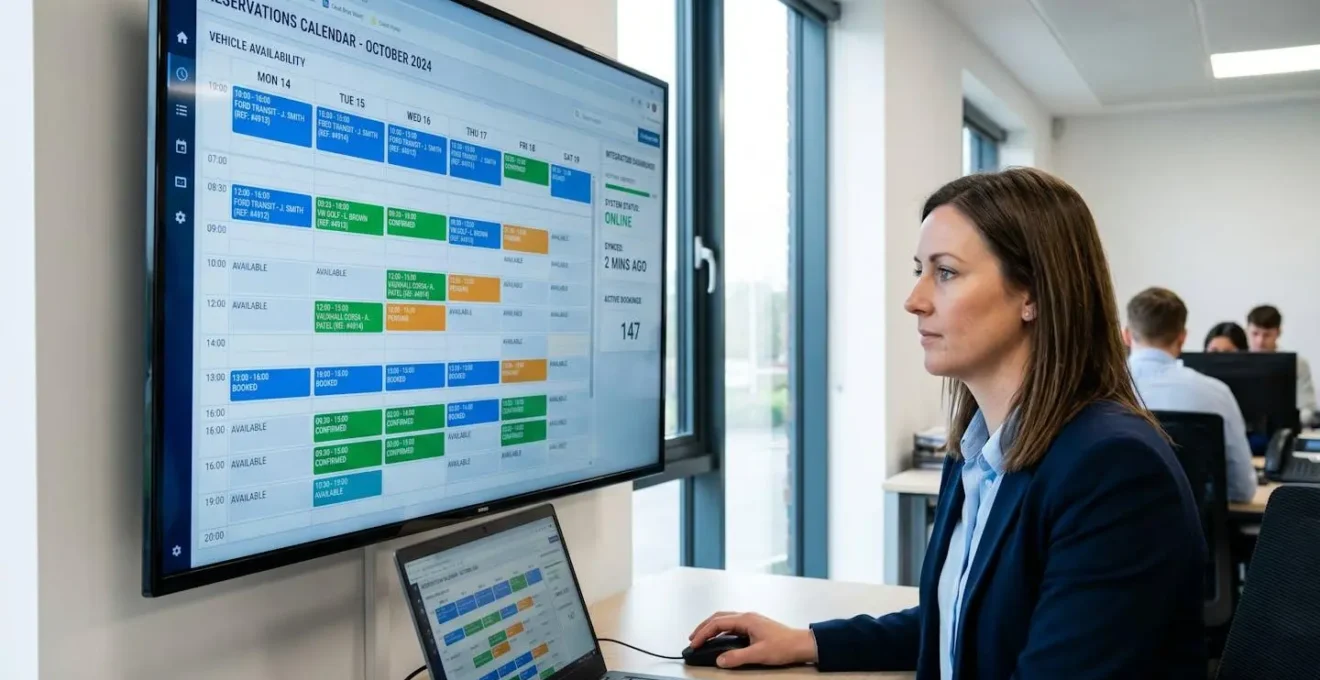
Dynamic planning interfaces maintain live availability that adjusts automatically as reservations arrive through online channels, phone bookings, or walk-in customers. The transition from scattered Excel trackers to using a unified car fleet management app eliminates double-booking errors. Cloud-based architectures ensure staff at different locations view identical real-time data, preventing coordination failures common with locally stored files.
Customer-facing workflow automation directly impacts revenue capture and operational efficiency. Electronic contract signing accelerates check-in while creating compliant audit trails. Automated confirmations reduce no-shows and late returns. Systems integrating these touchpoints seamlessly—online pre-check-in triggering automatic contract generation, payment processing, and vehicle assignment—deliver measurable time savings.
| Operational Priority | Essential Capability | Nice-to-Have Enhancement |
|---|---|---|
| Planning & Allocation | Real-time synchronized availability across all booking channels | AI-powered demand forecasting for dynamic pricing |
| Maintenance Oversight | Automated alerts based on mileage and time intervals | Predictive failure analysis via telematics integration |
| System Integration | API connections to accounting software and GPS tracking | Native integrations with 50+ third-party business tools |
Maintenance management automation prevents revenue loss from unexpected vehicle unavailability. Systems tracking service intervals by mileage and calendar days automatically block booking availability as deadlines approach, eliminating manual reminder failures. Automatic reassignment of traffic penalties to the driver on hire recovers costs that manual tracking misses.
Integration ecosystems determine whether fleet software becomes a central hub or another siloed tool. Platforms delivering high adoption rates offer API connectivity linking existing accounting systems (SAGE, Xero, QuickBooks), GPS tracking providers, and website booking engines. According to 2024 market analysis from Mordor Intelligence, cloud-based SaaS solutions command 63% of market revenue because their API-first architecture supports gradual integration rather than disruptive replacement.
Quantifying efficiency gains: metrics rental businesses actually track
Vendor promises remain abstract until translated into specific KPIs. The ROI framework examines utilization, revenue capture, time savings, and cost reduction. Industry implementations provide benchmarks separating expectations from exaggeration.

Significant
increase in vehicle utilization rates reported by rental operators after implementing centralized fleet management platforms
Vehicle utilization rates provide the clearest optimization measure. Rental days divided by available days directly impacts revenue since idle vehicles generate zero return while incurring costs. Spreadsheet operators typically achieve 60–70% utilization because manual coordination creates conservative buffers. Automated systems synchronizing availability in real time enable substantial improvements by reducing buffers and identifying idle vehicles.
Revenue capture improvements appear in pricing optimization and fee recovery. Dynamic data enables yield management—adjusting rates based on real-time demand. Automated tracking of fuel discrepancies, damage charges, and penalties increases recovery substantially versus manual processes. Operators digitizing workflows capture revenue that spreadsheet competitors write off.
Administrative time savings translate to cost reduction or capacity reallocation. Check-in processing time—averaging 15–20 minutes manually—drops by half with electronic contracts and automated payment. For locations processing fifty weekly transactions, this frees twenty staff hours. As outlined in automotive market trends, fleet automation is part of industry-wide modernization.
Maintenance cost reduction stems from predictive scheduling. Automated tracking ensures services occur at manufacturer-recommended intervals, preventing accelerated wear from missed deadlines. This extends vehicle lifespan and preserves resale values—factors significantly impacting total cost of ownership for rental fleets where vehicles typically remain in service two to four years.
Calculation framework for ROI assessment: A 100-vehicle fleet averaging £18,000 annual revenue per vehicle at 65% utilization can see substantial utilization improvements translate to hundreds of thousands in additional annual revenue when combined with improved fee recovery and administrative time savings, against typical software costs of £8,000–£15,000 for mid-sized fleets.
Addressing common reservations about fleet management technology
Operational patterns reveal that rental managers evaluating fleet software harbor predictable concerns based on past experiences with technology implementations that overpromised and underdelivered. These reservations deserve direct examination rather than dismissive reassurance.
How disruptive is implementation to ongoing operations?
Cloud-based SaaS platforms avoid server installation and IT infrastructure work that characterized legacy deployments. Implementation for mid-sized fleets typically spans two to six weeks: configuration and data migration in week one, staff training in week two, then parallel operation alongside existing systems for two to four weeks. The phased approach maintains business continuity. Critical periods like peak season warrant delaying rollout, but implementation outside high-demand windows rarely requires operational pauses.
Do subscription costs eventually exceed traditional software licensing?
SaaS subscriptions shift costs from large upfront capital expenditure to predictable monthly expenses. For 100-vehicle fleets, monthly subscriptions typically range £600–£1,200. Five-year totals reach £36,000–£72,000 versus legacy licensed software at £15,000–£25,000 initial purchase plus £3,000–£5,000 annual maintenance (five-year total: £30,000–£50,000). The subscription premium buys continuous updates, cloud hosting, automatic backups, and vendor-managed security. When factoring IT staff time for maintaining on-premise systems, total ownership cost often favours subscriptions.
How easily can you migrate data if switching vendors later?
Vendor lock-in risk depends on data export capabilities and API openness. Before committing, verify the platform provides bulk export of operational data (customer records, vehicle history, booking archives, transactions) in standard formats like CSV or JSON. Transport operators must maintain demonstrable continuous management, as set out in the official GOV.UK goods vehicle operator licensing guide, requiring full access to historical records regardless of software vendor. Systems offering comprehensive APIs provide better exit strategies. Confident vendors facilitate data portability, competing on functionality rather than artificial switching costs.
The regulatory landscape adds another technology consideration. UK operators using goods vehicles over 3.5 tonnes must maintain operator licensing compliance and demonstrate effective transport management. Fleet software automatically generating compliance reports and maintaining audit trails simplifies demonstrating oversight to the Driver and Vehicle Standards Agency during inspections—reducing regulatory risk while cutting administrative burden.
Looking toward technology evolution, rental operations increasingly intersect with connected vehicle capabilities. Platforms positioning for future relevance build integration pathways for telematics data, remote diagnostics, and vehicle-to-infrastructure communication. As detailed in examinations of emerging technologies in future cars, the industry’s digital transformation will make real-time vehicle data standard—meaning fleet systems need API architectures ready to absorb these streams.