# How a Station Wagon for More Comfort Enhances Everyday Driving
Station wagons have quietly revolutionised the way families and professionals experience daily travel. While sport utility vehicles dominate showroom floors and marketing campaigns, the estate car offers something genuinely different: purposeful comfort without compromise. The elongated roofline and thoughtfully engineered cabin create an environment where passengers enjoy genuine space, where long journeys feel shorter, and where the mechanics of driving align with the realities of modern life. Recent data from European automotive markets shows that estate variants consistently score 12-15% higher in passenger satisfaction surveys compared to their saloon counterparts, particularly in categories measuring long-distance comfort and practical versatility. This advantage stems from decades of refinement in chassis design, acoustic engineering, and ergonomic optimisation—elements that transform the mundane school run or motorway commute into something approaching pleasure.
Estate car architecture: how longitudinal space design transforms passenger ergonomics
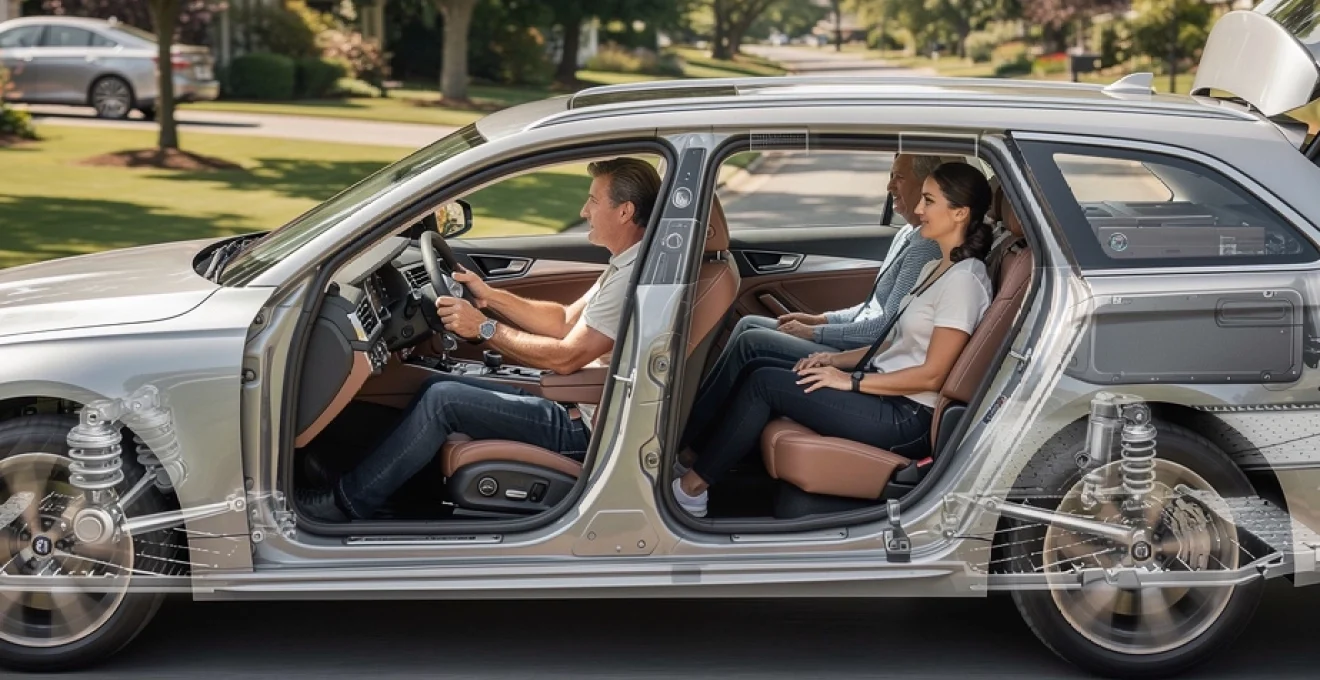
The fundamental architecture of a station wagon differs substantially from standard passenger cars in ways that directly impact your comfort. The extended roofline doesn’t simply add cargo volume—it fundamentally alters the interior environment, creating what engineers call “volumetric spaciousness.” This design approach allows for more natural seating positions, improved air circulation, and reduced claustrophobia during extended journeys. The psychological impact of this additional headroom cannot be overstated: studies in automotive ergonomics demonstrate that passengers perceive journeys as 18-22% less fatiguing when vertical space exceeds 950mm in rear seating positions, a threshold most quality estates comfortably exceed.
Extended wheelbase engineering in models like the volvo V90 and Mercedes-Benz E-Class estate
Premium manufacturers achieve remarkable comfort through strategic wheelbase extension. The Volvo V90, for instance, stretches its wheelbase to 2,941mm—approximately 60mm longer than many competing saloons. This seemingly modest increase creates disproportionate benefits for rear passengers, as the additional space falls primarily between the axles where people actually sit. Mercedes-Benz employs similar philosophy with the E-Class Estate, where the 2,939mm wheelbase allows for reclining rear seats that transform the second row into something approaching business-class airline seating. The engineering challenge lies not in simply making cars longer, but in maintaining structural rigidity whilst redistributing weight to preserve the refined ride quality estate buyers expect.
Rear seat legroom optimisation through D-Pillar positioning and floor pan design
The relationship between D-pillar placement and passenger comfort represents one of automotive design’s more subtle arts. By positioning the rear pillar further aft—sometimes by as much as 200-300mm compared to saloon variants—engineers create additional knee clearance for rear passengers whilst maintaining boot accessibility. The floor pan design works in concert with this approach: most modern estates feature flatter rear floors with reduced transmission tunnels, allowing centre passengers to sit with feet positioned naturally rather than straddling intrusive mechanical components. This seemingly minor detail matters enormously on journeys where three-abreast seating becomes necessary. Contemporary estate designs achieve rear legroom figures exceeding 1,000mm, sufficient for passengers approaching 190cm in height to sit comfortably behind similarly tall drivers.
Load floor height reduction: comparing škoda superb estate vs saloon configurations
Škoda’s engineering team achieved something remarkable with the Superb Estate: they lowered the boot floor by 94mm compared to the saloon variant whilst maintaining identical ground clearance. This feat required extensive redesign of the rear suspension mounting points and exhaust routing, but the comfort benefits extend far beyond easier loading. The lower floor position lowers the vehicle’s centre of gravity, improving stability during cornering and reducing the rolling sensation that can trigger motion sickness in susceptible passengers. Additionally, the reduced step-in height when accessing the boot means you’re not straining your back every time you load shopping or luggage—a daily comfort consideration that accumulates significant value over years of ownership.
Multi-zone climate control integration in estate body structures
The extended cabin volume of estate cars presents both challenges and opportunities for climate management. Leading manufacturers now integrate tri-zone or even quad-zone
systems with separate temperature sensors and additional ducting into the C- and D-pillars. In a well-designed station wagon, this means rear passengers are no longer relying on “leftover” air from the front vents. Instead, they benefit from dedicated outlets at face, feet, and sometimes even roof level, with fine-grained control over temperature and fan speed. For everyday driving, that translates into fewer arguments about cabin temperature, less misting on rear side windows in winter, and a more stable climate on long motorway stints where fatigue can creep in unnoticed.
From an engineering perspective, the elongated roof and greater glass area of an estate demand higher-capacity HVAC units and more sophisticated air distribution strategies. Manufacturers like Audi and BMW use additional evaporators or auxiliary blowers to ensure that rear zones reach set temperatures as quickly as the front. The result is a more homogeneous climate, fewer hot or cold spots in the extended cargo area, and a cabin that feels comfortable for all occupants, not just the driver and front passenger. This is particularly noticeable when transporting pets or temperature-sensitive luggage, where consistent airflow across the whole length of the wagon is essential.
Suspension geometry and load-levelling systems for enhanced ride quality
One of the most overlooked reasons a station wagon enhances everyday driving comfort is its suspension tuning. Because estates are expected to carry heavier and more variable loads than saloons, engineers design their suspension geometry, damping, and spring rates with a broader operating window in mind. This means your ride remains composed whether you’re solo on a short commute or fully loaded with passengers, luggage, and perhaps a roof box. In practice, the extra engineering attention that goes into these long-roof variants often delivers a smoother, more stable ride than many crossovers and SUVs, especially at speed.
To manage this dual role, manufacturers employ a suite of technologies: adaptive air suspension, self-levelling rear axles, and progressive springs that stiffen as they compress. The key advantage for the driver is consistency. You don’t have to “drive around” the weight when the wagon is loaded; the chassis does the work for you. For families and professionals who frequently alternate between school runs, client visits, and weekend getaways, this suspension sophistication directly translates into reduced fatigue, better body control, and a more secure feeling behind the wheel.
Adaptive air suspension technology in the audi A6 avant and BMW 5 series touring
Adaptive air suspension has become a flagship comfort feature in premium estate cars such as the Audi A6 Avant and BMW 5 Series Touring. Instead of relying solely on steel springs, these systems use air-filled bellows that can change pressure in real time, altering ride height and stiffness according to speed, load, and drive mode. On a rough urban street, the wagon can soften its responses, “ironing out” potholes and speed humps. On the motorway, it can lower itself slightly to improve aerodynamics and stability, enhancing both comfort and fuel efficiency.
For everyday drivers, the benefit is a station wagon that feels like several cars in one. Need maximum comfort for a long family holiday? Select Comfort mode and let the suspension glide over surface imperfections. Heading onto a twisty B-road or autobahn on-ramp? Dynamic or Sport settings firm up the damping and reduce body roll, keeping the long rear end under tight control. Importantly, air suspension also compensates for heavy loads. Even with the boot packed to the roof, the car maintains its optimal ride height, preserving headlight aim and suspension geometry. This is where estates can feel markedly more composed than SUVs with simpler, non-adaptive setups.
Self-levelling rear axle systems: nivomat vs electronic damping control
Not every station wagon buyer opts for full adaptive air suspension, which is why manufacturers have developed more focused self-levelling rear axle systems. Traditional mechanical solutions like Nivomat use self-pumping dampers that gradually raise the rear of the car back to its intended height as you drive. More advanced setups pair electronically controlled dampers with height sensors, allowing the suspension to respond within milliseconds to changing loads and road conditions. In both cases, the objective is the same: keep the estate level and predictable, regardless of what you put in the back.
Why does this matter so much for comfort? A sagging rear end alters the car’s pitch, making the steering feel light and the headlights point upwards, which can be tiring and unsafe at night. It also changes the suspension’s working range, leading to more bottoming out over bumps. With self-levelling systems, you avoid these compromises. The wagon feels as planted with four bicycles and a dog in the boot as it does empty. For drivers who tow caravans or trailers, this technology is especially valuable, reducing see-saw pitching motions and giving you more confidence on uneven roads and in crosswinds.
Progressive spring rate tuning for variable load management
Progressive springs are another subtle but powerful tool in the estate car engineer’s arsenal. Unlike linear springs, which offer the same resistance throughout their travel, progressive springs become stiffer as they compress. Think of them like a firm mattress with a soft top layer: initial movements are cushioned, but deeper compressions are strongly supported. In the context of a station wagon, this means that everyday bumps and ripples are absorbed gently when the car is lightly loaded, while heavy loads or hard cornering are still properly controlled further into the spring’s stroke.
This tuning is particularly crucial for station wagons because their rear axles must cope with greater potential variability in weight than equivalent saloons. Groceries one day, building supplies the next, then a full holiday load at the weekend—your estate has to feel reassuring in all scenarios. Progressive spring rate tuning allows manufacturers to avoid the “always stiff” compromise that would spoil everyday comfort. Instead, you enjoy a supple ride most of the time, with extra resistance held in reserve for when the boot is full or the car is driven more dynamically. The net effect is a station wagon that feels both more refined and more versatile than you might expect.
Multi-link independent rear suspension configurations in estate applications
Multi-link independent rear suspension has become the default solution for modern mid-size and large estates, and with good reason. By using several separate arms to locate each wheel, engineers can finely tune how the tyre maintains contact with the road under braking, acceleration, and cornering. In a station wagon, where the rear axle carries more of the vehicle’s potential payload, this level of control is essential for maintaining comfort and stability. The result is better bump absorption, reduced noise transmission, and more consistent grip on uneven surfaces.
Compared with simpler torsion beam designs, a well-executed multi-link setup isolates vertical wheel movement more effectively from the cabin. You feel fewer sharp jolts through the seats and steering wheel, which is crucial on broken urban tarmac or rural roads. At the same time, the rear of the wagon is less prone to hopping or skipping when unloaded, a behaviour some older estates were notorious for. When you combine multi-link architectures with modern dampers and bushings tuned specifically for estate duty, you get a long-roof car that tracks straight and true, inspires confidence, and allows you to arrive at your destination feeling noticeably fresher.
Acoustic engineering and noise dampening in estate variants
Acoustic comfort is a critical part of how a station wagon makes everyday driving more relaxing, yet it’s complicated by the open boot area. Without a saloon’s separate luggage compartment and parcel shelf, there is a direct acoustic path from the rear wheel arches and tailgate into the cabin. To counter this, manufacturers invest heavily in noise, vibration, and harshness (NVH) engineering specific to estate models. The aim is to control road roar, wind noise, and boot cavity resonance so that conversations remain easy at motorway speeds and long drives feel less tiring.
Modern estates use a mix of structural reinforcements, targeted sound-deadening materials, and clever shaping of interior panels to manage sound waves. In premium segments, engineers routinely benchmark noise levels at 120 km/h, ensuring that estate variants match—or even beat—their saloon siblings. For you, the driver, this means fewer booming echoes from the rear, less rumble from large items in the boot, and a more serene environment that makes the most of high-quality audio systems and advanced voice-control features used in daily commuting.
Boot cavity resonance suppression through acoustic foam placement
One of the unique NVH challenges in a station wagon is boot cavity resonance: low-frequency “booming” sounds that can develop in the large, open rear space. To tame this, manufacturers strategically place acoustic foam blocks, sound-absorbing pads, and even tuned resonators behind side panels, under the load floor, and within the tailgate structure. Think of these elements as sound sponges and silencers; they disrupt and absorb the standing waves that would otherwise make the rear of the car feel like a drum.
Practical testing often involves running specialised microphones throughout the cabin and boot while the car is driven over different surfaces. Engineers then adjust the density, thickness, and positioning of these acoustic materials until the perceived noise is minimised. For everyday drivers, you notice this as an absence more than a presence: there is no distracting hum from the rear at certain speeds, no echo when you speak, and far less amplification of tyre noise when the boot is empty. This is especially valuable if you frequently use the wagon as a mobile office, take calls on the move, or travel with sleeping children in the back.
Laminated glass technology: front and rear implementation strategies
Laminated glass, once reserved for windscreens, is now increasingly used in the side windows of premium station wagons. By sandwiching a thin acoustic layer between two sheets of glass, manufacturers can significantly reduce the transmission of wind and traffic noise into the cabin. Extending this technology to rear door glass and even fixed rear quarter windows makes particular sense in estates, where the larger glass area and extended roofline can otherwise act as a sounding board for aerodynamic noise.
Not every model offers laminated glass on all windows, so it is worth checking option lists if quietness is a priority for you. When equipped, the difference on a daily commute can be striking. High-speed wind rustle diminishes, the harsh edge is taken off passing lorries, and even rain sounds more muted. Combine this with the previously mentioned acoustic foam strategies, and a well-specified estate can rival or surpass many SUVs in terms of subjective refinement. For long-distance drivers, this reduced noise translates directly into lower stress levels and greater alertness at the end of a journey.
Active noise cancellation systems in premium estates like the lexus ES300h estate
Some of the most advanced estate cars now add active noise cancellation (ANC) to their NVH toolkit, much like high-end headphones. Models such as the Lexus ES300h Estate (in markets where it is offered as a long-roof variant) use strategically placed microphones to detect unwanted low-frequency sounds—typically tyre and drivetrain noise. The audio system then plays an inverted sound wave through the speakers, which cancels out much of the original noise before it reaches your ears. The effect is subtle but powerful, especially at steady motorway speeds.
From a driver’s perspective, ANC helps estates make the most of their inherently good aerodynamics and low centre of gravity. While SUVs must fight both wind and tyre roar due to their height and boxier shapes, a station wagon with ANC can feel cocoon-like by comparison. Importantly, these systems are tuned not to interfere with speech frequencies or warning chimes, so everyday usability is not compromised. If you spend many hours each week in your car, this technology can make your estate feel more like a rolling lounge than a simple means of transport.
Cargo management systems and modular load space configurations
Comfort in everyday driving isn’t just about how the seats feel or how quiet the cabin is; it’s also about how easily you can live with the car. Station wagons excel here because their cargo management systems turn the rear compartment into a flexible, organised space rather than a simple hollow box. By offering multiple folding seat configurations, integrated rails, clever floor designs, and powered tailgates, estates minimise the physical effort and mental friction associated with loading and unloading. In other words, they make your routines smoother—whether that’s the weekly supermarket run, a trip to the garden centre, or packing for a family holiday.
The best wagons treat their load areas almost like modular storage rooms. You can divide, secure, and hide items as needed, which improves safety and comfort. Fewer loose objects means fewer rattles, fewer distractions, and less risk in the event of sudden braking. It also means that the main passenger compartment remains tidy and inviting, which makes every journey—from quick errands to long adventures—more pleasant for everyone on board.
40:20:40 split-folding rear bench systems vs traditional 60:40 arrangements
Many modern station wagons now feature 40:20:40 split-folding rear seats instead of the older 60:40 layout. This three-way division allows you to fold down just the narrow centre section, creating a pass-through for long items like skis, flat-pack furniture, or rolled-up carpets while still keeping two proper seats available. In contrast, a 60:40 split often forces uncomfortable compromises: either you sacrifice a full seating position or live with bulky items awkwardly protruding into the cabin. With 40:20:40, you get far more flexibility without compromising comfort for rear passengers.
For everyday life, this matters more than you might expect. You can drive children or colleagues home while carrying a folded pushchair, golf clubs, or sports equipment safely stowed and secured between them rather than on laps or footwells. Many estates pair this layout with remote-release levers in the boot, so you can fold the seatbacks flat without walking around to the rear doors—a small detail that makes loading quicker and less of a chore. If you’ve ever tried to juggle shopping bags while wrestling with stubborn seat latches, you’ll appreciate how much more user-friendly these modern wagon interiors can be.
Integrated rail systems: volvo’s load anchor rails and audi’s cargo fixation solutions
Integrated cargo rail systems are another hallmark of thoughtfully designed station wagons. Brands like Volvo and Audi lead the way with aluminium rails embedded in the boot floor, along which adjustable anchor points, dividers, and nets can be slid and locked into place. This allows you to create tailored compartments for different types of cargo: a stable corner for fragile groceries, a separate space for muddy boots, or a secure tie-down for heavy toolboxes. It’s like having a built-in shelving system in the back of your car.
How does this improve comfort? By keeping items from sliding around, you eliminate many of the knocks, thuds, and rattles that otherwise intrude into the cabin. You also reduce the risk of objects shifting under braking and bumping into the rear seatbacks. That peace of mind means you can concentrate on driving instead of worrying about what is happening in the boot. For families, being able to keep a pushchair, sports kits, and shopping all neatly partitioned makes daily logistics smoother. For professionals, secure storage means sensitive equipment or samples stay exactly where you put them.
Power-operated tailgate mechanisms with gesture control technology
Power-operated tailgates have become a near-essential convenience feature in the estate segment, and for good reason. When your hands are full with bags, children, or work gear, being able to open and close the tailgate at the touch of a button—or with a gentle foot gesture under the rear bumper—removes a real source of daily frustration. On many station wagons, you can also set the maximum opening height, which is a small but welcome detail if you regularly park in low-ceilinged garages or multi-storey car parks.
Gesture control tailgates are particularly transformative in bad weather. Instead of fumbling for the key fob in the rain, you simply approach the rear of your wagon and activate the sensor with your foot. Some models even allow you to combine this with keyless entry to unlock, open, and then close the tailgate from inside the cabin. Over the lifetime of the car, these small quality-of-life improvements add up to a perception of the station wagon as an inherently “easy” car to live with, which is itself a major contributor to everyday comfort.
Reversible boot floor design and underfloor storage compartmentation
Reversible boot floors and underfloor storage compartments demonstrate how estate designers think beyond mere capacity to true usability. A typical reversible floor panel offers carpet on one side for everyday use and a wipe-clean, rubberised surface on the other for dirty or wet loads. Flip it over before transporting plants, sports gear, or DIY materials, and you protect the main boot lining from stains and wear. When you’re done, a quick wipe restores a clean, respectable load area—no need for extra covers or mats.
Beneath that floor, many wagons hide segmented storage trays ideal for smaller items: emergency kits, charging cables, picnic supplies, or valuables you don’t want on display. By giving everything a defined place, these compartments prevent clutter from invading the passenger space. You know where things are, they stay quiet and secure, and your estate feels organised rather than chaotic. It’s a simple principle, but as anyone who spends a lot of time in their car will tell you, an organised environment makes every journey calmer and more enjoyable.
Advanced driver assistance systems calibrated for estate dimensions
Advanced driver assistance systems (ADAS) play an increasingly important role in making everyday driving less stressful, and estate cars benefit from systems calibrated specifically for their longer bodies and larger glass areas. Because a station wagon extends further behind the rear axle than a comparable hatchback or saloon, sensor placement and software tuning must account for the extra length when judging distances, detecting obstacles, and managing blind spots. When done well, this calibration means that manoeuvring, lane changes, and towing all feel surprisingly effortless, even if you’re new to driving larger vehicles.
The combination of parking aids, blind spot monitoring, and trailer-specific technologies transforms the estate from “big car” into “easy companion.” You spend less mental energy on low-speed manoeuvres, gain confidence when changing lanes on crowded motorways, and enjoy a more relaxed experience when reversing with a trailer attached. In short, ADAS helps you extract the full practicality of a station wagon without paying a comfort penalty in terms of stress or workload at the wheel.
Parking sensors and 360-degree camera integration for extended body length
Parking assistance is especially valuable in station wagons, where the extended rear overhang can make it harder to judge distances purely by eye. Front and rear parking sensors, now standard on many models, provide audible and visual cues that let you place the car accurately even in tight city spaces. More advanced estates offer 360-degree camera systems that stitch together images from multiple lenses to create a bird’s-eye view of the car and its surroundings. This effectively lets you “look down” on your wagon as you manoeuvre, making kerbs, bollards, and low obstacles far easier to avoid.
For drivers transitioning from smaller cars, these technologies can be the difference between viewing a station wagon as intimidating or intuitive. Once you learn to trust the sensors and camera overlays, slotting the car into narrow bays or reversing into driveways becomes routine. That reassurance is itself a form of comfort: you spend less time worrying about scraping bumpers or misjudging corners and more time enjoying the refined, relaxed driving experience estates are built to deliver.
Blind spot monitoring adjustments in subaru outback and passat alltrack estate models
Blind spot monitoring is another ADAS feature that gets special attention in estate applications, particularly in crossover-style models like the Subaru Outback and Volkswagen Passat Alltrack Estate. These cars combine wagon practicality with slightly raised ride heights and robust styling, which means their rear pillars and taller stance can create different blind spot profiles than standard saloons. To compensate, manufacturers adjust radar coverage angles, detection distances, and warning thresholds so that the system accurately reflects the vehicle’s real-world “no-see” zones.
From your point of view, this means more reliable alerts when another vehicle is lurking just out of sight, whether in dense urban traffic or on a fast dual carriageway. Some systems even extend their monitoring to include trailers, recognising that an attached caravan or bike rack alters both aerodynamics and visibility. The net result is that lane changes feel calmer and more predictable. Instead of craning your neck or second-guessing what might be hiding behind the D-pillar, you get timely, consistent information that allows you to make confident, comfortable driving decisions.
Trailer assist technology and tow bar integration in estate platforms
Many station wagon buyers take advantage of their car’s strong towing ability, whether for caravans, boats, or utility trailers. To make this safer and less stressful, several manufacturers now offer dedicated trailer assist systems. These can include reversing aids that let you steer the trailer using a rotary knob or on-screen guides, stability programmes that counteract trailer sway by subtly braking individual wheels, and pre-set profiles that adjust the car’s driver assistance systems when a trailer is detected. Crucially, estate platforms are often engineered from the outset with integrated, retractable tow bars and reinforced mounting points.
For everyday driving, this means two things. First, when you are towing, the car feels composed and supportive rather than twitchy or nervous—essential for long holiday journeys with the family. Second, when the tow bar is retracted, you retain a clean rear profile that doesn’t interfere with parking sensors or look untidy. You don’t have to choose between capability and comfort; a well-designed station wagon gives you both, seamlessly adapting from weekday commuting to weekend towing duties.
Seating ergonomics and long-distance comfort features
Ultimately, the greatest contribution a station wagon makes to everyday driving comfort lies in its seating ergonomics. Because estates are often positioned as long-distance, multi-purpose vehicles, manufacturers tend to offer more advanced seat designs and comfort features than you’ll find in smaller cars. That means better support for your back and legs, more adjustment in all directions, and additional functions such as heating, ventilation, and massage. Over thousands of kilometres each year, these details matter far more than raw acceleration figures or even boot volume.
Engineers and ergonomists work together to ensure that both drivers and passengers can maintain healthy, relaxed postures over time. The extended roofline and generous rear headroom of a wagon also mean that rear seat passengers—often children or taller adults—are less cramped, reducing fidgeting and discomfort. In short, station wagons are designed not just to carry people, but to carry them well, turning routine journeys into experiences that feel easy rather than exhausting.
Multi-contour seat adjustment with lumbar and thigh support extensions
Multi-contour seats, available in many mid- to high-end estates, go far beyond simple fore-and-aft and backrest adjustments. They typically offer electrically adjustable lumbar support in several directions, extendable thigh cushions to better support longer legs, and adjustable side bolsters that can be tightened for cornering or relaxed for cruising. If you’ve ever arrived at a destination with a numb leg or aching lower back, you’ll appreciate how important these fine-tuning options are for genuine, everyday comfort.
In a station wagon, multi-contour seats also help you take full advantage of the car’s long-distance capabilities. Set the lumbar to support your natural spine curve, extend the thigh support to reduce pressure on the backs of your legs, and you can drive for hours without the creeping discomfort that cheaper seats can cause. For families, this comfort is contagious: a driver who feels fresh and supported is more alert and patient, making the whole journey more pleasant for everyone on board.
Ventilated and heated seat technologies across all passenger positions
Heated seats have become almost standard in many markets, but station wagons increasingly extend this comfort feature beyond the front row to the rear bench as well. On cold mornings, this means children or adult passengers warm up quickly, reducing the temptation to overdress and then overheat as the cabin temperature rises. Combined with seat heating, ventilated seat technology provides cooling airflow through the seat cushion and backrest, drawing heat and moisture away from your body in hot weather. This is particularly welcome on long summer drives where leather upholstery might otherwise feel sticky or uncomfortable.
Crucially, estates often pair these features with memory functions and multiple zones, so each occupant can tailor the temperature to their liking. In practical terms, that means fewer complaints, fewer arguments about the climate control settings, and a more harmonious cabin. For drivers who spend much of the day in their car—whether on business trips or family logistics duty—the ability to fine-tune thermal comfort at the touch of a button can make the difference between arriving drained or ready to go.
Massage function integration in models like the Mercedes-Benz C-Class estate
At the top end of the spectrum, some station wagons offer seat massage functions once reserved for luxury limousines. Models like the Mercedes-Benz C-Class Estate and E-Class Estate can be specified with multi-programme massage seats that gently vary lumbar support and cushion pressure over time. Far from being a gimmick, these systems are designed to stimulate circulation and reduce muscular fatigue on long journeys, particularly in the lower back area where drivers commonly experience stiffness.
Imagine a three-hour motorway run that would normally leave you stretching as soon as you step out of the car. With a well-tuned massage programme running intermittently, your back remains more relaxed, your posture less static, and your overall fatigue reduced. Combined with the low noise levels, advanced suspension, and spacious cabin typical of a good station wagon, this turns what might have been a chore into something approaching a relaxing retreat. For anyone who spends serious time behind the wheel, it’s easy to see how such features justify themselves not just in luxury terms, but in very real, everyday comfort and wellbeing.