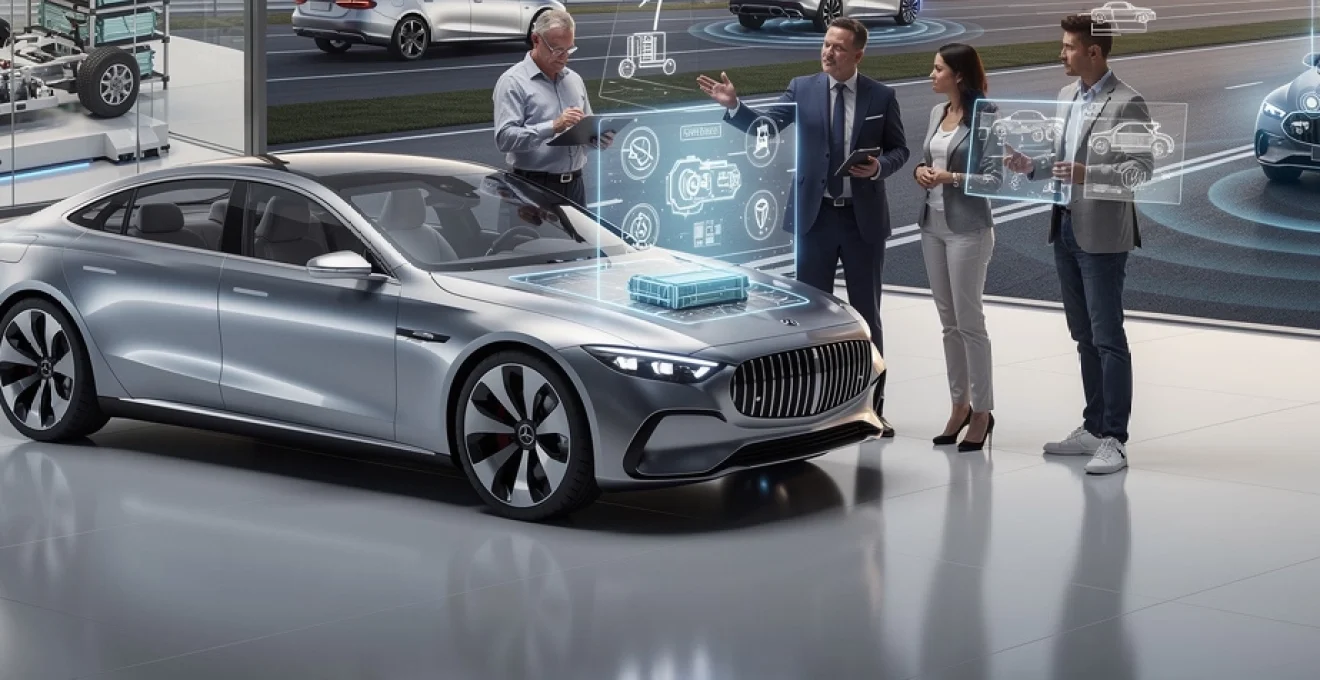
The automotive industry stands at a pivotal crossroads where brand legacy meets cutting-edge innovation, fundamentally reshaping how consumers approach vehicle purchasing decisions. Modern automobile manufacturers are no longer simply producing transportation solutions; they are crafting comprehensive technological ecosystems that influence everything from daily commuting habits to long-term lifestyle choices. This transformation has created a dynamic marketplace where traditional automotive hierarchy is being challenged by disruptive newcomers, while established players leverage their heritage to drive breakthrough innovations. Understanding how these brands orchestrate their influence requires examining the intricate relationship between corporate strategy, technological advancement, and consumer psychology that defines today’s automotive landscape.
Brand heritage and market positioning in automotive innovation cycles
The automotive sector demonstrates how brand heritage serves as both a foundation for innovation and a catalyst for market positioning strategies. Established manufacturers leverage decades of engineering expertise and consumer trust to introduce revolutionary technologies, while maintaining the reliability expectations that define their market identity. This delicate balance between tradition and transformation shapes how consumers perceive new automotive technologies and influences adoption rates across different market segments.
Brand positioning within automotive innovation cycles operates on multiple levels, encompassing technological leadership, market perception, and consumer emotional connections. Companies that successfully navigate these cycles understand that innovation without proper brand alignment often fails to achieve market penetration, regardless of technological superiority. The relationship between brand equity and innovation acceptance creates a competitive advantage that extends far beyond individual product launches.
Mercedes-benz S-Class technology leadership in luxury vehicle segments
Mercedes-Benz has consistently positioned the S-Class as a technological showcase that previews innovations destined for mainstream adoption across the automotive industry. This flagship model serves as a testbed for advanced driver assistance systems, luxury comfort features, and connectivity solutions that eventually filter down to more accessible vehicle segments. The brand’s approach demonstrates how luxury positioning enables higher development costs and risk-taking in technological advancement.
The S-Class innovation strategy encompasses predictive maintenance systems, augmented reality navigation displays, and advanced biometric monitoring that personalises the driving experience. These technologies establish Mercedes-Benz as a thought leader while creating consumer expectations for premium automotive experiences. The brand’s ability to justify higher price points through technological differentiation illustrates how innovation leadership translates into sustainable competitive advantages.
Tesla’s disruptive market entry and electric vehicle paradigm shift
Tesla’s market entry fundamentally altered consumer perceptions of electric vehicles by positioning them as desirable technology products rather than environmental compromises. The brand’s direct-to-consumer sales model, over-the-air software updates, and minimalist design philosophy challenged traditional automotive retail and ownership paradigms. This approach demonstrated how newcomer brands can leverage innovative business models to compete with established manufacturers.
The company’s influence extends beyond electric powertrains to encompass autonomous driving development, energy storage solutions, and manufacturing automation. Tesla’s brand positioning as a technology company that happens to make cars has attracted consumers who might otherwise never consider electric vehicles. This strategic positioning enables the brand to command premium pricing while building a loyal customer base that views vehicle ownership as participation in technological advancement.
Toyota’s hybrid powertrain development and mass market adoption strategy
Toyota’s hybrid technology development exemplifies how established brands can drive innovation through patient, systematic approaches that prioritise reliability and consumer acceptance. The Prius launch in 1997 required extensive consumer education and market development, demonstrating how brand credibility enables long-term investment in emerging technologies. Toyota’s commitment to hybrid development created an entirely new vehicle category that influenced global automotive strategies.
The brand’s approach emphasised practical benefits such as fuel economy and environmental responsibility rather than revolutionary technological claims. This positioning strategy enabled Toyota to build consumer confidence in hybrid technology while establishing manufacturing expertise that competitors struggled to replicate. The success of Toyota’s hybrid programme illustrates how innovation leadership requires both technological capability and strategic market positioning.
Bmw’s connected drive platform and digital ecosystem integration
BMW’s Connected Drive platform represents a comprehensive approach to integrating digital services with traditional automotive experiences. The system encompasses navigation, entertainment, vehicle monitoring, and remote access capabilities that extend the brand relationship beyond physical vehicle ownership. This digital ecosystem strategy positions BMW as a technology partner rather than simply a vehicle manufacturer.
The platform’s evolution demonstrates how established luxury brands can compete with technology companies by leveraging their understanding of premium consumer expectations. BMW’s approach integrates smartphone connectivity, cloud-based services, and predictive maintenance capabilities that enhance the
The platform’s evolution demonstrates how established luxury brands can compete with technology companies by leveraging their understanding of premium consumer expectations. BMW’s approach integrates smartphone connectivity, cloud-based services, and predictive maintenance capabilities that enhance the ownership experience throughout the vehicle lifecycle. By treating software updates and digital services as core value propositions rather than optional extras, BMW reinforces its brand positioning around driving pleasure augmented by intelligent technology. This illustrates how automobile brands can use digital ecosystems to deepen engagement and subtly guide future purchasing choices.
Research and development investment strategies across OEM manufacturers
Behind every visible leap in automotive innovation sits a complex web of research and development (R&D) investment decisions. Original Equipment Manufacturers (OEMs) must continuously balance spending on next-generation technologies with the need to improve existing platforms that still drive most of their revenue. In recent years, global automakers have collectively invested well over $100 billion annually in R&D, with an increasing share directed toward electric vehicles, battery chemistry, software-defined architectures, and autonomous driving systems.
How these funds are allocated directly shapes both innovation roadmaps and consumer choices. A brand that commits heavily to modular electric platforms, for example, can bring a wider range of EV models to market more quickly, influencing how fast consumers transition away from internal combustion engines. Conversely, manufacturers that under-invest or delay key technologies may find their brand relevance erode as buyers migrate to competitors perceived as more future-ready. The following OEM strategies highlight how platform thinking and vertical integration are becoming central to long-term competitiveness.
Volkswagen group’s MEB platform architecture for electric vehicle scalability
Volkswagen Group’s Modular Electric Drive Matrix (MEB) exemplifies how a dedicated platform can accelerate electric vehicle innovation and reduce per-unit costs. Rather than adapting legacy internal combustion architectures, VW created MEB from the ground up to support multiple body styles, battery sizes, and performance levels across brands like Volkswagen, Škoda, SEAT, and Audi. This shared foundation enables rapid development cycles and economies of scale that are essential for mainstream EV affordability.
From a consumer perspective, the MEB platform translates into greater choice within familiar brands, from compact city cars to family SUVs, all built on a common electric backbone. It also allows Volkswagen to standardise key components such as battery modules, inverters, and software interfaces, which simplifies maintenance and improves reliability over time. In effect, MEB turns the company into a technology provider to its own brand portfolio, subtly steering millions of buyers toward electric mobility by making the EV option feel normal rather than niche.
General motors’ ultium battery technology and vertical integration approach
General Motors’ Ultium platform reflects a complementary strategy focused on battery innovation and vertical integration. Ultium combines flexible, large-format pouch cells with a scalable architecture that can underpin everything from compact crossovers to heavy-duty trucks. By co-developing cells with partners and investing in dedicated battery plants, GM aims to control more of the value chain, reducing dependence on external suppliers and improving cost predictability.
This vertical integration approach has direct implications for consumer choice and brand positioning. As Ultium scales, GM can offer longer ranges, faster charging, and more competitive pricing across brands such as Chevrolet, Cadillac, GMC, and Buick, reinforcing its image as a technology-forward manufacturer rather than a follower. You can think of Ultium as a “battery operating system” that lets GM reconfigure capacity and performance to match different customer segments, much like how smartphone makers tweak hardware around a shared chipset.
Ford’s BlueCruise autonomous driving system development timeline
Ford’s BlueCruise represents a targeted investment in advanced driver assistance rather than full autonomy, reflecting a pragmatic reading of both technology readiness and consumer expectations. BlueCruise offers hands-free driving on pre-mapped highways, using a combination of cameras, radar, and high-definition maps to maintain lane position and speed while monitoring driver attention. Instead of promising fully self-driving capabilities in the near term, Ford has positioned BlueCruise as an incremental, upgradeable system.
The development timeline of BlueCruise illustrates how software updates are becoming central to automotive brand strategies. Early adopters gain access to core features, with new roads, functions, and refinements delivered over the air as the system matures. For consumers, this creates a sense that their vehicle improves over time, similar to a smartphone receiving new software. For Ford, it builds a recurring revenue opportunity through subscription services while reinforcing brand trust by delivering tangible, safety-focused benefits rather than speculative autonomy claims.
Stellantis multi-energy platform strategy for hybrid and electric powertrains
Stellantis has taken a different path by embracing multi-energy platforms capable of supporting internal combustion, hybrid, and full electric powertrains on the same architecture. This strategy acknowledges diverse global markets where infrastructure, regulation, and consumer readiness vary widely. By designing flexible platforms like CMP and STLA, Stellantis can adapt models from brands such as Peugeot, Fiat, Jeep, and Opel to local conditions without entirely separate development programmes.
For buyers, the multi-energy approach offers familiar models with multiple drivetrain choices, easing the transition to electrified mobility. Someone loyal to a particular SUV or city car can choose a mild hybrid today and a full EV in the next product cycle, all within the same brand ecosystem. While this strategy can add engineering complexity, it helps Stellantis maintain broad coverage across price points and geographies, aligning brand promises with practical realities in markets that are not yet ready to go all-electric.
Consumer purchasing decision matrix and brand loyalty mechanisms
When a consumer chooses between a Tesla, a Toyota, or a BMW, they are not just comparing spec sheets; they are navigating a complex decision matrix where brand perception, ownership experience, and long-term trust often outweigh pure performance metrics. Research consistently shows that brand reputation and perceived reliability remain among the top factors influencing vehicle purchases, particularly in higher-priced segments. At the same time, digital research behaviours mean that online reviews, social media sentiment, and influencer content now play a larger role than traditional advertising in shaping those perceptions.
Brand loyalty in the automotive sector is built through repeated, positive touchpoints over many years: a trouble-free first car, a transparent dealership interaction, responsive after-sales service, and software updates that keep a vehicle feeling current. When these experiences align with a brand’s stated values—whether that is safety, performance, sustainability, or innovation—loyalty deepens and switching barriers rise. Conversely, negative publicity, poor service, or ethical controversies can quickly erode trust, especially among younger buyers who are more willing to cross-shop brands and experiment with newcomers.
We can think of the modern consumer decision process as a layered funnel: initial awareness driven by brand heritage and marketing; active consideration shaped by digital research and peer recommendations; and final choice heavily influenced by perceived value, financing terms, and dealer experience. Automakers that understand this matrix use data and social listening to identify where they are strong or weak, then adjust their branding, product mix, and communications to guide consumers through each stage. In many cases, software features, warranty coverage, and connected services now tip the balance, turning a one-time sale into a long-term relationship anchored in recurring digital touchpoints.
Regulatory compliance impact on innovation roadmaps and market strategy
Regulatory frameworks act as powerful, if sometimes invisible, forces shaping automotive innovation. Emissions targets, safety protocols, and data protection laws are not merely compliance checklists; they directly influence which technologies are prioritised, how quickly they reach market, and how brands present their value propositions to consumers. For many automakers, regulatory changes over the past decade have been as transformative as competitive pressures, accelerating the phase-out of traditional powertrains and elevating safety and data ethics to board-level concerns.
From a strategic perspective, brands that anticipate regulatory shifts can turn compliance into competitive advantage. Early investment in cleaner engines, advanced driver assistance systems (ADAS), and secure data architectures allows them to launch compliant products ahead of deadlines, often with better performance and lower costs than last-minute solutions. For consumers, these regulatory-driven innovations show up as cleaner, safer, and smarter vehicles—though they may also contribute to higher sticker prices or shorter model cycles as technology evolves more rapidly.
Euro 7 emissions standards influence on ICE engine development
The upcoming Euro 7 emissions standards illustrate how regulation can both constrain and redirect internal combustion engine (ICE) innovation. Euro 7 aims to significantly reduce pollutants such as NOx and particulates, while also tightening limits under real-world driving conditions. For automakers, meeting these standards with conventional engines requires sophisticated exhaust after-treatment systems, improved combustion control, and more complex on-board diagnostics—all of which add cost and engineering complexity.
As a result, many brands are re-evaluating the business case for developing entirely new ICE families versus accelerating investment in electrified powertrains. Some manufacturers have publicly stated that Euro 7 will be their last major ICE upgrade, effectively placing a regulatory end date on traditional engine innovation. For consumers, this means that new petrol and diesel models will become cleaner but may also be priced closer to hybrid or EV alternatives, subtly nudging purchasing decisions toward electrified options that promise lower running costs and future-proof compliance.
NCAP safety protocols driving advanced driver assistance systems evolution
Safety assessment programmes like Euro NCAP and their counterparts in other regions play a crucial role in advancing driver assistance technologies. Over time, NCAP protocols have expanded from passive crashworthiness to include active safety systems such as automatic emergency braking, lane-keeping assistance, and pedestrian detection. To achieve top ratings, automakers must continuously upgrade their ADAS suites, integrating more sensors, faster processors, and increasingly sophisticated algorithms.
This arms race in safety technology has a direct impact on brand differentiation and consumer expectations. Buyers now routinely expect features like adaptive cruise control or collision warnings, even in mid-range vehicles, associating their presence with a brand’s overall commitment to safety. In practice, NCAP acts as both carrot and stick: high ratings become valuable marketing assets, while mediocre scores can damage reputation. The net effect is that safety innovation, once seen as a cost centre, is now a core component of how automobile brands shape consumer choices and justify pricing across segments.
GDPR data protection requirements in connected vehicle technologies
As vehicles become increasingly connected and software-defined, data protection regulations such as the EU’s General Data Protection Regulation (GDPR) have moved to the forefront of automotive strategy. Modern cars collect and transmit vast amounts of information—from location data and driving behaviour to biometric markers used for personalised settings. While this data can enable powerful services and business models, it also introduces significant privacy and security risks if not managed correctly.
Under GDPR, automakers operating in or selling into the EU must ensure lawful data processing, explicit consent for certain uses, robust encryption, and clear rights for users to access or delete their data. This forces brands to design privacy-by-default architectures and transparent user interfaces that explain what is being collected and why. For consumers, strong data protection can become a trust anchor, making them more comfortable adopting connected services and over-the-air updates. For brands, getting this right differentiates them as responsible stewards of digital mobility, whereas missteps can result in reputational damage and substantial fines that undermine innovation budgets.
Supply chain partnerships and technology transfer ecosystems
No modern automaker innovates in isolation. The complexity of electric drivetrains, high-density batteries, semiconductors, and software platforms has turned the automotive supply chain into a dense ecosystem of technology partners, joint ventures, and cross-industry collaborations. Brands now routinely work with chip manufacturers, cloud providers, and battery specialists to co-develop critical components, sharing both risk and intellectual property in pursuit of faster, more cost-effective innovation.
Strategic partnerships can dramatically influence how quickly new technologies reach consumers and which brands are perceived as leaders. Battery joint ventures, for example, allow OEMs to secure cell supply and refine chemistries that improve range and longevity, while alliances with tech companies accelerate the deployment of infotainment systems, voice assistants, and over-the-air update capabilities. The transfer of knowledge flows in both directions: traditional automakers bring expertise in safety, manufacturing, and regulations, while technology firms contribute agility and software-centric thinking.
However, this interconnected ecosystem also introduces new dependencies and vulnerabilities. Semiconductor shortages during the early 2020s demonstrated how fragile supply chains can disrupt production, leaving consumers facing long waiting lists and limited model availability. In response, many brands are diversifying suppliers, localising critical manufacturing, and even designing their own chips or operating systems. For buyers, the end result is a market where innovation is increasingly co-branded—think “powered by” or “in collaboration with” labels—highlighting that the car in your driveway is the product of a global technology network rather than a single company working behind closed doors.
Digital transformation and software-defined vehicle architecture implementation
The shift toward software-defined vehicles (SDVs) represents one of the most profound changes in how automobile brands design, build, and support their products. In an SDV, core functions—from power management and driver assistance to infotainment and climate control—are governed by software running on centralised computing platforms rather than dozens of isolated electronic control units. This architecture enables features to be added, refined, or even monetised after the vehicle leaves the factory, much like apps and updates on a smartphone.
For consumers, software-defined architectures mean that a car can evolve significantly during its lifetime. You might purchase a vehicle with basic driver assistance today and later unlock enhanced capabilities, new user interface designs, or improved energy management through over-the-air updates. This not only extends the perceived modernity of the vehicle but also creates new value propositions around flexibility and personalisation. For brands, it opens recurring revenue streams through subscriptions and feature-on-demand models, while also providing rich telemetry data to inform future product development and quality improvements.
Implementing SDV architectures, however, is far from trivial. Automakers must rethink everything from wiring harness design and cybersecurity to organisational structures that historically separated hardware and software teams. Partnerships with cloud providers, adoption of agile development practices, and investment in in-house software talent become critical success factors. Brands that navigate this transition effectively are likely to be seen as digital leaders, attracting tech-savvy buyers who value continuous improvement and connected experiences. Those that lag risk being perceived as outdated, even if their mechanical engineering remains world-class.
In this emerging landscape, automobile brands are no longer judged solely by horsepower, fuel economy, or even design. Instead, they are evaluated on how fluently they integrate technology, how transparently they handle data, and how successfully they translate complex innovation into everyday benefits. As vehicles become rolling computers and mobility ecosystems, the brands that win consumer trust will be those that combine robust engineering with thoughtful, human-centred software experiences—shaping not just what we drive, but how we move, connect, and live.