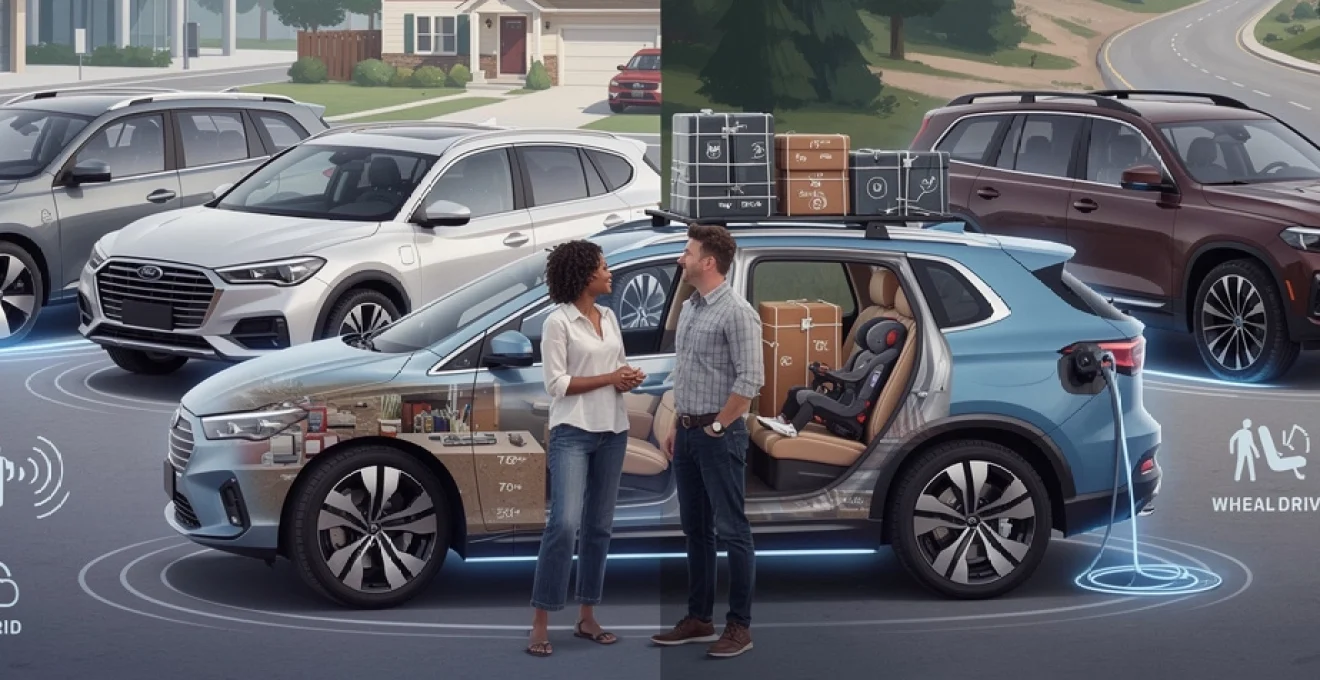
The SUV market has experienced unprecedented growth across the UK, with these versatile vehicles now representing over half of all new car sales. This surge in popularity stems from their unique combination of elevated driving position, spacious interiors, and impressive capability across diverse driving conditions. Modern SUVs offer everything from compact city-friendly models to luxurious full-size vehicles equipped with cutting-edge technology and premium amenities.
Selecting the perfect SUV requires careful consideration of your specific needs, driving habits, and lifestyle requirements. The right choice depends on numerous factors including family size, typical journey types, terrain preferences, and budget constraints. With manufacturers continuously introducing innovative powertrains, advanced safety systems, and sophisticated all-wheel drive technologies, understanding these developments becomes crucial for making an informed decision.
The complexity of modern SUV offerings means that thorough research and understanding of different vehicle segments, technologies, and capabilities will significantly impact your satisfaction with the final purchase. From fuel efficiency calculations to safety rating assessments, each aspect contributes to the overall ownership experience and long-term value proposition.
SUV classification systems and vehicle segment analysis
Understanding SUV classifications forms the foundation of making an informed purchase decision. Modern SUVs are categorised into distinct segments based on size, capability, and intended use. These classifications help narrow down options and ensure alignment between vehicle characteristics and lifestyle requirements.
Compact SUV specifications: nissan qashqai vs honda CR-V dimensions
Compact SUVs represent the most popular segment in the UK market, offering excellent fuel efficiency while maintaining practical space for families. The Nissan Qashqai measures 4,425mm in length with a wheelbase of 2,665mm, providing 430 litres of boot space. This positioning makes it ideal for urban environments while offering sufficient space for weekend adventures.
The Honda CR-V, slightly larger at 4,600mm length, delivers 497 litres of cargo capacity and features a more spacious rear passenger area. Both vehicles excel in different areas: the Qashqai prioritises manoeuvrability and running costs, while the CR-V emphasises interior space and versatility. Height clearance for both models ranges between 195-205mm, suitable for light off-road conditions but primarily designed for tarmac use.
Mid-size SUV category: toyota RAV4 and mazda CX-5 comparative analysis
Mid-size SUVs bridge the gap between compact efficiency and full-size capability. The Toyota RAV4 Hybrid delivers exceptional fuel economy of approximately 55mpg combined, while offering 580 litres of cargo space. Its advanced all-wheel drive system automatically distributes power based on road conditions, enhancing both safety and capability.
The Mazda CX-5 emphasises driving dynamics and premium interior quality. With a slightly smaller 522-litre boot but superior driving refinement, it appeals to enthusiasts who prioritise handling characteristics. Both vehicles feature comprehensive safety packages, though the RAV4’s Toyota Safety Sense 2.0 includes more advanced pedestrian detection capabilities compared to the CX-5’s i-ACTIVSENSE system.
Full-size SUV capabilities: land rover discovery vs BMW X7 performance metrics
Full-size SUVs cater to families requiring maximum space and capability. The Land Rover Discovery offers exceptional off-road prowess with 900mm wading depth and advanced Terrain Response technology. Its seven-seat configuration provides 1,137 litres of cargo space with the third row folded, making it ideal for large families or commercial applications.
The BMW X7 prioritises on-road luxury and performance, featuring adaptive air suspension and powerful engine options ranging from efficient diesel variants to high-performance petrol units. While less capable off-road than the Discovery, it delivers superior on-road dynamics and premium interior appointments. Towing capacity for both vehicles exceeds 3,000kg, suitable for large caravans or trailers.
Premium luxury SUV segment: range rover sport and mercedes GLE technical features
Premium luxury SUVs represent the
Premium luxury SUVs represent the pinnacle of comfort, technology and refinement, while still retaining genuine practicality. The Range Rover Sport combines adaptive air suspension, configurable Terrain Response and a choice of powerful mild-hybrid and plug‑in hybrid powertrains, delivering a blend of off‑road capability and refined motorway cruising. Its cabin showcases advanced infotainment, high-grade materials and extensive noise insulation, creating a near-luxury-saloon experience with SUV versatility.
The Mercedes GLE takes a slightly different approach, focusing heavily on on-road comfort and cutting-edge driver assistance technology. With air suspension, E‑ACTIVE BODY CONTROL (on selected models) and a range of efficient petrol, diesel and plug‑in hybrid engines, it excels on long-distance journeys and daily commuting alike. Both the Range Rover Sport and Mercedes GLE offer advanced all-wheel drive systems, adaptive cruise control, and comprehensive active safety packages, making them ideal choices for buyers seeking a premium SUV that can adapt to varied lifestyles and driving conditions.
Powertrain technologies and fuel efficiency calculations
Choosing the right SUV powertrain is central to matching your vehicle to your lifestyle and running-cost expectations. Modern SUVs offer a wide array of petrol, diesel, hybrid and fully electric options, each with distinct performance characteristics and fuel efficiency profiles. Understanding how these technologies work and how to interpret real-world consumption figures will help you avoid surprises at the fuel pump or charging station.
When comparing SUV powertrains, it is essential to look beyond brochure mpg and WLTP figures and consider your own driving pattern. Do you mainly cover short urban journeys, or are you regularly driving long motorway distances with a full load of passengers and luggage? By analysing your annual mileage, typical trip length and access to charging infrastructure, you can identify whether a petrol, diesel, hybrid or electric SUV will offer the best balance of performance, efficiency and total cost of ownership.
Petrol engine variants: turbocharged vs naturally aspirated performance data
Most modern petrol SUVs now use turbocharged engines, particularly in compact and mid-size segments. Turbocharging allows smaller-displacement engines to produce higher power and torque figures, improving acceleration and mid-range pull without the weight penalty of a larger engine. For example, a 1.3‑litre turbocharged engine in a compact SUV can deliver similar performance to an older 2.0‑litre naturally aspirated unit, while offering better fuel economy under typical mixed driving.
Naturally aspirated petrol engines still feature in some SUVs, particularly in markets where simplicity and long-term durability are prioritised. These engines often provide a more linear throttle response and can be less complex to maintain, but they usually need to be revved harder to access their performance, which can increase fuel consumption. When comparing turbocharged vs naturally aspirated options, pay close attention to torque figures at low rpm as well as official mpg; a turbocharged engine with strong low-down torque will generally feel more relaxed and efficient in everyday use.
Real-world fuel efficiency for turbocharged petrol SUVs often depends heavily on driving style. Gentle acceleration and steady cruising allow the turbo to operate efficiently, keeping fuel consumption close to WLTP figures. However, frequent hard acceleration, towing or high-speed motorway driving can cause consumption to rise significantly. If you enjoy brisk driving or plan to tow regularly, it may be worth considering a slightly larger engine or even a hybrid system to balance performance and running costs.
Diesel engine efficiency: euro 6 emission standards and torque characteristics
Diesel SUVs remain popular among drivers who cover high annual mileages or require strong towing capability. Euro 6-compliant diesel engines feature advanced exhaust after-treatment systems, including diesel particulate filters (DPF) and selective catalytic reduction (SCR) with AdBlue injection, to meet stringent NOx and particulate limits. These technologies have significantly reduced emissions, making modern diesel SUVs far cleaner than their predecessors when correctly maintained.
One of the key advantages of diesel engines is their high torque output at low engine speeds. This trait is particularly beneficial for heavier SUVs, as it enables effortless acceleration from low rpm, relaxed motorway cruising and superior pulling power for towing caravans, horseboxes or trailers. For example, a mid-size SUV diesel engine producing 400Nm of torque at 1,500–2,000rpm will typically feel stronger and more composed under load than an equivalent petrol engine with lower torque.
In terms of fuel efficiency, diesel SUVs can often achieve 10–20% better real-world consumption than comparable petrol models on long journeys. However, they can be less efficient on very short trips, particularly while the engine and emissions systems are warming up. If your lifestyle involves mainly short, urban journeys with frequent stop-start traffic, a diesel SUV may not be ideal, both in terms of DPF longevity and potential low-emission zone charges. In that scenario, a hybrid or efficient petrol SUV is usually a better fit.
Hybrid SUV systems: toyota prius AWD-e and lexus NX hybrid drivetrain analysis
Hybrid SUVs offer an appealing compromise between conventional combustion engines and fully electric vehicles, especially for mixed driving patterns. The Toyota Prius AWD‑e, although closer to a hatchback in form, showcases how hybrid all-wheel drive can enhance traction without excessive weight or complexity. Its electric rear axle engages automatically when slip is detected, providing extra stability in wet, icy or gravel conditions while maintaining impressive fuel economy figures above 50mpg in many real-world scenarios.
The Lexus NX Hybrid extends this concept into the premium SUV space, combining a petrol engine with one or more electric motors and a compact battery pack. Its hybrid drivetrain recovers energy during braking and deceleration, using it to power the electric motors at low speeds or under light load. This helps reduce fuel consumption in urban environments where stop-start traffic is common, making the NX a strong candidate if you spend much of your time in town but still undertake regular motorway trips.
When evaluating hybrid SUVs, consider how often you drive in conditions where regenerative braking and electric-only operation will be most effective. Hybrids tend to deliver their best fuel savings in city and suburban driving with frequent deceleration phases. If most of your journeys are long, steady motorway runs, the benefits of a standard hybrid system may be reduced, and a diesel or plug‑in hybrid SUV could offer better overall efficiency.
Electric SUV range calculations: tesla model Y and audi e-tron battery specifications
Fully electric SUVs are rapidly gaining market share, driven by lower running costs, zero tailpipe emissions and increasingly competitive purchase prices. The Tesla Model Y is a benchmark in this segment, offering battery capacities up to around 82kWh (usable) in Long Range variants and WLTP ranges exceeding 330 miles, depending on specification. Its efficient powertrain and access to the Tesla Supercharger network make it particularly attractive for drivers who cover long distances and want to minimise charging downtime.
The Audi e‑tron, by contrast, focuses more heavily on comfort and refinement, with battery capacities typically in the 71–86kWh range depending on the specific model and generation. Real-world ranges often sit between 200–260 miles for many owners, reflecting a heavier body and a greater emphasis on luxury features. For many lifestyles, this range is more than sufficient, especially if you can charge at home overnight and mainly undertake predictable daily journeys.
To calculate whether an electric SUV suits your lifestyle, start by estimating your average daily mileage and the longest regular trips you undertake. A simple rule of thumb is to ensure that your SUV’s realistic range (around 70–80% of WLTP in varied conditions) comfortably covers your typical day without charging. Also consider seasonal variation: cold weather, high motorway speeds and heavy loads can all reduce range. If you frequently tow, or often drive at 70mph+ on motorways, you may wish to select an EV with a larger battery or plan regular rapid-charging stops.
All-wheel drive systems and terrain response technologies
All-wheel drive (AWD) and four-wheel drive (4WD) systems play a crucial role in how an SUV behaves on slippery roads, rough tracks and challenging terrain. Not all systems are created equal: some are primarily designed to improve on-road stability in poor weather, while others are engineered for serious off-road use. Understanding the differences will help you choose an SUV that matches your driving environment, whether that is urban winter streets, rural lanes or unpaved mountain tracks.
Entry-level and compact SUVs often use on-demand AWD, where the rear axle is engaged only when the front wheels begin to slip. This arrangement improves fuel efficiency compared to permanent AWD, while still offering extra security in rain, snow or on loose gravel. More advanced systems, such as Subaru’s Symmetrical All-Wheel Drive or Audi’s quattro, constantly monitor wheel speed, steering angle and throttle position, distributing torque proactively rather than reactively. This can result in more confident handling and better traction when conditions change suddenly.
For those intending to venture properly off-road, full-time AWD or traditional 4×4 systems with low-range gearing remain the gold standard. Models like the Land Rover Discovery and some versions of the Toyota Land Cruiser offer selectable terrain modes (mud, sand, rock, snow) and hill descent control, adjusting throttle response, gear selection and traction control to suit the surface. Think of these systems as an expert off-road driver built into the car, fine-tuning the vehicle’s behaviour so you can focus on steering and choosing the safest line.
When assessing AWD requirements, start by asking: how often will I actually need extra traction, and in what situations? Occasional snow days or muddy festival car parks may justify an on-demand AWD system, whereas regular trips along unpaved farm tracks, steep drives or remote holiday homes may demand a more capable 4×4. Keep in mind that AWD is not a substitute for winter tyres; for maximum safety in cold climates, combining an appropriate drivetrain with seasonally suitable tyres is the most effective strategy.
Interior space optimisation and cargo capacity measurements
Interior space and cargo capacity are central to choosing the right SUV for your lifestyle, particularly if you have a growing family, pets or bulky sports equipment. While on-paper boot volumes provide a useful starting point, they do not always tell the full story. How the space is shaped, how easily the seats fold and how many storage compartments are available all influence day-to-day practicality more than a simple litre figure.
When comparing SUVs, it is helpful to consider three key dimensions: legroom, headroom and boot flexibility. Compact SUVs like the Nissan Qashqai balance rear-seat space with overall vehicle length, making them easy to park while still accommodating two adults comfortably in the back. Larger mid-size and full-size SUVs, such as the Toyota RAV4 or BMW X7, provide significantly more space for passengers, often with sliding rear benches or optional third-row seating that allows you to prioritise either passenger comfort or luggage room as needed.
Practical features make a substantial difference in everyday use. Split-fold rear seats (typically 60:40 or 40:20:40), adjustable boot floors and hands-free tailgates transform loading and unloading into a much simpler process. If you regularly carry pushchairs, bicycles or camping gear, it is worth taking these items to the dealership and checking how easily they fit. This hands-on approach is like trying on a pair of shoes before you buy them: you quickly discover whether the SUV really matches your lifestyle, rather than relying purely on specifications.
Pets and child seats introduce further considerations. Isofix mounting points, wide-opening rear doors and a low boot lip can make family life considerably easier. If you plan to transport dogs, check whether the boot opening is tall and square enough to accommodate them comfortably, and whether genuine accessories such as dog guards or load dividers are available. Taking the time to assess these small but important details ensures that your chosen SUV feels like a practical extension of your home, not a daily compromise.
Advanced driver assistance systems and safety rating assessments
Advanced driver assistance systems (ADAS) have become a key differentiator in the modern SUV market, significantly enhancing both active and passive safety. From autonomous emergency braking to adaptive cruise control and lane-keeping assistance, these technologies can help prevent collisions and reduce driver fatigue. For many buyers, particularly those with families, these features are now just as important as performance or fuel economy.
However, ADAS packages vary widely between manufacturers and even across trim levels of the same model. Some SUVs include comprehensive safety suites as standard, while others require optional packs that can add significantly to the purchase price. When comparing models, it is vital to look beyond headline claims and examine exactly which systems are fitted, how they are configured and whether they have been evaluated by independent bodies such as Euro NCAP.
Euro NCAP five-star rating criteria for modern SUVs
Euro NCAP’s five-star safety ratings are widely recognised benchmarks for vehicle safety across Europe. For modern SUVs, achieving five stars requires strong performance in four key areas: Adult Occupant Protection, Child Occupant Protection, Vulnerable Road Users (pedestrians and cyclists) and Safety Assist technologies. A high overall rating indicates that the vehicle not only protects occupants well in a crash, but also actively helps to prevent accidents in the first place.
When reviewing Euro NCAP data, it is useful to look at the percentage scores within each category rather than relying solely on the star rating. For example, an SUV scoring above 90% in Adult and Child Occupant Protection and above 75% in Safety Assist will generally offer an excellent level of real-world safety. Detailed test reports also highlight specific strengths and weaknesses, such as whiplash protection, side-impact performance or cyclist detection, allowing you to prioritise areas that matter most to your driving environment.
Another important consideration is whether the safety rating applies to the exact specification you are considering. Some advanced safety features, such as enhanced AEB or lane-keeping assist, may only be standard on higher trims in certain markets. In such cases, Euro NCAP will often test a “safety pack” model, and the published score will assume those systems are fitted. Always verify whether the vehicle you intend to buy matches the tested specification, especially if safety is a top priority for you and your family.
Autonomous emergency braking systems: volvo city safety vs subaru EyeSight
Autonomous Emergency Braking (AEB) is one of the most significant safety innovations of recent years, particularly for urban driving where low-speed collisions are common. Volvo’s City Safety system is a benchmark in this field, using a combination of radar and camera sensors to detect vehicles, pedestrians, cyclists and large animals. If the driver fails to react to an impending collision, the system can apply the brakes automatically to avoid or mitigate the impact, often at speeds up to 50mph or more depending on the scenario.
Subaru’s EyeSight system takes a slightly different technical approach, relying primarily on a pair of forward-facing cameras mounted near the rear-view mirror. These stereo cameras provide depth perception, enabling the system to recognise vehicles, pedestrians and lane markings with high accuracy. EyeSight integrates adaptive cruise control, lane-keeping assist and pre-collision braking into a cohesive package, earning strong praise in both independent tests and owner feedback for its effectiveness and relatively natural intervention behaviour.
When deciding between SUVs with different AEB systems, it is worth considering not just the presence of the technology but also the breadth of scenarios it covers. Does it operate at both low and higher speeds? Can it detect pedestrians at night or in poor weather? Reading detailed manufacturer documentation and neutral road-test reviews will help you understand how each system behaves in real-world conditions, ensuring that the safety technology aligns with your typical journeys and driving environment.
Adaptive cruise control technologies: mercedes DISTRONIC vs BMW active cruise control
Adaptive cruise control (ACC) can transform long motorway drives, reducing fatigue by automatically maintaining a set distance to the vehicle ahead. Mercedes’ DISTRONIC system is widely regarded as one of the most sophisticated implementations, capable of adjusting speed smoothly, bringing the vehicle to a complete stop in heavy traffic and then pulling away again when the road clears. In conjunction with lane centring aids, DISTRONIC can support semi-automated driving on suitable roads, although the driver must always remain attentive and keep their hands on the wheel.
BMW’s Active Cruise Control offers a slightly more driver-focused interpretation, with an emphasis on responsive acceleration and deceleration that aligns with the brand’s dynamic character. The system uses radar and camera data to adapt speed and can be configured with different distance settings and driving modes. In some models, route-based speed adaptation uses navigation data to anticipate bends, junctions and speed limits, adjusting speed proactively rather than reactively.
For your lifestyle, the key question is how often you spend time on dual carriageways and motorways, and whether you regularly encounter stop-start congestion. If long commutes or frequent trips on busy major roads are part of your routine, investing in an SUV with a well-calibrated adaptive cruise control system can significantly reduce stress and improve comfort. Take the time to test these systems during a thorough test drive, paying attention to how naturally they accelerate, brake and respond to “cut-in” vehicles.
Lane keeping assist functionality: audi lane assist vs toyota safety sense 2.0
Lane keeping assist (LKA) systems are designed to help prevent unintentional lane departures, a common factor in many motorway and rural-road accidents. Audi Lane Assist monitors road markings using a forward-facing camera and can provide gentle steering inputs to keep the vehicle centred within its lane. The system is typically configurable, allowing you to choose between a subtle steering correction or a more assertive intervention, as well as haptic feedback through the steering wheel.
Toyota Safety Sense 2.0 incorporates Lane Tracing Assist (LTA), which not only helps keep the vehicle in its lane but can also work in combination with adaptive cruise control to support semi-automated driving on clearly marked roads. LTA uses road edge detection and preceding vehicles as additional references when lane markings are poor, helping maintain position even in less-than-ideal conditions. This can be particularly useful on UK A-roads and rural routes where markings may be faded or intermittent.
Different drivers have different tolerance levels for steering intervention, so it is important to experience lane keeping systems first-hand. Some people find constant nudges from the steering wheel reassuring, while others may consider them intrusive. Fortunately, most modern SUVs allow you to adjust sensitivity or temporarily disable the system. During your test drive, experiment with these settings on a suitable stretch of road to determine whether the technology complements your driving style and enhances your sense of control.
Total cost of ownership analysis and depreciation calculations
While list price is often the first figure buyers focus on, total cost of ownership (TCO) provides a far more accurate picture of what an SUV will really cost over several years. TCO includes depreciation, fuel or electricity costs, insurance, maintenance, road tax, finance charges and, where relevant, congestion or low-emission zone fees. Two SUVs with similar purchase prices can differ dramatically in overall cost once these factors are taken into account.
Depreciation is usually the single largest component of ownership cost, especially in the first three years. Premium SUVs from brands such as Lexus, Toyota and certain German manufacturers often retain value better than less established rivals, thanks to strong demand on the used market and reputations for reliability. Tools provided by motoring organisations and finance providers can help you estimate residual values based on mileage and ownership term, giving you a clearer idea of monthly cost if you plan to keep the vehicle for three, four or five years.
Fuel or electricity consumption is the next major cost element. To estimate this, consider your annual mileage and divide by realistic mpg or miles-per-kWh figures based on independent tests rather than optimistic official data. Then multiply your expected fuel use by current fuel or energy prices, adding a margin to allow for potential price increases. For electric SUVs, also factor in the proportion of home charging (usually cheaper) versus public rapid charging, which can be closer to or even above the cost of running an efficient diesel on a per-mile basis.
Maintenance, tyres and insurance add further variation between models. Larger, heavier SUVs tend to require more expensive tyres and can attract higher insurance group ratings. Hybrid and electric SUVs may have lower servicing requirements due to fewer moving parts and reduced brake wear from regenerative braking, but any savings can be offset by higher purchase prices or specialist repair costs outside warranty. Extended warranties and service plans can provide predictability, but you should weigh their cost against the likelihood of major repairs.
To bring all these elements together, it can be helpful to create a simple spreadsheet comparing a shortlist of SUVs over your intended ownership period. Include purchase price, predicted resale value, estimated fuel or electricity costs, insurance quotes and typical servicing costs. This analytical approach turns a complex decision into a clearer financial picture, helping you identify which SUV truly fits your lifestyle and budget, not just on day one, but for every mile you drive thereafter.