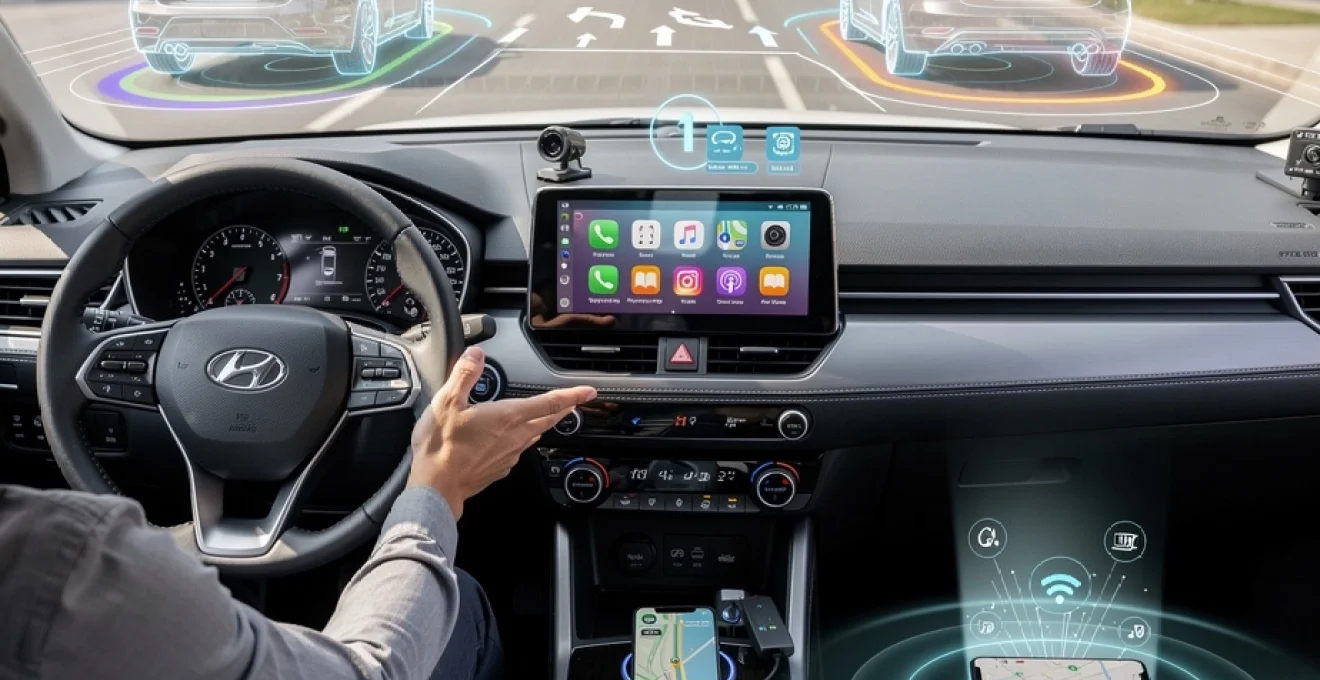
The automotive landscape is experiencing a technological revolution that extends far beyond the vehicles rolling off production lines. Modern drivers are increasingly seeking ways to transform their existing cars into intelligent, connected platforms that rival the smartest factory-installed systems. From artificial intelligence-powered safety features to seamless smartphone integration, today’s high-tech car accessories are bridging the gap between older vehicles and cutting-edge automotive technology.
The global market for automotive aftermarket accessories is projected to reach £380 billion by 2026, driven primarily by consumers’ desire for enhanced connectivity, safety, and convenience features. This surge reflects a fundamental shift in how we perceive our vehicles—no longer simply transportation tools, but intelligent companions that adapt to our digital lifestyles and safety requirements.
Advanced driver assistance systems (ADAS) integration technologies
The integration of Advanced Driver Assistance Systems into aftermarket accessories represents one of the most significant developments in automotive safety technology. These systems leverage artificial intelligence, machine learning, and sophisticated sensors to create a protective cocoon around your vehicle, dramatically reducing the likelihood of accidents and enhancing overall driving confidence.
Mobileye EyeQ5 Chip-Based dash cameras with AI object recognition
The latest generation of dash cameras powered by Mobileye’s EyeQ5 chip represents a quantum leap in vehicle safety technology. These sophisticated systems don’t merely record footage—they actively analyse the driving environment in real-time, identifying potential hazards with remarkable precision. The EyeQ5 processor can distinguish between pedestrians, cyclists, vehicles, and road signs, providing proactive alerts that can prevent accidents before they occur.
What sets these systems apart is their ability to learn from driving patterns and environmental conditions. The AI continuously refines its recognition algorithms, becoming more accurate at predicting potential collision scenarios. These cameras can detect lane departures, monitor following distances, and even alert drivers to pedestrians entering their path—capabilities that were once exclusive to luxury vehicles costing over £50,000.
Garmin DriveAssist series GPS navigation with collision warnings
Garmin’s DriveAssist series combines traditional navigation excellence with cutting-edge safety features, creating a comprehensive driving assistance platform. These devices integrate forward collision warnings, lane departure alerts, and “Go” alerts that notify you when traffic begins moving after a stop. The system’s dual-purpose design means you’re getting both premium navigation and advanced safety monitoring in a single, elegantly designed unit.
The collision warning system uses advanced algorithms to calculate closing speeds and distances, providing crucial seconds of warning time that can make the difference between a near-miss and a costly accident. Recent studies indicate that forward collision warning systems can reduce rear-end crashes by up to 27%, making these devices invaluable investments in driver safety.
Nextbase 622GW 4K dashboard camera with emergency SOS features
The Nextbase 622GW represents the pinnacle of consumer dash camera technology, combining ultra-high-definition recording with intelligent emergency response capabilities. This device automatically detects severe impacts and can send emergency alerts with your precise location to designated contacts, potentially saving precious minutes in critical situations. The 4K recording quality ensures that even the smallest details—such as number plates and road signs—are captured with forensic clarity.
Beyond its emergency features, the 622GW incorporates Intelligent Parking Mode that monitors your vehicle even when parked, automatically recording any impacts or suspicious activity. This feature has proven invaluable for insurance claims, with many users reporting successful claims for parking incidents that would otherwise have been impossible to prove.
Continental ehorizon predictive cruise control retrofit systems
Continental’s eHorizon technology represents the future of adaptive cruise control, using predictive algorithms to anticipate traffic conditions and road topography ahead. These retrofit systems can be integrated into many existing vehicles, providing intelligent speed management that optimises fuel efficiency while maintaining safety margins. The system accesses real-time traffic data and road gradient information to make proactive adjustments to vehicle speed.
The economic benefits are substantial, with users typically experiencing fuel savings of 3-8% during highway driving. More importantly, the system reduces driver fatigue on long journeys by managing
acceleration and braking more smoothly than most human drivers. For anyone who spends hours on the motorway, this kind of predictive cruise control upgrade can transform your car into a much “smarter” long‑distance companion without changing vehicles.
Wireless connectivity and smartphone integration solutions
While ADAS upgrades focus on safety, wireless connectivity accessories are all about turning your car into a seamless extension of your digital life. Whether you’re driving a 10‑year‑old hatchback or a nearly new SUV, the right high-tech car accessories can add features like wireless mirroring, hands‑free calls and stable data connections that rival built‑in systems on premium models. This is where you really feel the difference between a basic car and a genuinely smart driving experience.
Apple CarPlay and android auto wireless adapters for legacy vehicles
If your car only supports wired Apple CarPlay or Android Auto—or worse, has no smartphone integration at all—a wireless adapter is one of the most impactful upgrades you can make. These compact dongles plug into your vehicle’s existing USB or infotainment port and create a secure Wi‑Fi bridge between your phone and head unit. The result? Your favourite navigation, messaging and music apps appear on the dashboard automatically whenever you start the engine, with no cable juggling.
Modern wireless CarPlay and Android Auto adapters typically boot in under 30 seconds and reconnect to your phone each time you get in, maintaining low latency so maps, calls and voice commands feel responsive. For drivers who get in and out of the car frequently, eliminating a wired connection cuts down on wear to the phone port and reduces distraction. When choosing a model, look for firmware update support and broad compatibility lists—some cars and phones can be fussy, and regular software updates are key to long‑term reliability.
Anker roav SmartCharge F2 bluetooth FM transmitters
For vehicles with no Bluetooth or USB input, Bluetooth FM transmitters like the Anker Roav SmartCharge F2 offer an elegant workaround. The device plugs into your 12V socket, connects to your smartphone via Bluetooth, then rebroadcasts audio on a clear FM frequency that your factory radio can tune into. It’s a clever bridge between analogue and digital, letting you stream music, podcasts and navigation prompts through speakers that are decades older than your phone.
The SmartCharge F2 also functions as a dual USB car charger and includes noise‑cancelling microphones for hands‑free calls. Real‑time voltage monitoring can even give you early warning of a weak battery—an underrated bonus for older cars. The key to getting the best performance from any FM transmitter is to choose a frequency with minimal local radio interference; a quick scan across the dial before setup will help you find a clean channel for consistently clear audio.
Pioneer DMH-WC5700NEX capacitive touchscreen head units
If you’re ready to overhaul your in‑car tech entirely, a modern capacitive touchscreen head unit like Pioneer’s DMH‑WC5700NEX delivers a full infotainment upgrade in one shot. Designed as a modular, shallow‑chassis system, this unit fits into dashboards that can’t accommodate traditional double‑DIN bodies, making it an excellent option for many legacy vehicles. Once installed, you gain wireless Apple CarPlay, Android Auto, advanced Bluetooth, high‑resolution audio playback and extensive customisation options.
The capacitive touchscreen provides smartphone‑like responsiveness, while support for steering‑wheel control adapters means you don’t have to give up factory convenience features. For drivers who care about audio quality, the built‑in time‑alignment, 13‑band EQ and high‑voltage pre‑outs allow you to tune your system far beyond what stock stereos can offer. Think of it as replacing a basic office monitor with a 4K touch display—suddenly every interaction with your car’s tech feels faster, clearer and more intuitive.
Weboost drive reach mobile signal boosters for enhanced coverage
Dead zones are one of the biggest frustrations for connected drivers, especially if you rely on cloud navigation, music streaming or work calls while on the move. The WeBoost Drive Reach is a high‑gain mobile signal booster that uses an exterior antenna, interior antenna and amplifier to strengthen weak cellular signals within your vehicle. In rural areas or along patchy motorway stretches, this can be the difference between a dropped call and a stable connection.
Independent testing shows that high‑quality boosters can improve usable coverage area by several kilometres in poor‑signal zones, and increase data speeds enough to keep navigation and messaging apps responsive. Installation is typically straightforward—magnetic or adhesive antenna mounting, a fused power lead, and discreet cable routing along trim panels. For professionals who spend hours on the road or families who road‑trip in remote regions, this kind of signal‑boosting accessory turns your car into a far more reliable mobile office or entertainment hub.
Alexa auto echo integration with voice command capabilities
Bringing Amazon’s Alexa into your car via an Echo Auto or similar device effectively adds a cloud‑based co‑driver that never gets tired. These compact units connect to your smartphone for data and your car’s audio system via Bluetooth, AUX or FM. Once set up, you can use hands‑free voice commands to control music, ask for directions, add items to your shopping list, check your calendar, or even control smart home devices while you’re stuck in traffic.
Why does this matter for a smarter driving experience? Because every task you complete with your voice is one less reason to pick up your phone. With features like routine automation, you can set Alexa to automatically open your navigation to work each morning or play a specific news briefing when you start the engine. Integration does require a stable data connection—another reason why pairing Alexa Auto with a mobile signal booster can be such a powerful combination for frequent drivers.
Intelligent parking and manoeuvring assistance devices
Low‑speed bumps and scrapes are among the most common insurance claims, yet they’re also some of the easiest to avoid with the right parking technology. Intelligent parking and manoeuvring accessories retrofit “big car” convenience into smaller or older vehicles, reducing stress in multi‑storey car parks, tight urban streets and narrow driveways. If you’ve ever wished your car could “see” a little better around it, this category of high-tech car accessories is for you.
Aftermarket ultrasonic parking sensor kits can be installed into front and rear bumpers, providing progressive audio alerts as you approach obstacles. Many modern systems pair these sensors with visual distance indicators or overlay graphics on a connected display, giving you a more intuitive sense of space. Unlike basic beepers of the past, intelligent kits can distinguish between static objects and moving hazards, reducing nuisance alerts while still warning you about pedestrians or pets moving behind the car.
Reversing cameras and 360‑degree camera systems take things a step further. A rear‑view camera, integrated with your existing head unit or a clip‑on screen, offers a clear, wide‑angle view of what’s happening behind you—particularly helpful in taller vehicles or vans with limited window visibility. More advanced multi‑camera systems stitch together feeds from front, side and rear cameras to create an overhead “bird’s‑eye” view, making parallel parking or navigating tight car parks feel much more manageable. Installation quality is critical here: correct alignment, weatherproofing and neat wiring ensure reliable performance year‑round.
For drivers who regularly tow caravans or trailers, specialised trailer backing cameras and wireless hitch‑alignment systems can transform a chore into a simple one‑person task. These accessories often include guiding lines that bend with your steering input, helping you judge your steering angle and distance without getting in and out repeatedly. Combined with parking sensors, they significantly reduce the risk of jack‑knifing or accidental contact with obstacles when manoeuvring large loads in confined spaces.
OBD-II diagnostic and vehicle health monitoring systems
The On‑Board Diagnostics (OBD‑II) port hidden under your dashboard is like a USB port for your car’s brain. High‑tech OBD‑II diagnostic tools and monitoring dongles tap into this data stream, giving you real‑time insights into engine health, emissions, battery condition and more. Instead of waiting for a warning light to appear—and then guessing what it means—you can see live fault codes and performance metrics on your smartphone.
Many consumer‑friendly OBD‑II adapters pair with mobile apps to translate complex diagnostic trouble codes into plain English, suggest likely causes and even recommend next steps. This helps you decide whether an issue can wait for a scheduled service or needs immediate attention, potentially saving you from costly breakdowns. Think of it as having a virtual mechanic riding along, quietly keeping track of temperatures, pressures and error logs in the background.
Fleet‑grade telematics systems take this concept further by logging driving behaviour, fuel consumption, idling time and location over long periods. Even for private owners, similar features can be valuable: accurate fuel‑economy tracking helps you spot changes that might indicate a developing fault, while trip logs make it easier to claim business mileage. When combined with maintenance‑reminder functions—based on actual mileage and engine hours rather than rough estimates—OBD‑II monitoring becomes a powerful tool for extending your vehicle’s lifespan.
Security‑focused OBD‑II devices add another layer by integrating GPS tracking and movement alerts. If your car is moved without the ignition on, or leaves a predefined geofenced area, you can receive an instant notification on your phone. For high‑value vehicles or areas with increased theft risk, this turns a standard diagnostic interface into part of a broader anti‑theft strategy. Just be sure to choose hardware from reputable brands with strong data‑security practices, as these devices access sensitive vehicle and location information.
Enhanced security and anti-theft technologies
Vehicle theft techniques have evolved rapidly in recent years, with organised gangs exploiting keyless entry systems and relay attacks to steal cars in under a minute. In response, modern security and anti‑theft accessories focus on adding layers of protection that disrupt these methods, deter opportunistic thieves and improve the chances of recovering a stolen vehicle. If you think of your car’s security like a home alarm system, these devices are the smart sensors, cameras and locks that make intrusion far more difficult.
GPS tracking systems are now one of the most effective high-tech car accessories for theft recovery. Discreet, hard‑wired trackers with backup batteries can report your vehicle’s live location even if the main battery is disconnected, and some integrate with monitoring centres that liaise directly with law enforcement. Insurance data shows that cars with accredited tracking systems have significantly higher recovery rates, and some insurers offer premium discounts when such devices are installed.
Smart immobilisers and digital kill‑switches add proactive protection by preventing the engine from starting without the correct authentication. Unlike traditional steering‑wheel locks—which are still useful visible deterrents—these systems operate electronically, often using encrypted communication with a paired smartphone or fob. You might, for example, require a secret sequence of steering‑wheel button presses or a confirmed smartphone proximity before the car will start. To a thief, the vehicle appears dead, buying you valuable time and making it a far less attractive target.
Dash cams with parking‑surveillance modes and motion detection also play a growing role in vehicle security. While they won’t physically stop a theft, visible cameras and “video recording” stickers can deter vandalism and opportunistic damage. In crowded car parks, having recorded evidence of number plates and faces can make the difference between paying for repairs yourself and a successful claim or police investigation. Some advanced systems now upload critical clips to the cloud over LTE when tampering is detected, ensuring footage isn’t lost even if the device is removed.
Ergonomic comfort and climate control innovations
Smart driving isn’t just about sensors, chips and data—it’s also about how you feel behind the wheel. Ergonomic and climate control accessories may not sound as futuristic as AI dash cams, but they have a direct impact on fatigue, focus and overall driving enjoyment. If you regularly arrive at your destination with a stiff back or freezing hands, a few targeted upgrades can make your car feel like a tailored workspace rather than a generic seat on wheels.
Heated seat cushions and steering‑wheel covers are among the simplest yet most transformative additions for drivers in colder climates. Powered from a 12V socket or hard‑wired, they warm key contact points within minutes, reducing the need to blast the cabin heater and demist on full power. Not only is this more energy‑efficient—particularly important for hybrid and electric vehicles—it also means you stay comfortable sooner on short journeys. Many models now include adjustable temperature settings and automatic shut‑off timers for safety.
On the ergonomic side, memory‑foam seat toppers, lumbar supports and adjustable neck pillows help you maintain a healthier posture on long drives. Poor seat ergonomics can lead to back pain, fatigue and slower reaction times, especially during motorway commutes or holiday trips. By supporting the natural curve of your spine and reducing pressure points, these accessories work much like a high‑quality office chair upgrade: subtle at first, but game‑changing once you get used to them.
Finally, compact in‑car air purifiers and smart climate monitors round out the comfort picture by improving cabin air quality. These devices filter particulates, pollen and some pollutants while displaying temperature and humidity levels on an easy‑to‑read screen. For allergy sufferers or city drivers spending hours in traffic fumes, cleaner air can reduce headaches and irritation, making you feel more alert. Combine this with reflective sunshades, ventilated seat cushions and window deflectors, and you create a micro‑climate that keeps you comfortable and focused, whatever the weather outside.