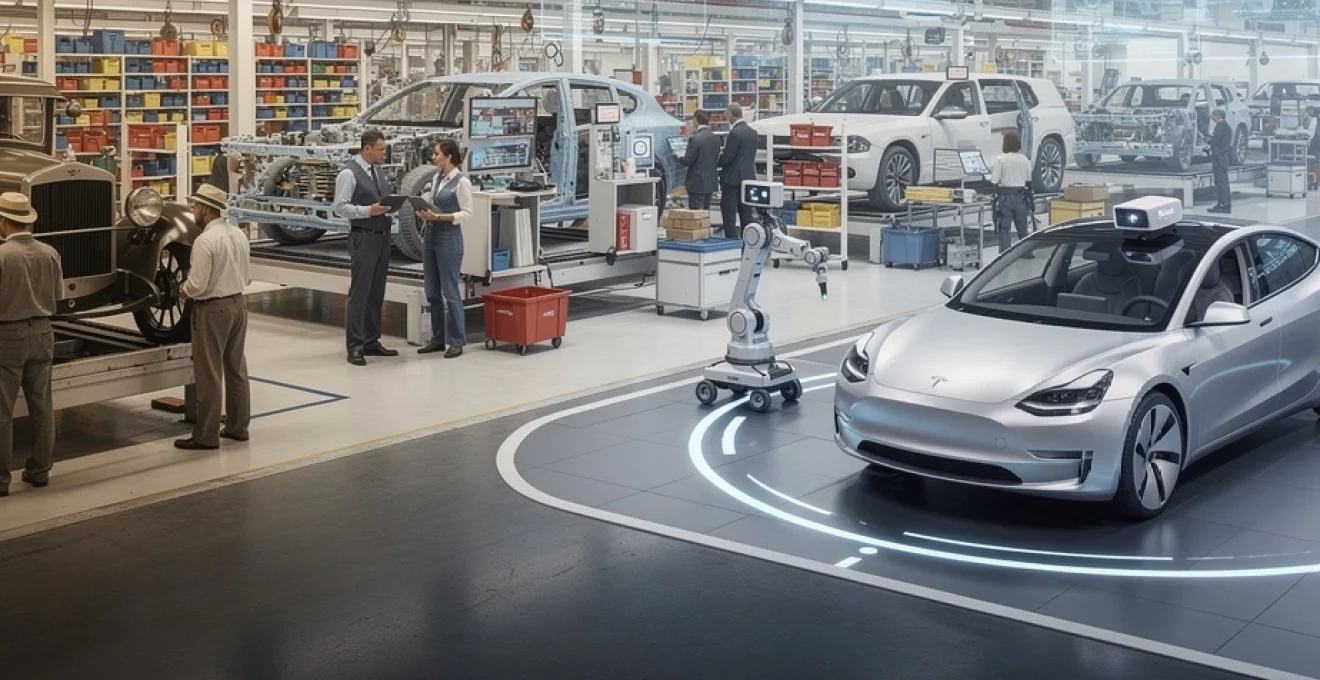
The automotive industry stands at a pivotal moment in its evolution, where manufacturers are no longer merely assembling vehicles but orchestrating fundamental transformations that reshape entire economies and societies. From the introduction of mass production techniques that democratised personal mobility to today’s revolutionary shifts towards electrification and autonomous systems, automotive manufacturers have consistently served as catalysts for technological advancement and industrial innovation. This transformation extends beyond traditional boundaries, influencing everything from urban planning to energy infrastructure, while simultaneously addressing pressing challenges such as climate change and resource scarcity.
As global markets witness unprecedented technological convergence, manufacturers face the complex challenge of balancing traditional automotive excellence with emerging technologies that demand entirely new competencies. The industry’s evolution reflects broader societal shifts towards sustainability, connectivity, and personalisation, positioning automotive manufacturers as key players in defining the future of human mobility and technological integration.
Historical paradigm shifts driven by manufacturing innovation
Throughout automotive history, manufacturers have consistently pushed the boundaries of industrial capability, creating paradigm shifts that extend far beyond the automotive sector. These transformative moments have reshaped not only how vehicles are produced but also how entire industries approach manufacturing, quality control, and market segmentation. The legacy of these innovations continues to influence modern manufacturing philosophy and strategic planning across diverse industrial sectors.
Ford’s assembly line revolution and mass production standardisation
Henry Ford’s introduction of the moving assembly line in 1913 represents perhaps the most significant manufacturing innovation in modern history. This revolutionary approach reduced the time required to assemble a Model T from over 12 hours to just 93 minutes, fundamentally altering the economics of automobile production. The standardisation principles underlying this system established the foundation for modern manufacturing practices, emphasising precision, interchangeability, and continuous workflow optimisation.
Ford’s manufacturing philosophy extended beyond mere production efficiency, encompassing workforce development and consumer accessibility. By dramatically reducing production costs, Ford made automobile ownership accessible to middle-class consumers for the first time, creating a mass market that transformed social mobility patterns and urban development. The economies of scale achieved through this approach established manufacturing principles that continue to influence production strategies across numerous industries today.
Toyota production system and lean manufacturing methodology
Toyota’s development of the Toyota Production System (TPS) in the post-war era introduced revolutionary concepts that redefined manufacturing efficiency and quality control. This system, characterised by just-in-time production, continuous improvement (kaizen), and waste elimination, challenged traditional mass production paradigms by emphasising flexibility and responsiveness to market demands. The TPS methodology demonstrated that manufacturers could achieve superior quality while simultaneously reducing costs and inventory requirements.
The lean manufacturing principles pioneered by Toyota have been adopted across industries worldwide, influencing everything from healthcare delivery to software development. This approach emphasises value stream mapping, employee empowerment, and systematic problem-solving, creating manufacturing environments that adapt continuously to changing market conditions and customer requirements. The success of TPS has established Toyota as a benchmark for manufacturing excellence and operational efficiency.
General motors’ divisional structure and market segmentation strategy
General Motors’ implementation of divisional organisation under Alfred Sloan revolutionised automotive marketing and brand management during the 1920s. This structure created distinct brand identities targeting different market segments, from Chevrolet’s affordability focus to Cadillac’s luxury positioning. The divisional approach enabled GM to capture market share across diverse consumer preferences while maintaining operational synergies and cost advantages.
This organisational innovation demonstrated how manufacturers could leverage product differentiation and brand portfolio management to achieve market dominance. The GM model influenced corporate structure development across industries, establishing frameworks for managing complex, multi-brand organisations while maintaining strategic coherence and operational efficiency. The legacy of this approach continues to shape modern automotive conglomerate strategies and market positioning tactics.
Volkswagen’s platform strategy and modular manufacturing architecture
Volkswagen’s development of platform-based manufacturing represents a sophisticated evolution of mass production principles, enabling the production of diverse vehicle models using shared underlying architectures. The MQB (Modular Transverse Matrix) platform demonstrates how manufacturers can achieve economies of scale while offering extensive product customisation and brand differentiation. This approach allows VW Group to produce vehicles ranging from compact Audis to full-size Škodas using common components and production processes.
By standardising interfaces, component dimensions and manufacturing processes, Volkswagen has been able to reduce development time, optimise supplier relationships and simplify global capacity planning. The modular manufacturing architecture also provides a strategic bridge between internal combustion engine (ICE), hybrid and battery-electric vehicles (BEVs), enabling plants to be reconfigured rather than completely rebuilt as demand shifts. This blend of flexibility and scale has become a reference model for other automotive manufacturers seeking to manage complex product portfolios while maintaining cost discipline.
Electrification leadership and battery technology integration
The transition to electric vehicles marks one of the most profound shifts in automotive manufacturing since the advent of the assembly line. Unlike previous incremental improvements in engine efficiency or safety systems, electrification requires manufacturers to rethink product architecture, supply chains, plant layouts and even their relationships with energy providers. Battery technology integration sits at the heart of this change, determining not only vehicle performance and range but also overall manufacturing economics and long-term competitiveness.
As a result, leading automotive manufacturers are investing heavily in battery research, gigafactory development and vertical integration strategies. The way they design their electric platforms, secure raw materials and organise their production networks will shape the competitive landscape for decades. We can already see distinct strategic models emerging, from tightly integrated battery-to-vehicle ecosystems to highly modular architectures designed for multi-brand, multi-segment deployment.
Tesla’s vertical integration model and gigafactory production scale
Tesla has become synonymous with electric vehicle innovation largely because of its aggressive vertical integration model. Instead of relying primarily on external suppliers, Tesla has brought critical capabilities in-house, from battery cell production and power electronics to software, autonomous driving systems and even charging infrastructure. This approach allows the company to control key cost drivers, iterate quickly and capture a disproportionate share of the value created by the shift to electrification.
The cornerstone of this strategy is the gigafactory concept: large-scale facilities designed to produce batteries, drive units and vehicles under one roof. By 2024, Tesla operated or was constructing gigafactories in the United States, Europe, China and Mexico, each optimised for high-volume electric vehicle manufacturing. The combination of scale, standardised processes and close coupling between product engineering and manufacturing enables rapid design changes and continuous improvement, much like a software company pushing regular updates to its platform.
From a manufacturing perspective, Tesla’s gigafactories are laboratories for new production technologies, including large casting “giga-press” machines, highly automated battery module lines and advanced material handling systems. For other manufacturers, the key lesson is not simply to copy Tesla’s plant size but to recognise how tight integration of design, software and production can compress development cycles and reduce the cost per kilowatt-hour. The more electric vehicles become a platform for digital services, the more this integration model becomes a strategic advantage.
Byd’s battery-to-vehicle manufacturing ecosystem
While Tesla has pioneered vertical integration in the West, Chinese manufacturer BYD has built an equally powerful, albeit distinct, battery-to-vehicle ecosystem. Originally a battery producer, BYD expanded into complete vehicle manufacturing, public transport solutions and energy storage, creating a tightly connected industrial network. This means BYD controls the full lifecycle of critical technologies, from lithium iron phosphate (LFP) cell chemistry to final vehicle assembly.
One of BYD’s key differentiators is its focus on LFP batteries and its proprietary “Blade” cell design, which allows for higher packaging efficiency and improved safety. By producing cells, modules and packs in-house and integrating them directly into the vehicle structure, BYD reduces cost and complexity in the manufacturing process. This battery integration strategy also enables standardised production lines that can serve multiple vehicle segments, from compact cars to buses and commercial vehicles.
The broader BYD ecosystem extends beyond the factory walls. The company is active in solar energy, stationary storage and grid solutions, positioning itself as an end-to-end clean energy provider rather than a pure automotive manufacturer. For global manufacturers, BYD’s trajectory underscores how critical it is to view electric vehicles not in isolation, but as part of a wider energy and mobility system. Those who can coordinate vehicle manufacturing with energy production, storage and charging infrastructure will be best placed to offer compelling total-cost-of-ownership propositions to both private and fleet customers.
General motors’ ultium platform and modular battery architecture
General Motors has taken a platform-centric approach to electrification with its Ultium architecture. Rather than designing separate systems for each brand or segment, GM has developed a flexible battery and propulsion platform that can underpin vehicles ranging from compact crossovers to large pickup trucks. The Ultium battery system uses large-format pouch cells that can be stacked vertically or horizontally, offering significant freedom in pack design and vehicle integration.
This modularity simplifies manufacturing because the same core components and production processes can be reused across multiple plants and models. GM can configure Ultium-powered vehicles for different ranges, performance levels and price points simply by adjusting the number and arrangement of modules. In practical terms, this means the company can respond more quickly to shifting consumer demand for specific electric vehicle segments without reengineering the entire platform each time.
The Ultium strategy also reflects a careful balance between in-house capabilities and strategic partnerships. GM collaborates with suppliers and energy companies on cell chemistry, raw material sourcing and charging networks, while retaining control over system integration, software management and vehicle architecture. For other legacy manufacturers, GM’s approach provides a roadmap for scaling electric vehicle manufacturing: standardise as much as possible at the platform level, while leaving space for brand differentiation and regional customisation.
Stellantis STLA frame platform and multi-chemistry battery systems
Stellantis, formed from the merger of PSA Group and Fiat Chrysler Automobiles, faces the complex challenge of electrifying a diverse portfolio of brands and vehicle types. The STLA platform family, and in particular the STLA Frame platform, has been designed to support this transition. STLA Frame targets larger vehicles such as pickup trucks, SUVs and light commercial vehicles, providing a robust architecture optimised for high-capacity battery packs and powerful electric drive units.
One distinctive aspect of Stellantis’ strategy is its focus on multi-chemistry battery systems. Rather than committing to a single cell chemistry, the company plans to deploy different technologies—such as high-energy NMC cells, cost-effective LFP and future solid-state solutions—within the same overarching platform framework. This allows Stellantis to tailor vehicles to specific market requirements, from long-range premium models to cost-sensitive fleet applications, while maintaining manufacturing commonality.
From a production standpoint, supporting multi-chemistry batteries demands a high degree of flexibility in pack assembly lines, thermal management systems and quality control procedures. Plants must be able to adapt as new chemistries mature and as regional regulations or incentives change. For manufacturers, Stellantis’ STLA and battery roadmap illustrates how designing for technological optionality at the platform level can reduce long-term risk in a rapidly evolving electric vehicle market.
Advanced driver assistance systems and autonomous vehicle development
Beyond electrification, advanced driver assistance systems (ADAS) and autonomous driving technologies are reshaping how manufacturers design and build vehicles. What started as incremental safety features—such as anti-lock braking and electronic stability control—has evolved into complex sensor suites, high-performance computing platforms and software stacks that rival those of consumer electronics. Manufacturers are now effectively building rolling computers, where hardware and software integration is as critical as body-in-white welding or paint quality.
From a manufacturing perspective, this shift introduces new challenges. Plants must integrate cameras, radar, lidar, high-bandwidth wiring harnesses and domain controllers with automotive-grade reliability. Assembly processes need tighter tolerances to ensure sensors are correctly calibrated and protected from vibration or contamination. At the same time, manufacturers must manage a continuous software development cycle, issuing over-the-air updates to improve ADAS performance and patch vulnerabilities. This represents a radical departure from the traditional model where a vehicle’s capabilities were largely fixed at the point of sale.
Manufacturers also play a central role in defining the regulatory and safety frameworks for autonomous mobility. By conducting large-scale pilots, sharing data with authorities and collaborating with technology partners, they help validate new functional safety standards and cybersecurity requirements. For organisations across the automotive value chain, the gradual progression from Level 2+ assistance to higher levels of autonomy will demand new testing methodologies, digital simulation tools and end-of-line validation processes. The manufacturers that can industrialise these complex systems at scale, while keeping costs under control, will set the benchmark for the next era of intelligent mobility.
Sustainable manufacturing processes and carbon neutrality initiatives
As climate commitments tighten worldwide, automotive manufacturers are under pressure not only to produce low-emission vehicles but also to decarbonise their own operations. This means rethinking energy use, materials, logistics and waste management across the entire manufacturing footprint. The goal is no longer limited to improving fuel economy or tailpipe emissions; it is about achieving climate-neutral factories, circular material flows and transparent reporting on environmental impact.
This transformation requires a combination of technological investment and process redesign. Companies are deploying renewable energy, electrifying on-site processes, implementing closed-loop recycling for metals and plastics, and using life-cycle assessment to guide design decisions. Yet sustainability is not only a compliance issue; it is becoming a differentiator. Customers, investors and regulators increasingly favour manufacturers that can demonstrate measurable progress towards net-zero manufacturing. In this context, leading brands such as BMW, Volvo Cars, Mercedes-Benz and Audi provide concrete examples of how sustainability can be embedded into the core of production strategy.
Bmw’s carbon fibre production and recycled material integration
BMW has long experimented with lightweight materials to improve vehicle efficiency, most notably with carbon fibre reinforced plastic (CFRP). While the company’s early large-scale use of CFRP on models like the i3 and i8 was ambitious, the real impact lies in how BMW integrated carbon fibre production into its manufacturing ecosystem. By investing in its own carbon fibre plants and partnering on renewable-energy-powered production, BMW reduced the carbon footprint associated with this energy-intensive material.
In parallel, BMW has significantly increased the proportion of recycled and secondary materials in its vehicles. For example, the company targets using up to 50% secondary aluminium and a high share of recycled plastics in future model lines. Integrating recycled materials at scale requires close collaboration between design, procurement and manufacturing, since material properties, supply stability and processing constraints must all be managed. You can think of this like switching ingredients in a complex recipe: small changes can ripple through the whole process if they are not carefully tested and controlled.
For other manufacturers, BMW’s approach highlights the importance of designing vehicles from the outset with recyclability and material circularity in mind. This includes standardising material grades, labelling components for easier disassembly and partnering with recycling specialists to create reliable closed loops. As regulations increasingly mandate minimum recycled content and extended producer responsibility, such strategies will move from optional to essential.
Volvo cars’ climate-neutral manufacturing by 2030 strategy
Volvo Cars has set one of the most ambitious timelines in the industry: achieving climate-neutral manufacturing operations by 2030 and becoming a fully electric car company in the same timeframe. Several of its plants, such as the Skövde engine facility and the Torslanda plant in Sweden, already operate on 100% climate-neutral electricity, with heat supply progressively decarbonised through biofuels and district heating. These initiatives show how manufacturing sites can be transformed step by step rather than waiting for perfect conditions.
To reach its climate targets, Volvo is combining energy efficiency upgrades, on-site renewables, green power purchase agreements and process electrification. It also places strong emphasis on supplier decarbonisation, recognising that a large share of lifecycle emissions originates upstream in steel, aluminium and battery production. By setting science-based targets and integrating climate criteria into sourcing decisions, Volvo encourages its supply base to invest in low-carbon technologies and transparent reporting.
For manufacturers considering similar climate-neutral manufacturing strategies, Volvo’s roadmap underscores the importance of aligning corporate commitments with concrete plant-level action plans. This includes establishing clear baselines, prioritising high-impact measures and using digital energy management systems to monitor progress in real time. The earlier these initiatives are embedded into capital investment decisions, the lower the long-term cost of decarbonisation.
Mercedes-benz’s factory 56 digital production methodology
Mercedes-Benz’s Factory 56 in Sindelfingen is often cited as a blueprint for next-generation, sustainable automotive manufacturing. Designed for high flexibility, digital integration and reduced environmental impact, the plant produces a range of vehicles, including luxury sedans and electric models, on the same line. Compared with previous assembly facilities, Factory 56 reportedly uses up to 25% less energy and incorporates a significant share of renewable power through photovoltaic installations.
The core of Factory 56 is its digital production methodology. Virtually all processes are modelled in a digital twin, enabling simulations, layout optimisation and early validation before physical implementation. Automated guided vehicles (AGVs) replace traditional conveyor systems in many areas, allowing rapid reconfiguration as new models or derivatives are introduced. Data from machines, tools and quality checks is collected and analysed in real time, enabling predictive maintenance and continuous improvement of both productivity and sustainability metrics.
For other manufacturers, the Factory 56 concept illustrates how digitalisation and sustainability can reinforce each other. When you can “see” your factory in data—energy flows, process bottlenecks, scrap rates—it becomes much easier to identify where to invest to cut emissions and costs simultaneously. This integrated view will be critical as automotive plants become more complex, accommodating electric, hybrid and ICE vehicles during a long transition period.
Audi’s closed-loop water management and renewable energy systems
Audi has focused strongly on resource efficiency at its production sites, with flagship initiatives in water management and renewable energy use. At its San José Chiapa plant in Mexico, for instance, Audi operates a closed-loop water system that allows the facility to function without drawing groundwater. Process water is treated, recycled and reused multiple times, reducing both environmental impact and long-term operational risk in a water-stressed region.
Across its global manufacturing network, Audi is also transitioning plants to run on renewable electricity and implementing rooftop solar, biogas and waste-heat recovery solutions. The company aims for all its sites to be net carbon-neutral in terms of operations, following the example of the Audi Brussels plant, which has already achieved this status for vehicle production. Integrating these systems requires careful coordination between facility engineering, production planning and local energy providers.
For manufacturers, Audi’s initiatives demonstrate how focusing on specific resources—such as water or energy—can yield replicable best practices. By treating the factory as an integrated ecosystem, rather than a collection of isolated lines and buildings, companies can design closed loops that reduce dependency on external inputs. In an era of climate volatility and resource constraints, such resilience becomes a strategic asset as much as an environmental commitment.
Connected vehicle infrastructure and over-the-air update capabilities
The rise of connected vehicles has transformed the automobile from a largely standalone product into a node within a broader digital ecosystem. Modern vehicles routinely communicate with cloud platforms, mobile apps, dealer systems and even other vehicles or roadside infrastructure. This connectivity enables new features such as real-time traffic routing, remote diagnostics, predictive maintenance and personalised in-car services. For manufacturers, however, it also demands a complete rethinking of electrical architectures and software development processes.
A cornerstone of this transformation is the ability to deliver over-the-air (OTA) updates. Instead of requiring physical visits to workshops for software fixes or feature upgrades, manufacturers can now push updates wirelessly, much like smartphone operating system patches. This capability changes the economic model of automotive manufacturing: a vehicle’s value can increase over time as new functionalities are unlocked, safety systems are improved and battery management algorithms are refined. In practice, this means manufacturing teams must collaborate closely with software engineers to ensure that hardware and software are decoupled enough to allow future upgrades.
Yet connected vehicle infrastructure also introduces new responsibilities. Cybersecurity becomes a central concern, with manufacturers needing robust encryption, secure boot mechanisms and continuous monitoring for threats. Homologation and compliance processes must adapt to a world where software evolves post-sale. For organisations across the automotive value chain, embracing connected vehicles is less about adding a few telematics modules and more about building a long-term digital platform strategy that supports rapid, secure and reliable OTA updates at scale.
Manufacturing 4.0 technologies and digital twin implementation
The concept of Industry 4.0—applying cyber-physical systems, IoT connectivity and advanced analytics to manufacturing—has moved from theory to practice in the automotive sector. Manufacturers are deploying sensors, edge computing, cloud platforms and artificial intelligence to create highly responsive, data-driven production environments. At the centre of this shift lies the digital twin: a dynamic virtual model of a product, process or entire factory that mirrors its physical counterpart in real time.
Digital twins allow manufacturers to simulate production scenarios, test layout changes, validate robot programs and optimise logistics before making costly physical adjustments. They also provide a foundation for advanced quality control, predictive maintenance and energy optimisation. In effect, the digital twin acts as both a crystal ball and a control panel, enabling teams to anticipate problems and fine-tune operations continuously. To implement these capabilities at scale, many automotive manufacturers rely on specialised software platforms and strong partnerships with technology providers.
Siemens PLM software integration in automotive production lines
Siemens’ Product Lifecycle Management (PLM) and manufacturing execution systems (MES) have become widely used tools for orchestrating complex automotive production processes. By integrating design, engineering, planning and shop-floor execution within a single digital backbone, manufacturers can ensure that product changes are reflected quickly and consistently across global plants. This reduces the risk of discrepancies between engineering intent and manufacturing reality—a common source of quality issues and rework.
In practical terms, integrating Siemens PLM software into automotive production lines enables detailed process simulation, ergonomic analysis and virtual commissioning of equipment. Production engineers can design and test assembly sequences in a digital environment, identify potential bottlenecks and optimise workstation layouts before physical implementation. Once the line is running, MES components collect performance data, track parts and provide real-time visibility into key performance indicators such as overall equipment effectiveness (OEE).
For manufacturers striving to implement Manufacturing 4.0 at scale, such integrated platforms provide a common language between departments and sites. Instead of relying on isolated spreadsheets or local solutions, teams can collaborate on shared models and data sets. This not only accelerates new product introductions but also improves the consistency of quality and productivity across the global manufacturing network.
Artificial intelligence quality control systems and predictive maintenance
Artificial intelligence is increasingly embedded within automotive factories, particularly in quality control and maintenance. Traditional inspection methods—whether manual checks or rule-based vision systems—struggle to keep up with the complexity and speed of modern production lines. AI-driven vision systems, trained on large data sets of images, can identify subtle defects in paint, welds or assembly alignment that would be difficult for the human eye to detect consistently.
Similarly, predictive maintenance uses machine learning algorithms to analyse sensor data from robots, presses, conveyors and other equipment. By identifying patterns that precede failures—such as changes in vibration, temperature or cycle times—these systems can alert maintenance teams before breakdowns occur. This reduces unplanned downtime, optimises spare parts inventory and extends the life of critical assets. For a high-volume automotive plant, even a small improvement in uptime can translate into thousands of additional vehicles produced per year.
Implementing AI in manufacturing is not without challenges. Data quality, model interpretability and change management all play critical roles in success. Yet when manufacturers invest in robust data pipelines and cross-functional teams that combine domain expertise with data science skills, AI becomes a powerful lever for both cost reduction and quality enhancement. In many ways, it is the digital equivalent of the continuous improvement ethos introduced by lean manufacturing—only now applied at machine speed and scale.
Additive manufacturing for prototype development and spare parts production
Additive manufacturing, often referred to as 3D printing, has moved well beyond its early role as a tool for rapid prototyping. In automotive manufacturing, it is increasingly used for producing jigs, fixtures, lightweight brackets, custom tooling and even certain low-volume or highly complex components. Because additive processes build parts layer by layer, they can create geometries that would be impossible or prohibitively expensive using traditional machining or casting.
For prototype development, additive manufacturing dramatically shortens the iteration cycle between design and physical testing. Engineers can print functional components overnight, test them the next day and refine designs in rapid succession. This agility is particularly valuable in the development of electric vehicles and new ADAS hardware, where packaging constraints and thermal behaviour may require multiple design tweaks. You can liken it to editing a digital document instead of rewriting it by hand each time—a fundamental shift in speed and flexibility.
In the realm of spare parts, additive manufacturing opens the door to on-demand production for low-volume or legacy components. Instead of maintaining large inventories of rarely needed parts, manufacturers and dealers can store digital models and print parts as required, closer to the point of use. This reduces warehousing costs and the risk of obsolescence while improving service levels for customers with older vehicles. As materials and certification standards evolve, we can expect additive manufacturing to play a growing role in both production and aftersales support.
Collaborative robotics and human-machine interface optimisation
Collaborative robots, or cobots, are transforming the way humans and machines interact on the automotive factory floor. Unlike traditional industrial robots, which are typically caged off for safety reasons, cobots are designed to work alongside human operators, sharing tasks such as component handling, screwdriving, adhesive application or inspection. They can be reprogrammed quickly for new tasks, making them ideal for mixed-model production and shorter product cycles.
The introduction of cobots is not simply a matter of swapping people for machines. Instead, it prompts manufacturers to rethink task allocation and workstation design. Humans retain responsibility for complex, judgement-based or highly variable tasks, while robots handle repetitive, ergonomically challenging or precision-critical operations. This division of labour can improve both productivity and worker well-being, reducing the risk of injuries associated with heavy lifting or awkward postures.
Effective human-machine interface (HMI) optimisation is essential to realise these benefits. User-friendly programming interfaces, clear visual feedback and intuitive safety systems help operators collaborate confidently with robotic colleagues. Training and change management are equally important to ensure that the workforce sees automation as an enabler rather than a threat. When implemented thoughtfully, collaborative robotics can become a cornerstone of flexible, resilient and human-centric automotive manufacturing in the era of Industry 4.0.