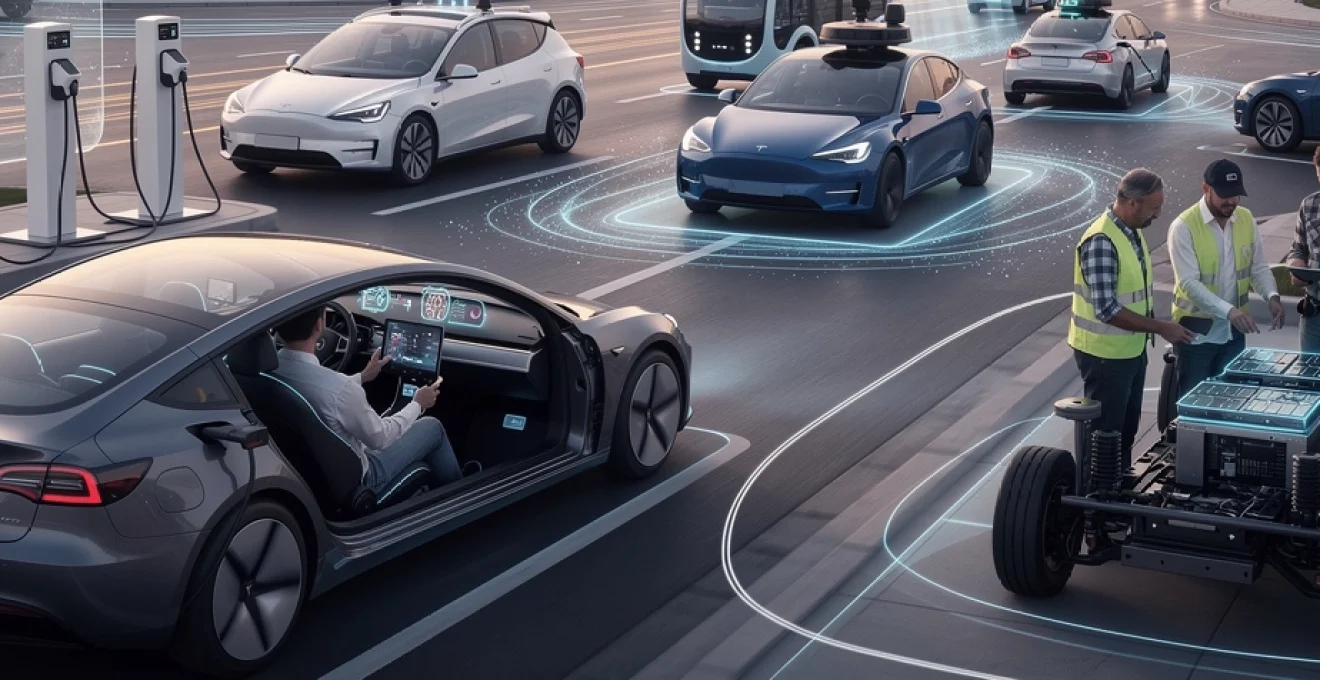
The automotive industry stands at an unprecedented crossroads, experiencing its most significant transformation since Henry Ford revolutionised manufacturing over a century ago. Today’s automotive landscape is being reshaped by a convergence of technological innovations, environmental imperatives, and evolving consumer expectations that are fundamentally altering how vehicles are designed, manufactured, and operated.
This transformation extends far beyond mere technological upgrades—it represents a complete reimagining of mobility itself. From electric powertrains that promise zero-emission transportation to autonomous systems that could redefine the very concept of driving, the industry is witnessing revolutionary changes that will determine the future of personal and commercial transportation for decades to come.
The pace of change has accelerated dramatically, driven by urgent climate considerations, regulatory pressures, and fierce global competition. Traditional automotive manufacturers now find themselves competing not only with established rivals but also with technology companies, start-ups, and new entrants from emerging markets, particularly China, which has emerged as a dominant force in electric vehicle production.
Electrification revolution: battery technology and charging infrastructure developments
The electrification revolution represents the most visible and impactful trend reshaping the automotive industry today. Global electric vehicle sales have experienced remarkable growth, with battery electric vehicle sales increasing by approximately 40% year-over-year in key markets including South America and the Asia-Pacific region. This surge reflects not only technological advances but also shifting consumer attitudes towards sustainable transportation solutions.
The transition to electric vehicles is being accelerated by significant improvements in battery energy density, cost reductions, and enhanced charging capabilities. Modern electric vehicles now offer ranges exceeding 400 miles on a single charge, effectively addressing one of the primary concerns that previously deterred potential buyers. Furthermore, charging times have decreased substantially, with some systems capable of adding 200 miles of range in just 15 minutes.
However, the electrification journey faces notable challenges in 2026. Despite optimistic forecasts, the industry is experiencing a measured slowdown in pure electric vehicle adoption, influenced by ongoing trade tensions between China and Western markets, infrastructure limitations, and the higher manufacturing costs associated with advanced battery technologies. These factors have led many manufacturers to focus increasingly on hybrid vehicles as a transitional solution.
Solid-state battery breakthroughs from toyota and QuantumScape
Solid-state battery technology represents the next frontier in electric vehicle power storage, promising to overcome many limitations of current lithium-ion systems. These advanced batteries offer significantly higher energy density, improved safety characteristics, and faster charging capabilities compared to conventional battery chemistries. Toyota and QuantumScape have emerged as leaders in this technology, with both companies making substantial investments in commercialisation efforts.
The advantages of solid-state batteries extend beyond mere performance improvements. These systems eliminate the liquid electrolyte found in traditional batteries, reducing fire risk and enabling more compact designs. Additionally, solid-state batteries demonstrate superior performance in extreme temperatures and offer longer cycle life, potentially lasting the entire lifetime of a vehicle without significant degradation.
Tesla supercharger V4 network expansion and CCS compatibility
Tesla’s Supercharger network continues to set the standard for fast-charging infrastructure, with the introduction of V4 stations marking a significant leap forward in charging technology. These advanced charging stations offer increased power output, improved user experience, and enhanced compatibility with various vehicle types through CCS (Combined Charging System) integration.
The strategic expansion of Tesla’s charging network has implications far beyond the company’s own vehicles. By opening access to other manufacturers’ electric vehicles, Tesla is positioning itself as a key infrastructure provider in the broader electrification ecosystem. This move addresses one of the most significant barriers to electric vehicle adoption: charging anxiety and infrastructure availability.
Lithium iron phosphate (LFP) vs nickel manganese cobalt (NMC) battery chemistry
The choice between LFP and NMC battery chemistries represents a critical decision point for electric vehicle manufacturers, each offering distinct advantages and trade-offs. LFP batteries provide superior thermal stability, longer cycle life, and lower costs, making them particularly attractive for entry-level and commercial vehicles. These batteries also eliminate the need for cobalt, addressing both cost and ethical sourcing concerns associated with this material.
By contrast, NMC batteries deliver higher energy density, which translates into longer range and better performance in a similar-sized pack. This makes NMC chemistry a preferred choice for premium electric vehicles where extended driving range and rapid acceleration are key selling points. However, NMC packs are typically more expensive and rely on critical materials such as nickel and cobalt, which are subject to price volatility and geopolitical risk. In practice, many automakers are adopting a dual-strategy approach: using LFP for cost-sensitive models and NMC for long-range or performance-oriented variants.
Looking ahead, we can expect continuous optimisation rather than a single “winner-takes-all” solution in battery chemistry. Improvements in both LFP and NMC formulations, including manganese-rich variants and high-voltage LFP, aim to narrow the performance gap while preserving cost and safety advantages. For fleet operators and consumers alike, understanding these differences helps in making informed decisions about total cost of ownership, longevity, and use cases such as urban commuting versus long-distance travel. As battery innovation accelerates, informed buyers will increasingly treat battery chemistry as a core specification, not an afterthought.
Bidirectional charging technology and vehicle-to-grid integration
Bidirectional charging is emerging as one of the most transformative electric vehicle technologies, enabling EVs not only to draw energy from the grid but also to send electricity back. Often referred to as vehicle-to-grid (V2G), vehicle-to-home (V2H), or vehicle-to-load (V2L), these capabilities turn an electric car into a mobile energy storage system. In practical terms, this means you could power your home during a blackout or sell excess energy back to the grid when electricity prices peak. Several major manufacturers, including Hyundai, Kia, Ford, and Nissan, are already commercialising bidirectional-ready models and chargers.
From a grid perspective, widespread V2G integration could help stabilise electricity networks increasingly reliant on intermittent renewable sources such as solar and wind. EVs parked for most of the day can act like a distributed battery farm, smoothing demand spikes and supporting frequency regulation. Of course, there are challenges: utilities and regulators must develop clear compensation schemes, technical standards must ensure interoperability, and concerns about accelerated battery degradation need to be addressed. Nevertheless, early studies suggest that with intelligent charge management, the impact on battery life can be minimal while economic benefits for drivers and grid operators can be substantial.
For consumers, bidirectional charging changes the economic equation of EV ownership. Instead of seeing the battery purely as a cost, you begin to view it as an asset that can generate value over time. Imagine combining rooftop solar with an EV that charges during the day and powers your home at night—suddenly the car becomes a critical piece of your personal energy ecosystem. As these systems mature and more energy retailers offer time-of-use tariffs, you will likely see tailored EV energy plans, much like mobile phone contracts, designed around how and when you drive and charge.
Autonomous driving systems: ADAS evolution and level 5 automation progress
While electrification reshapes how vehicles are powered, autonomous driving is redefining how they are controlled. Advanced driver assistance systems (ADAS) have already become mainstream, with features such as adaptive cruise control, lane-keeping assistance, and automatic emergency braking now standard on many new models. These systems represent the lower levels of automation but form the building blocks for higher levels, up to Level 5, where a vehicle can operate without any human intervention. The journey from today’s assisted driving to full autonomy is complex, involving advances in hardware, software, regulation, and social acceptance.
In 2026, we find ourselves in an intermediate phase: Level 2 and Level 2+ systems are widespread, Level 3 is emerging in selected markets and conditions, and Level 4 pilots are operating in defined geofenced areas. Progress is impressive but uneven. Technical breakthroughs in AI perception, sensor fusion, and high-definition mapping are counterbalanced by real-world challenges such as unpredictable human behaviour, adverse weather, and the legal implications of handing control from human to machine. As we explore specific implementations by leading players, a clear pattern emerges: instead of a single “big bang” moment of autonomy, we are seeing a gradual layering of increasingly capable features.
Tesla full Self-Driving beta neural network architecture
Tesla’s Full Self-Driving (FSD) Beta is one of the most widely discussed autonomous driving programmes, not least because of its ambitious claims and rapid iteration cycle. Under the bonnet, FSD relies on a vision-centric neural network architecture that uses data from a suite of cameras around the vehicle. Rather than depending heavily on LiDAR or high-definition maps, Tesla’s approach aims to mimic human driving by training AI models on billions of miles of real-world driving data. This data-driven method allows the system to continually improve via over-the-air software updates.
The neural networks powering FSD are designed to handle multiple tasks simultaneously, including object detection, lane prediction, path planning, and control. Tesla has shifted towards what it calls “end-to-end” neural networks that attempt to learn directly from raw sensor input to driving actions, reducing the need for handcrafted rules. Think of it as teaching the car to “see” and “decide” in a holistic way rather than following a long list of pre-programmed instructions. This architecture runs on Tesla’s custom-designed FSD computer, optimised for high-throughput AI inference in real time.
Despite these advances, Tesla’s system remains, from a regulatory perspective, a driver-assistance technology that requires active human supervision. Real-world performance can vary based on road conditions, weather, and regional driving norms. For drivers considering such systems, the key is to treat them as powerful assistants rather than autonomous chauffeurs—at least for now. As regulators scrutinise safety data and Tesla refines its neural networks, we can expect ongoing debate about naming, marketing, and the gap between perceived and actual autonomy.
Waymo’s LiDAR-based perception systems in phoenix operations
In contrast to Tesla’s camera-first philosophy, Waymo has built its autonomous platform around a rich sensor stack that includes LiDAR, radar, and high-resolution cameras. Operating commercial robotaxi services in Phoenix and other select cities, Waymo’s vehicles rely on LiDAR to generate precise 3D maps of their surroundings, even in low-light or poor-visibility conditions. This multi-sensor fusion approach provides redundancy and enhances the system’s ability to detect and classify objects at various distances and angles.
Waymo’s deployment in Phoenix is often cited as a proof point for Level 4 autonomy in controlled environments. The company’s vehicles operate within defined geofenced areas where road layouts, traffic patterns, and environmental conditions are well-understood. Detailed pre-mapped routes, combined with real-time sensor data, allow the system to predict and respond to complex situations such as unprotected left turns or pedestrians crossing mid-block. From the passenger’s perspective, hailing a Waymo can feel much like using any other ride-hailing app—except there is no human driver at the wheel.
However, scaling this model beyond favourable urban pockets remains challenging. Each new city requires extensive mapping and validation, and unexpected scenarios can still confound even the most advanced AI. For policymakers and businesses, the lesson from Waymo’s operations is that autonomous mobility is likely to roll out corridor by corridor and city by city, where the conditions and regulations are most supportive. If you operate a logistics fleet or urban mobility service, it is worth monitoring where such pilots launch, as those regions may offer early-mover advantages in autonomous services.
Mercedes-benz drive pilot level 3 certification and legal framework
Mercedes-Benz has taken a different path by focusing on legally certified Level 3 systems under clearly defined conditions. Its Drive Pilot system, approved in markets such as Germany and parts of the United States, allows drivers to hand over control to the vehicle on certain motorways at limited speeds, typically in heavy traffic. In Level 3, the system is responsible for driving within its operational design domain, and the driver is permitted to take their eyes off the road, though they must remain available to take back control when requested.
This approach hinges not only on technology but also on legal and regulatory frameworks that clarify liability. When Drive Pilot is engaged and operating within its certified parameters, Mercedes-Benz accepts responsibility for the driving task. That is a significant shift from Level 2 systems, where the driver remains fully accountable. As you might imagine, this change raises complex questions: Who is at fault in the event of a collision? How is evidence recorded and analysed? What happens if the driver fails to retake control when prompted?
To address these issues, regulators and automakers are working together on standards for data logging, driver monitoring, and system handover protocols. Drive Pilot-equipped vehicles, for example, feature robust driver monitoring to ensure the person behind the wheel is able to resume control when needed. Over time, the legal precedents set by such systems will shape how higher levels of automation are deployed and insured. For businesses managing corporate fleets, understanding where Level 3 is permitted and how liability is allocated will be crucial for risk management and driver training.
NVIDIA DRIVE orin platform and real-time processing capabilities
Underlying many advanced driver assistance and autonomous systems is a new generation of high-performance computing platforms, with NVIDIA’s DRIVE Orin emerging as a key player. DRIVE Orin is designed specifically for automotive applications, offering trillions of operations per second (TOPS) of AI compute in a power-efficient package. This computational muscle is essential for processing vast streams of data from cameras, radar, LiDAR, and ultrasonic sensors in real time. Without it, the vehicle’s “brain” would not be able to perceive, predict, and act quickly enough to ensure safety.
Automakers and Tier 1 suppliers use DRIVE Orin as a scalable foundation for Level 2+ through Level 4 systems, allowing different configurations depending on vehicle class and target capabilities. For example, a premium SUV might use multiple Orin chips to support sophisticated highway autonomy and rich infotainment, while a smaller vehicle deploys a single chip optimised for core ADAS features. By standardising on a common hardware and software platform, manufacturers can reduce development complexity and accelerate time-to-market for new features delivered via over-the-air updates.
For drivers and fleet operators, the presence of such advanced compute platforms translates into smoother, more reliable assistance features and a clearer upgrade path. Instead of buying a static bundle of features at the time of purchase, you increasingly buy into a hardware platform that can gain capabilities over time. In this sense, the car becomes more like a smartphone, where new apps and functions can be unlocked long after you drive off the lot. As 5G connectivity and cloud integration deepen, we can expect even more computational tasks to be shared between the vehicle and the cloud, further enhancing performance and flexibility.
Connected vehicle ecosystems and over-the-air software updates
Connectivity is the digital glue that ties many of these automotive trends together. Modern vehicles are no longer isolated machines; they are nodes in a wider connected vehicle ecosystem that includes cloud platforms, mobile apps, charging networks, and even smart homes. Through built-in modems and 5G connectivity, cars can transmit and receive data in real time, enabling features such as live traffic updates, remote diagnostics, usage-based insurance, and predictive maintenance. This connectivity transforms vehicles from one-time purchases into continuously evolving digital services.
One of the most impactful outcomes of this shift is the rise of over-the-air (OTA) software updates. Instead of visiting a dealership for every improvement or recall, owners can receive new features, bug fixes, and performance enhancements wirelessly, often overnight. Tesla pioneered this model, but now virtually every major manufacturer is investing in their own OTA capabilities. For you as a driver, this means your car can actually improve with age—gaining range, refining ADAS behaviour, or adding new infotainment options without any physical intervention.
From a business perspective, connected vehicle platforms open up new revenue streams. Automakers can offer subscription-based features, pay-per-use services, and app marketplaces that extend the vehicle’s functionality. Consider personalised insurance tailored to your actual driving patterns, or fleet management tools that analyse real-time vehicle data to reduce downtime. At the same time, this data-centric model raises critical questions about privacy, cybersecurity, and data ownership. Companies that can balance innovation with transparent, robust data protection will have a clear competitive edge in winning and keeping customer trust.
Sustainable manufacturing processes and carbon-neutral production goals
Sustainability in the automotive industry goes far beyond tailpipe emissions. Increasingly, manufacturers are scrutinising the entire lifecycle of vehicles—from raw material extraction and component manufacturing to assembly, use, and end-of-life recycling. Many leading automakers have set ambitious carbon-neutral or even carbon-negative targets for their operations, often aiming for 2035 or 2040. Achieving these goals requires a combination of renewable energy adoption, process optimisation, circular economy practices, and closer collaboration with suppliers.
On the factory floor, we are seeing a shift towards energy-efficient production lines powered by solar, wind, or hydroelectric sources. Lightweight materials such as aluminium and advanced composites are being used more extensively to reduce vehicle mass and improve efficiency, while also demanding less energy to transport and assemble. Meanwhile, digital tools such as digital twins and AI-driven process control help manufacturers identify waste, reduce scrap rates, and optimise resource use. Think of a digital twin as a virtual mirror of the factory, where engineers can test changes and spot inefficiencies before they affect the real world.
End-of-life management is another critical piece of the sustainability puzzle. Battery recycling facilities are being scaled up to recover valuable materials like lithium, nickel, and cobalt, which can then be reused in new packs. Some automakers are exploring second-life applications for EV batteries, such as stationary storage for renewable energy. For consumers and fleet operators, this means that choosing a vehicle from a brand with robust sustainability initiatives increasingly aligns environmental responsibility with long-term cost savings. As regulations tighten and carbon accounting becomes more granular, the entire supply chain will be judged not only on price and quality but also on its environmental footprint.
Advanced driver assistance systems integration with 5G connectivity
The convergence of advanced driver assistance systems and 5G connectivity is poised to unlock a new wave of safety and convenience features. While today’s ADAS primarily rely on onboard sensors, 5G-enabled vehicles can tap into real-time information from other cars, infrastructure, and cloud services. This vehicle-to-everything (V2X) communication allows a car to “see” around corners, anticipate hazards beyond the range of its sensors, and coordinate with other road users to reduce congestion and collisions. Imagine your vehicle receiving a warning from a car several hundred metres ahead that has just performed an emergency stop, giving you precious extra seconds to react.
Practically, 5G integration enhances functions such as cooperative adaptive cruise control, where multiple vehicles synchronise their speeds to improve traffic flow, or smart traffic light systems that communicate with approaching vehicles to optimise signal timing. For automated shuttles and logistics fleets, low-latency 5G links enable more responsive remote monitoring and control, which can be critical in complex environments like busy city centres or ports. Over time, we can expect ADAS features to become more predictive and less reactive, using cloud-based intelligence to anticipate rather than simply respond.
Of course, this increased connectivity also expands the automotive cybersecurity attack surface. Protecting vehicles against hacking and ensuring the integrity of over-the-air updates becomes even more important when safety-critical systems depend on networked data. Automakers, telecom providers, and regulators are therefore investing heavily in security standards, encryption protocols, and continuous monitoring solutions. As a driver or fleet manager, you will benefit from safer, more efficient journeys—but you should also pay attention to how your chosen brands handle software updates, data security, and incident response. In a world where cars behave more like connected computers on wheels, cybersecurity is no longer a niche concern; it is central to trust in the entire mobility ecosystem.