# What to Expect from Cars of the Future and Emerging Technologies
The automotive industry stands at the precipice of its most transformative decade since the invention of the internal combustion engine. From autonomous systems that promise to eliminate human error to battery technologies that could triple current driving ranges, the vehicles emerging from research labs and production facilities today bear little resemblance to their predecessors. Electric powertrains are no longer experimental curiosities but mainstream alternatives, while hydrogen fuel cells offer complementary solutions for heavy-duty applications. Meanwhile, artificial intelligence permeates every aspect of vehicle operation, from predictive maintenance to real-time decision-making in complex traffic scenarios. The convergence of these technologies is not merely incremental progress—it represents a fundamental reimagining of personal mobility, urban planning, and environmental sustainability. Understanding these developments is essential for anyone interested in where transportation is headed in the coming years.
Autonomous driving systems: from level 3 to full level 5 autonomy
The journey toward fully autonomous vehicles represents one of the most complex engineering challenges of the 21st century. Current systems operate across a spectrum defined by the Society of Automotive Engineers, ranging from Level 0 (no automation) to Level 5 (full automation under all conditions). Most production vehicles today incorporate Level 2 features—adaptive cruise control and lane-keeping assistance that still require constant driver supervision. The transition to Level 3, where vehicles can handle specific driving tasks independently while the driver remains ready to intervene, marks a critical threshold. Mercedes-Benz became the first manufacturer to receive international certification for Level 3 technology with their Drive Pilot system, operational in certain conditions on German autobahns. This milestone demonstrates that conditional automation is no longer theoretical but a commercial reality, albeit within carefully defined parameters.
Tesla full Self-Driving and neural network architecture
Tesla’s approach to autonomy diverges significantly from competitors by relying primarily on camera-based vision systems rather than expensive LiDAR sensors. The company’s Full Self-Driving (FSD) package employs eight surround cameras that feed data into sophisticated neural networks trained on billions of miles of real-world driving data. Tesla’s proprietary computer vision algorithms process this visual information to identify road markings, traffic signals, pedestrians, and other vehicles in real time. The system’s architecture mimics human visual processing, using depth perception derived from overlapping camera views rather than direct distance measurements. Over-the-air updates continuously refine these algorithms, with each fleet vehicle contributing to collective learning. However, despite its name, FSD currently operates at Level 2, requiring constant driver attention. The gap between driver assistance and true autonomy remains substantial, with edge cases and unpredictable scenarios presenting ongoing challenges to purely vision-based systems.
Waymo’s LiDAR-Based perception technology
In contrast to Tesla’s camera-centric philosophy, Waymo has developed autonomous systems that heavily utilize LiDAR (Light Detection and Ranging) technology alongside cameras and radar. LiDAR sensors emit laser pulses that bounce off surrounding objects, creating precise three-dimensional maps of the vehicle’s environment with centimetre-level accuracy. This redundancy provides exceptional reliability in determining distances and detecting obstacles, even in challenging lighting conditions where cameras might struggle. Waymo’s sixth-generation system incorporates 29 cameras, complementary radar units, and streamlined LiDAR sensors that work in concert to create a comprehensive environmental model. The company’s vehicles have accumulated over 20 million autonomous miles on public roads, predominantly in geographically defined areas where detailed mapping supports navigation. This approach demonstrates that achieving higher autonomy levels may initially require geographic constraints, with expansion occurring gradually as systems prove their reliability across diverse conditions.
Mercedes-benz drive pilot and conditional automation standards
Mercedes-Benz Drive Pilot represents a landmark achievement as the first commercially available Level 3 system certified for public road use. Unlike Level 2 systems that merely assist drivers, Drive Pilot assumes full responsibility for driving tasks under specific conditions—speeds up to 60 km/h on approved motorway sections during daytime with clear lane markings. When these conditions are met, drivers can legally divert their attention to secondary activities, though they must be prepared to resume control when the system requests. The technology employs a redundant sensor array including LiDAR, radar, cameras, and even microphones
to detect emergency vehicles. Redundant steering, braking, and power systems ensure that a single point of failure will not compromise safety, aligning with stringent German and UN-ECE regulatory standards. For consumers, Drive Pilot offers a preview of how conditional automation might first appear in everyday commuting: tightly constrained, highly regulated, and focused on low-speed traffic jams where automation provides the most comfort benefit. Yet it also highlights open questions around liability, driver re-engagement times, and how quickly human attention can be recaptured when the system reaches its limits.
Vehicle-to-everything (V2X) communication protocols
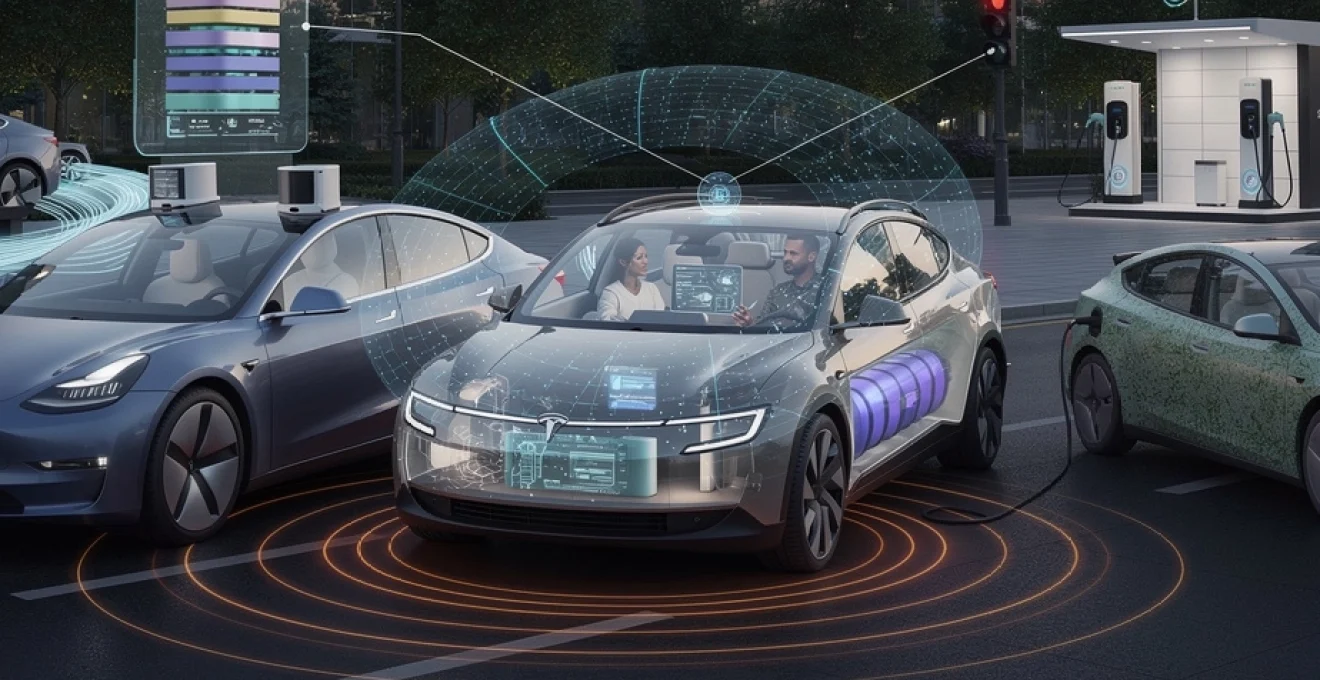
Beyond onboard sensors, autonomous and semi-autonomous cars increasingly rely on Vehicle-to-Everything (V2X) communication to understand what lies beyond their immediate line of sight. V2X encompasses Vehicle-to-Vehicle (V2V), Vehicle-to-Infrastructure (V2I), and Vehicle-to-Pedestrian (V2P) links, enabling cars to share data about speed, position, hazards, and traffic conditions in real time. Standards such as Dedicated Short-Range Communications (DSRC) and Cellular V2X (C-V2X) define how this information is encoded and transmitted. While DSRC operates more like a specialised Wi‑Fi network, C‑V2X leverages existing 4G and emerging 5G networks to deliver low-latency, wide-area coverage.
Imagine approaching a blind intersection where another vehicle, obscured by buildings, is about to run a red light. With robust V2V in place, your car could receive a warning and initiate emergency braking before either driver could react. Similarly, V2I allows traffic lights to broadcast their phase and timing, enabling smoother adaptive cruise control and reducing stop‑and‑go congestion. Urban planners see V2X as a cornerstone of smart city ecosystems, where connected cars, buses, and delivery fleets co-ordinate to minimise emissions and optimise road usage. However, standardisation, cybersecurity, and privacy remain major hurdles, as vehicles effectively become rolling nodes on the internet.
Edge computing and real-time sensor fusion algorithms
Autonomous driving would be impossible if every decision had to be sent to the cloud for processing. Instead, vehicles deploy powerful onboard computers that perform edge computing, processing sensor data locally with millisecond latency. These systems ingest information from cameras, radar, LiDAR, ultrasonic sensors, and GPS, then combine it through sophisticated sensor fusion algorithms. The goal is to build a unified, probabilistic model of the environment that can support split-second decisions—whether to brake, change lanes, or navigate a complex roundabout. In a sense, the car’s central computer acts like a highly trained conductor, ensuring each sensor plays its part in harmony.
Modern autonomous platforms can perform up to hundreds of trillions of operations per second, yet they must operate within strict power and thermal limits to remain viable in a vehicle. To achieve this, manufacturers increasingly use specialised hardware accelerators for neural networks and perception tasks. Over-the-air software updates continually refine these algorithms, allowing improvements in lane-keeping, pedestrian detection, and path planning without changing any mechanical components. Looking ahead, the combination of edge AI with selective cloud offloading—for tasks like high-definition map updates—will define how far and how quickly we move from Level 3 to reliable Level 4 and, eventually, Level 5 autonomy.
Electric vehicle battery technology and solid-state innovation
While autonomy reshapes how vehicles drive, advances in battery technology determine how far and how efficiently they can travel. The last decade has seen lithium-ion batteries evolve from being a limiting factor to the enabling backbone of the modern electric vehicle. Yet range anxiety, charging times, and long-term degradation remain central concerns for many drivers considering the switch to electric mobility. Manufacturers, suppliers, and research institutions are therefore engaged in an intense global race to increase energy density, reduce costs per kilowatt-hour, and improve safety. The next generation of batteries will not only extend driving range but also reshape how vehicles interact with homes, businesses, and the power grid.
Lithium-ion chemistry: NMC versus LFP cell configurations
Today’s electric vehicles primarily use two lithium-ion chemistries: Nickel Manganese Cobalt (NMC) and Lithium Iron Phosphate (LFP). NMC cells offer higher energy density, which translates into longer driving ranges in a lighter package—an attractive proposition for premium EVs and long-distance commuters. However, they rely on cobalt and nickel, materials that can be expensive and ethically contentious due to mining practices. Thermal management is also more critical, as NMC packs can be more susceptible to overheating if abused or damaged. As a result, sophisticated battery management systems constantly monitor temperature and charge levels to maintain safety and longevity.
LFP batteries, by contrast, typically deliver lower energy density but shine in durability, safety, and cost. They are less prone to thermal runaway, tolerate frequent fast charging, and often boast longer cycle life, making them ideal for fleet vehicles, city cars, and markets where affordability is paramount. You can think of NMC as a high-performance athlete and LFP as a dependable marathon runner—each excels in different contexts. Many manufacturers are now offering both chemistries within their line-up, allowing customers to choose between maximum range and lower upfront cost. As cell-to-pack designs and structural battery packs evolve, even LFP-based vehicles are beginning to achieve ranges that would have seemed ambitious only a few years ago.
Quantumscape and toyota’s solid-state battery development
Beyond conventional lithium-ion technology, solid-state batteries are often described as the “holy grail” of electric vehicle energy storage. Companies like QuantumScape and Toyota are investing billions in research and pilot production lines to bring this technology to market. Instead of using a liquid electrolyte, solid-state cells employ a solid ceramic or polymer medium, which can dramatically enhance safety and energy density. In theory, this allows for smaller, lighter battery packs that provide greater range and support ultra-fast charging without the risk of dendrite formation causing short circuits.
QuantumScape has reported prototype cells capable of achieving more than 800 charging cycles while retaining over 80% capacity, with the potential to charge from 10% to 80% in under 15 minutes. Toyota, meanwhile, has announced plans to introduce solid-state batteries in select models later this decade, targeting ranges exceeding 1,000 km on a single charge. If these claims translate into mass production, we could see EVs that outperform combustion cars not only in emissions but also in convenience and total cost of ownership. However, challenges remain in scaling manufacturing, reducing costs, and ensuring reliability across temperature extremes—a reminder that promising lab results must still survive the realities of everyday driving.
Silicon anode technology and energy density improvements
Even within traditional lithium-ion frameworks, incremental innovations can unlock significant gains. One of the most promising developments is the use of silicon-dominant anodes to replace or supplement conventional graphite. Silicon can theoretically store up to ten times more lithium ions per unit mass than graphite, offering a straightforward path to higher energy density. Startups and established suppliers alike are working on engineered silicon materials and binders that mitigate the expansion and contraction that occurs during charge cycles, which historically caused silicon anodes to crack and degrade.
By integrating silicon into the anode, manufacturers aim to increase range by 20–40% without fundamentally redesigning the rest of the battery system. For drivers, this could mean smaller packs delivering the same range, reducing vehicle weight and cost, or maintaining pack size and significantly extending how far you can travel between charges. As with many disruptive technologies, early deployments are likely to appear in premium models before filtering down to more affordable segments. Combined with improvements in cathode materials and electrolyte additives, silicon anode technology exemplifies how a series of targeted refinements can collectively push EV performance beyond what most of us consider normal today.
Bidirectional charging and Vehicle-to-Grid (V2G) integration
As battery capacities grow, electric vehicles are evolving from passive loads on the power grid into dynamic energy assets. Bidirectional charging enables power to flow both ways—into the vehicle during charging and back out again when needed. Vehicle-to-Grid (V2G), Vehicle-to-Home (V2H), and Vehicle-to-Building (V2B) technologies allow EVs to support the grid during peak demand, provide backup power during outages, or help homeowners optimise their energy bills by storing electricity when it is cheap and feeding it back when prices rise. In effect, your car becomes a mobile battery bank that can work for you even while parked in the driveway.
Pilots in Europe, Japan, and North America have already demonstrated that aggregated fleets of V2G-enabled vehicles can stabilise renewable-heavy grids by smoothing the intermittency of wind and solar power. For fleet operators, this opens up new revenue streams, as parked delivery vans or buses can provide grid services when not in use. Yet widespread adoption will require clear regulatory frameworks, standardised charging protocols, and business models that fairly reward vehicle owners for participating. There is also the question of battery wear: smart energy management systems must balance grid benefits with preserving battery health to ensure that drivers are not trading long-term degradation for short-term gains.
Hydrogen fuel cell powertrains and infrastructure deployment
While battery-electric vehicles dominate the headlines, hydrogen fuel cells represent a complementary pathway toward zero-emission transportation, particularly for heavy-duty and long-range applications. Fuel cell electric vehicles (FCEVs) generate electricity onboard by combining hydrogen with oxygen from the air, producing only water vapour as exhaust. This process enables quick refuelling—often in less than five minutes—while delivering ranges comparable to or greater than traditional combustion engines. For industries where downtime is costly, such as freight logistics and public transport, hydrogen’s fast turnaround can be a decisive advantage.
However, the success of hydrogen mobility hinges on building an extensive, reliable network of production facilities, pipelines, and refuelling stations. Today, hydrogen infrastructure is concentrated in a handful of regions such as California, Japan, South Korea, and parts of Europe. Governments are beginning to invest heavily in national hydrogen strategies, recognising its potential not just for transport but also for decarbonising industry and energy storage. As with early EV charging networks, we are likely to see a gradual build-out focused on key corridors and fleet hubs before hydrogen becomes a truly mainstream option for private motorists.
Toyota mirai and hyundai NEXO proton exchange membrane systems
The Toyota Mirai and Hyundai NEXO are among the most advanced commercial fuel cell vehicles currently on the road, showcasing how Proton Exchange Membrane (PEM) technology can be packaged into everyday cars. In these systems, hydrogen stored at high pressure flows into a fuel cell stack, where it is split into protons and electrons. The protons pass through a polymer membrane while the electrons travel through an external circuit, generating electrical power that drives the motor and charges a small buffer battery. The only by-product is water, which is expelled through the tailpipe.
Both the Mirai and NEXO offer ranges in the region of 600 km under standard test cycles, with refuelling times comparable to petrol or diesel vehicles. They also integrate advanced driver assistance and connectivity features, making them competitive with battery EVs in terms of comfort and technology. The challenge, of course, is that without a dense network of hydrogen stations, many potential buyers remain hesitant. For now, these vehicles often serve as flagships or testbeds in regions where governments and energy companies are jointly investing in hydrogen corridors. Over the next decade, lessons learned from these early deployments will shape the design of larger fuel cell trucks, buses, and even trains.
Green hydrogen production through electrolysis
Not all hydrogen is created equal. Today, most hydrogen is produced from natural gas through steam methane reforming, a process that emits significant CO₂—so-called “grey” hydrogen. For hydrogen mobility to deliver genuine climate benefits, the industry must pivot toward green hydrogen, produced via electrolysis using renewable electricity. In an electrolyser, water molecules are split into hydrogen and oxygen using an electrical current. When powered by wind, solar, or hydroelectric sources, this process yields hydrogen with near-zero lifecycle emissions, aside from equipment manufacturing.
Large-scale electrolysis projects are already underway in Europe, the Middle East, Australia, and North America, often co-located with abundant renewable resources. These facilities aim to supply hydrogen for both industrial processes and transportation, leveraging economies of scale to drive down costs. From a systems perspective, green hydrogen can act as a long-term storage medium for surplus renewable energy, complementing batteries, which are more efficient for short-duration storage. The key question is how quickly production, transport, and distribution can be scaled while maintaining competitive prices compared with fossil fuels and battery-electric alternatives. Policy support, carbon pricing, and international collaboration will all play decisive roles.
High-pressure storage tanks: 700 bar safety standards
Storing hydrogen onboard a vehicle presents its own set of engineering challenges. Most fuel cell cars use composite tanks that hold hydrogen at pressures up to 700 bar (around 10,000 psi). These tanks are constructed from multiple layers, including a polymer liner to contain the gas and carbon-fibre-reinforced shells to withstand the enormous internal pressure. Rigorous safety standards govern their design, testing them against impact, fire, gunshots, and even deliberate puncture to ensure that they fail in a controlled manner if damaged. In many respects, hydrogen tanks are engineered with greater redundancy and safety margins than traditional fuel tanks.
International regulations, such as those from the United Nations Economic Commission for Europe (UN-ECE), specify how these tanks must perform under extreme conditions, from sub-zero climates to scorching heat. In real-world terms, the likelihood of a catastrophic hydrogen tank failure is extremely low, often lower than that of a conventional fuel system. Nonetheless, public perception can lag behind engineering reality, so transparent testing, clear labelling, and education will be essential for broader acceptance. As we move toward heavier-duty vehicles and higher storage capacities, innovations in tank design and alternative storage methods—such as metal hydrides or liquid organic hydrogen carriers—may further enhance both safety and practicality.
Advanced driver assistance systems (ADAS) and sensor arrays
Even before full autonomy arrives, advanced driver assistance systems are dramatically improving safety and convenience in everyday driving. ADAS features such as automatic emergency braking, adaptive cruise control, lane-keeping assistance, and blind-spot monitoring are rapidly becoming standard, driven both by consumer expectations and regulatory mandates. At their core, these systems aim to reduce human error—the leading cause of road accidents worldwide—by acting as an ever-vigilant co-driver that can intervene when our attention lapses. For many drivers, ADAS represents the most tangible expression of future car technology available today.
To function reliably, ADAS relies on a carefully orchestrated sensor array. Forward-facing radar units detect vehicles and obstacles at long range, while cameras interpret lane markings, traffic signs, and pedestrian movements. Ultrasonic sensors around the vehicle support low-speed manoeuvres and parking assistance, and in more advanced systems, LiDAR adds precise depth information. The real magic lies in how these inputs are fused, using machine learning algorithms to interpret complex scenes and predict how other road users are likely to behave. Have you ever noticed how adaptive cruise control smoothly adjusts to a merging vehicle, almost as if anticipating its move? That is sensor fusion at work.
Regulators, particularly in Europe, are increasingly mandating advanced safety features as part of new vehicle type approvals. This push accelerates adoption but also raises important design questions: how much control should the car have, and how should it communicate its intentions to the driver? Clear human-machine interfaces—through dashboards, head-up displays, and haptic feedback—are becoming critical to ensure drivers understand when systems are active and what they can (and cannot) do. As we progress, the line between ADAS and lower levels of autonomy will blur, making education and transparent labelling essential to avoid over-reliance or misuse.
Sustainable materials: bio-based composites and recycled components
As powertrains become cleaner, attention is turning to the environmental footprint of the vehicles themselves. The car of the future is not only defined by its zero-emission tailpipe but also by the sustainability of its materials and manufacturing processes. Automakers are increasingly adopting life-cycle assessments to measure emissions from raw material extraction through production, use, and end-of-life recycling. The result is a surge of interest in bio-based composites, recycled plastics, low-carbon metals, and circular economy design principles that keep valuable materials in use for as long as possible.
Bio-based composites—often derived from natural fibres such as hemp, flax, or kenaf—are already being used in interior panels, seat structures, and trim pieces. These materials can reduce weight while offering a smaller carbon footprint compared with traditional glass-fibre-reinforced plastics. Some manufacturers are experimenting with biopolymers and plant-based foams for seats and insulation, reducing reliance on petrochemical-derived products. Recycled plastics from end-of-life vehicles, consumer waste, or even ocean debris are being incorporated into dashboards, carpets, and underbody components. The idea is straightforward but powerful: by treating waste as a resource, the automotive industry can cut raw material demand and support broader sustainability goals.
Metals are also under scrutiny. Aluminium and high-strength steels help reduce vehicle mass, improving efficiency for both EVs and combustion engines, but they must be sourced and processed responsibly. Many brands now specify recycled content targets for aluminium body panels and battery housings, while exploring low-carbon steel produced using green hydrogen instead of coal. Design for disassembly is gaining traction, ensuring that at the end of a vehicle’s life, batteries, motors, and structural components can be separated and recycled more easily. For you as a buyer, this shift may be less visible than a large infotainment screen or a longer range estimate, but it plays a crucial role in making future mobility genuinely sustainable rather than merely shifting emissions from one place to another.
Connected car ecosystems: 5G integration and over-the-air updates
Connectivity is the glue that binds many of these emerging automotive technologies together. Modern vehicles are effectively computers on wheels, equipped with multiple communication modules that link them to the cloud, to infrastructure, and to other vehicles. The rollout of 5G networks promises to take this connectivity to the next level, offering ultra-low latency, high bandwidth, and the capacity to support millions of devices in dense urban environments. For drivers, this means more reliable real-time traffic information, richer infotainment services, and a smoother interface between their car and the digital services they use every day.
One of the most transformative aspects of the connected car ecosystem is the rise of over-the-air (OTA) updates. Instead of visiting a dealership for every software tweak, vehicles can receive new features, performance enhancements, and security patches remotely—much like smartphones. This capability turns the car into a continually evolving product rather than a static purchase, extending its functional lifespan and allowing manufacturers to respond quickly to emerging issues. Some brands already unlock additional horsepower, extended range, or new driver assistance features via software, raising intriguing questions about how we value and configure vehicles over time.
Of course, with great connectivity comes great responsibility. Cybersecurity has become a top priority as vehicles gain external interfaces that could be exploited if not properly secured. Automakers and suppliers are implementing multi-layered defences, from encrypted communications and secure hardware enclaves to intrusion detection systems that monitor for suspicious behaviour. Data privacy is another key concern: connected cars generate vast amounts of information about driving patterns, locations, and personal preferences. Regulators and manufacturers alike must ensure that this data is handled transparently, with clear consent and meaningful controls for users. As we look ahead, the most successful connected car ecosystems will be those that combine convenience and innovation with robust protections and genuine respect for driver autonomy—both on the road and in the digital realm.