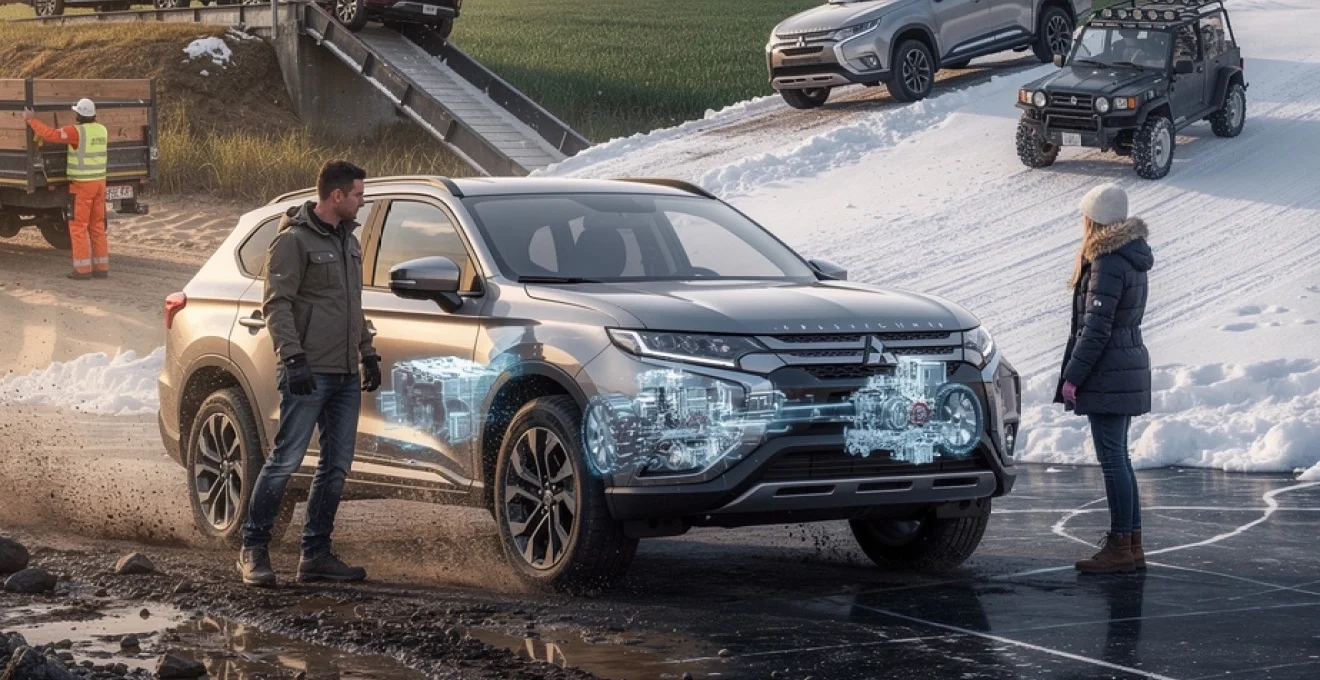
The decision to opt for a four-wheel drive vehicle represents more than just a preference for capability—it reflects specific requirements that two-wheel drive configurations simply cannot fulfil. Whether you’re navigating treacherous mountain passes, towing heavy loads across variable terrain, or simply seeking enhanced safety during adverse weather conditions, understanding when a 4×4 drivetrain becomes essential rather than optional can significantly impact your vehicle ownership experience. Modern four-wheel drive systems have evolved considerably from their utilitarian origins, now incorporating sophisticated electronic management systems that deliver power precisely where it’s needed most. The versatility of contemporary 4×4 platforms extends far beyond traditional off-road scenarios, making them increasingly relevant for a diverse range of driving conditions and applications that demand superior traction management and control.
Understanding 4×4 drivetrain architecture and torque distribution systems
At its core, a 4×4 system distributes engine torque to all four wheels rather than just the front or rear pair. This fundamental difference creates numerous advantages in traction-limited scenarios, but the specific architecture employed determines how effectively this power reaches the ground. Modern four-wheel drive systems utilise various mechanical and electronic components working in concert to manage torque distribution dynamically. The sophistication of these systems has increased dramatically, with today’s platforms capable of monitoring wheel speeds, steering angles, throttle inputs, and even individual wheel slip rates hundreds of times per second.
Understanding the underlying architecture helps clarify which system best suits your particular requirements. The complexity ranges from relatively simple mechanical engagement systems to highly sophisticated platforms incorporating multiple electronic control units and hydraulic actuators. Each approach offers distinct advantages depending on your intended usage patterns, with permanent systems providing continuous all-wheel traction whilst part-time configurations offer improved fuel efficiency when four-wheel drive isn’t required.
Permanent Four-Wheel drive vs Part-Time 4WD mechanical configurations
Permanent four-wheel drive systems, sometimes termed full-time 4WD, continuously distribute torque to all four wheels regardless of driving conditions. This constant engagement eliminates the need for driver intervention when traction suddenly deteriorates, providing seamless security during unexpected slippery conditions. The trade-off involves slightly reduced fuel efficiency and increased mechanical complexity, as the system requires a centre differential or similar mechanism to accommodate the different rotational speeds of front and rear axles during cornering.
Part-time 4WD configurations, conversely, operate in two-wheel drive mode under normal conditions, with the driver manually engaging four-wheel drive when circumstances demand enhanced traction. These systems typically cannot be used on high-traction surfaces like dry pavement when engaged, as the solid mechanical connection between front and rear axles creates what’s known as transmission wind-up during turns. This limitation makes part-time systems less convenient but often more fuel-efficient for vehicles that spend the majority of their time on paved roads.
Centre differential lockup mechanisms and viscous coupling technology
The centre differential represents a critical component in permanent four-wheel drive systems, allowing the front and rear axles to rotate at different speeds whilst still distributing torque to both ends of the vehicle. When you navigate a corner, the front wheels travel a greater distance than the rear wheels, necessitating this speed differential. Without a centre differential, permanent 4×4 systems would experience severe binding and potential drivetrain damage on high-traction surfaces.
However, an open centre differential presents a problem when one axle loses traction entirely—power naturally follows the path of least resistance, potentially directing all torque to the slipping axle. Centre differential lockup mechanisms address this limitation by locking the front and rear axles together when maximum traction is required. Viscous coupling technology provides one elegant solution, using silicone fluid within a sealed chamber that thickens under shear stress to progressively lock the differential as speed differences increase between axles.
Electronic torque vectoring in modern 4×4 platforms
Contemporary 4×4 systems increasingly incorporate electronic torque vectoring capabilities that transcend traditional mechanical differential limitations. These advanced platforms can actively distribute torque not just between front and rear axles, but between individual wheels on the same axle. By selectively applying braking force to specific wheels or using clutch packs to redirect tor
que from the slipping wheel, these systems can maintain forward momentum and enhance vehicle stability in situations where a traditional 4×4 design would struggle. In effect, electronic torque vectoring allows the control unit to “decide” in real time which wheel will make the best use of available grip. This is particularly valuable on mixed-friction surfaces—such as patches of ice interspersed with dry tarmac—where individual wheels experience radically different traction levels within a single rotation.
From a driver’s perspective, electronic torque vectoring in a modern four-wheel drive platform translates into more neutral handling and greater confidence, especially during emergency manoeuvres. By overdriving an outside rear wheel through targeted torque delivery, some systems can even help pivot the vehicle into a corner, reducing understeer. The system’s rapid response time, often measured in milliseconds, allows it to pre-empt loss of control rather than simply reacting to it. When you are evaluating when to choose a 4×4 design for versatility and control, access to such predictive stability interventions can be a deciding factor—particularly if you frequently drive on challenging or unpredictable surfaces.
Transfer case gear ratios and low-range crawl capabilities
The transfer case is the heart of any serious 4×4 drivetrain, responsible for splitting torque between front and rear axles and, in many cases, providing low-range gearing for demanding off-road conditions. Low-range is achieved via an additional gear set that multiplies torque while dramatically reducing output speed. Typical low-range ratios vary between 2.0:1 and 4.0:1, allowing the engine to operate in its optimal power band while the wheels turn slowly enough to maintain precise control over obstacles. If you anticipate frequent slow-speed work—such as rock crawling, forestry access, or steep farm tracks—low-range capability becomes far more than a luxury.
Low-range gearing in a four-wheel drive vehicle functions like a magnifying glass for torque: it concentrates the engine’s output at the wheels, enabling controlled movement where a high-range 4×4 or 2WD vehicle would simply stall or spin. This increased control also reduces clutch wear and heat build-up in automatic transmissions, as the drivetrain does not have to “slip” to modulate speed. Some modern transfer cases are electronically shifted, while others retain a manual lever that provides a more tactile connection and can be preferable in wet or corrosive environments. When comparing 4×4 designs for versatility and control, consider not only whether a transfer case is present, but also its specific low-range ratio and how easily it can be engaged when conditions deteriorate unexpectedly.
Off-road terrain conditions requiring 4×4 traction management
Different off-road environments impose very different demands on a 4×4 system, and understanding these distinctions will help you decide when a four-wheel drive design is essential. Loose surfaces, steep gradients, deep ruts and low-friction obstacles all challenge the ability of a vehicle to maintain traction and forward progress. While tyre choice and driver skill remain crucial, the underlying drivetrain architecture and torque distribution strategy often determine whether a particular obstacle can be negotiated safely. By examining key terrain categories, you can match a 4×4 platform’s capabilities to your real-world use cases instead of relying on generic “off-road” branding.
Loose surface dynamics: sand, gravel, and deep snow environments
On loose surfaces such as sand, gravel and deep snow, your primary enemy is wheel spin and the rapid loss of supporting material beneath the tyres. In these conditions, a 4×4 system that can smoothly distribute torque to all four wheels reduces the likelihood that any single tyre will dig in and create a trench. Permanent 4×4 designs with centre differentials, or advanced on-demand systems with fast-acting clutch packs, often perform best here because they avoid the sudden engagement shocks that can break traction. Maintaining momentum without abrupt throttle inputs is critical, and a low first gear or low-range transfer case helps keep wheel speed under control.
Modern four-wheel drive vehicles frequently include specific drive modes for sand or snow that adjust throttle mapping, gearbox shift points and traction control interventions. These modes typically allow slightly more wheel slip than on-road stability settings, recognising that some slip is necessary to clear and compact the surface beneath the tyre. If you regularly drive on unmaintained winter roads or coastal access tracks, choosing a 4×4 design with dedicated loose-surface calibration can dramatically increase your margin of safety. Ask yourself: will you need to start on an uphill gravel drive with a trailer attached, or move confidently through unploughed snow to reach remote properties? If so, loose-surface performance should be a priority.
Rock crawling and articulation demands on steep gradients
Rock crawling represents one of the most demanding use cases for a 4×4 vehicle, combining extreme gradients, uneven surfaces and the need for precise tyre placement. In this environment, wheel articulation—the ability of each wheel to move up and down independently—ensures as many tyres as possible remain in contact with the ground. A solid-axle design can provide excellent articulation, but independent suspension systems have become increasingly capable when paired with long-travel components and electronic aids. Low-range gearing is non-negotiable for serious rock work, as it allows centimetre-precise control with minimal throttle input.
Equally important in rock crawling is the availability of locking differentials, particularly at the rear axle and ideally at both axles. When one wheel lifts into the air or rests on a low-friction surface, an open differential will simply spin that wheel, robbing the opposite wheel of usable torque. Lockers mechanically link both sides of the axle, forcing them to rotate at the same speed and guaranteeing torque delivery to the wheel with grip. For drivers who intend to tackle steep rock shelves, ledges or deeply eroded tracks, choosing a 4×4 design that combines low-range, robust underbody protection and selectable locking differentials is essential for both progress and component longevity.
Mud bogging and water fording with cross-axle differential locks
Mud is often described as the great equaliser of off-road driving, capable of immobilising even powerful vehicles that lack appropriate traction management. In muddy ruts or bogs, tyres must simultaneously claw for grip and clear thick material from their tread blocks. A four-wheel drive system with effective cross-axle locks—either mechanical lockers or electronically controlled limited-slip differentials—can prevent the common scenario where diagonally opposite wheels spin uselessly in the air or in low-resistance mud. By ensuring that at least one tyre on each axle receives meaningful torque, these systems greatly increase your chances of driving through rather than bogging down.
Water fording introduces additional variables, including buoyancy, hidden obstacles and the risk of hydraulic lock if water is ingested by the engine. A 4×4 platform designed with sealed electrical connectors, raised breathers for differentials and transfer cases, and an appropriate wading depth rating offers more than just marketing appeal—it provides real-world resilience in flood-prone regions or remote river crossings. In combination with low-range gearing, controlled entry speed and steady throttle application, four-wheel drive engagement helps maintain a stable bow wave and reduces the risk of stalling mid-stream. When your operations involve access across poorly drained fields, forestry cuts or seasonal riverbeds, these mud and water capabilities can be decisive.
Ice and black ice navigation with advanced ABS integration
Ice, and particularly black ice, presents one of the most deceptive traction challenges because it often remains invisible until grip is already lost. Contrary to a common misconception, four-wheel drive does not shorten braking distances on ice; instead, its primary benefit is in maintaining directional control and reducing the likelihood of complete loss of traction. Modern 4×4 systems integrate closely with anti-lock braking systems (ABS), electronic stability control (ESC) and traction control, using wheel-speed sensors to modulate both braking and torque delivery hundreds of times per second. This integration can prevent individual wheels from locking and sliding, helping you retain at least partial steering authority.
Some premium 4×4 platforms include specialised winter or ice modes that soften throttle response and bias torque toward the axle with better grip, often the rear, to maintain stable progress. Think of these systems as the digital equivalent of a skilled co-driver, constantly adjusting inputs to keep the vehicle balanced on a razor-thin margin of traction. For drivers in regions where freezing rain and overnight refreezing of wet surfaces are common, choosing a 4×4 design with sophisticated ABS and ESC integration is less about off-road adventure and more about everyday survivability. You may not be able to see black ice, but a well-calibrated four-wheel drive and stability system can help you respond to it before it becomes unmanageable.
Agricultural and commercial applications demanding 4×4 capability
Agricultural and commercial users place very different demands on a four-wheel drive system compared with recreational off-road drivers. Here, the priority often lies in predictable performance under load, year-round access to remote locations and minimal downtime rather than exploring technical trails. Farm tracks, construction sites and utility corridors frequently combine soft ground, uneven surfaces and steep approaches that can challenge even experienced operators. In these settings, a 4×4 vehicle becomes a working tool that must consistently deliver traction, regardless of weather or soil conditions.
Many agricultural operations require towing heavy implements, feed trailers or livestock boxes across fields that may be saturated after rainfall. A part-time 4WD system with a robust low-range transfer case can provide the necessary tractive effort while allowing the vehicle to revert to two-wheel drive on the road for improved fuel economy. For commercial fleets, electronic shift-on-the-fly systems reduce driver training requirements and minimise the risk of drivetrain abuse. If your business model depends on accessing sites with limited infrastructure—be it a hillside vineyard, remote telecom tower or forestry stand—investing in a 4×4 platform with appropriate ground clearance and underbody protection often pays for itself through reduced delays and recovery costs.
Towing performance and load distribution with Four-Wheel drive engagement
Towing places unique stresses on a vehicle’s drivetrain, suspension and braking systems, and four-wheel drive can significantly improve stability and control when operating near maximum capacity. By distributing torque across both axles, a 4×4 configuration reduces the likelihood of wheel spin at the drive axle, especially when pulling away on inclines or slippery surfaces. This is particularly important when towing near the vehicle’s gross combined weight rating (GCWR), where any loss of traction can quickly escalate into a loss of directional stability. For many owners, the decision to choose a 4×4 design is driven as much by towing requirements as by off-road ambitions.
Trailer sway control and weight distribution hitch compatibility
Trailer sway is one of the most unnerving experiences a driver can encounter, often triggered by crosswinds, sudden steering inputs or uneven loading. Many modern 4×4 vehicles incorporate trailer sway control systems that use the existing ESC hardware to detect and counteract oscillations. By selectively applying the brakes at individual wheels and, in some cases, reducing engine torque, these systems can bring a swaying trailer back into line before the driver needs to intervene. When combined with a properly adjusted weight distribution hitch, which helps balance vertical load between the front and rear axles, the result is a more planted, confidence-inspiring towing experience.
Four-wheel drive engagement further enhances this stability by giving the front axle an active role in transmitting torque, reducing the risk that a heavily loaded rear axle will break traction under acceleration. This can be particularly valuable when overtaking, merging onto motorways or climbing long grades, where maintaining steady momentum is essential. If you regularly tow caravans, horseboxes or equipment trailers, verifying that your chosen 4×4 platform supports both trailer sway control and weight distribution hitch compatibility should be high on your checklist. The synergy between these systems often makes the difference between a relaxed journey and a white-knuckle experience.
Uphill grade performance with maximum gross combined weight rating
Climbing steep gradients while towing at or near maximum GCWR pushes any vehicle’s cooling system, transmission and drivetrain to their limits. In these scenarios, a four-wheel drive system equipped with low-range gearing can dramatically ease the strain by allowing the engine to operate in a more efficient rev band while maintaining slow, controlled ascent speeds. Rather than relying on excessive throttle input in high range—which increases heat and fuel consumption—a 4×4 vehicle can leverage mechanical advantage to “walk” up the incline. This approach reduces the likelihood of wheel spin, which can be catastrophic when a heavy trailer begins to push a sliding tow vehicle backwards.
Manufacturers often provide specific towing guidelines for steep grades, including recommendations for 4WD engagement, gear selection and cooling pauses. Some modern automatic transmissions in 4×4 vehicles offer tow/haul modes that adjust shift patterns and improve engine braking on descents, further enhancing control. If your regular routes include mountain passes, quarry access roads or long climbs to remote worksites, opting for a four-wheel drive platform with proven grade-climbing performance is a pragmatic safety decision. Think of it as choosing a vehicle that can maintain composure when fully loaded rather than one that only performs well when unladen on level ground.
Boat launch ramp and slippery surface recovery scenarios
Boat ramps combine several traction challenges: smooth concrete surfaces, algae growth, standing water and often a pronounced slope. Rear-wheel-drive vehicles in particular can struggle to generate sufficient grip when pulling a laden trailer up the ramp, especially if the rear tyres are partially unloaded by the ramp angle. Engaging four-wheel drive allows the front tyres—which are usually on drier, less contaminated sections of the ramp—to share the work, dramatically reducing wheel spin. This is one of the most common real-world scenarios where owners who rarely “off-road” still benefit from a 4×4 drivetrain.
Similarly, recovery scenarios—such as extracting a trailer from soft ground at a campsite or pulling a colleague’s van off a snowy verge—often demand short bursts of high tractive effort. A four-wheel drive vehicle with appropriate recovery points and, ideally, low-range gearing can provide this assistance with far less risk of drivetrain damage. When assessing your own needs, consider not just the glamour of off-road trails but also the mundane realities of slipways, wet grass event parking and unpaved site entrances. In all these cases, a 4×4 design substantially increases your margin of error and reduces the reliance on ideal surface conditions.
Fuel efficiency trade-offs and selectable 4WD system economics
One of the most common objections to four-wheel drive vehicles concerns fuel consumption and overall running costs. It is true that, all else being equal, a 4×4 drivetrain introduces additional weight, mechanical drag and complexity compared with a two-wheel drive equivalent. However, advances in drivetrain design—such as on-demand coupling systems, efficient transfer cases and lightweight materials—have significantly narrowed the gap. Many modern selectable 4WD systems can decouple the front axle during steady-state cruising, effectively operating as a 2WD vehicle until sensors detect slip or the driver selects a dedicated mode.
When deciding whether to choose a 4×4 design for versatility and control, it is helpful to view fuel efficiency in context rather than isolation. How often do your journeys genuinely require four-wheel drive engagement, and how much would hiring a specialist vehicle cost each time instead? For many users, the slight increase in fuel consumption is offset by the reduced risk of missed appointments, recovery charges or delayed deliveries due to poor conditions. Additionally, residual values for well-specified 4×4 models often remain stronger in markets where adverse weather or rural usage is common, partially compensating for higher purchase and running costs. Treat the economics holistically: factor in downtime avoidance, operational flexibility and long-term resale alongside litres per 100 km.
Vehicle platforms featuring advanced 4×4 systems: land rover terrain response and toyota Multi-Terrain select
Not all four-wheel drive systems are created equal, and several manufacturers have developed sophisticated control interfaces to help drivers extract maximum capability with minimal guesswork. Land Rover’s Terrain Response and Toyota’s Multi-Terrain Select are two leading examples of such integrated 4×4 management systems. Rather than expecting the driver to manually configure every aspect of the drivetrain, these platforms offer intuitive mode selections—such as Grass/Gravel/Snow, Mud and Ruts, Sand or Rock Crawl—that automatically adjust dozens of parameters behind the scenes. For many drivers, this translates into expert-level off-road performance without requiring years of experience.
Jeep Selec-Terrain system across wrangler and grand cherokee models
Jeep’s Selec-Terrain system follows a similar philosophy, offering mode-based control over throttle response, transmission mapping, traction control and differential behaviour. Available in various forms across Wrangler and Grand Cherokee models, Selec-Terrain typically provides Auto, Snow, Sand, Mud and Rock settings, with some variants adding a dedicated Sport mode for on-road dynamics. In Auto, the system continuously monitors wheel slip and load to determine the optimal front-to-rear torque split, effectively acting as an intelligent all-wheel-drive system. As conditions become more challenging, selecting the appropriate mode tailors the vehicle’s responses to the specific terrain.
For example, in Rock mode, available on suitably equipped models, Selec-Terrain will usually lock the centre coupling, engage low-range and relax certain traction control thresholds to allow controlled wheel slip where necessary for climbing. In Snow mode, by contrast, throttle inputs are softened and torque is biased to minimise abrupt weight transfer. For buyers considering a 4×4 design primarily for mixed on-road use with occasional demanding excursions, such integrated systems reduce the learning curve and help ensure that the vehicle’s significant mechanical capabilities are actually utilised. It is the digital layer of intelligence that turns raw hardware into accessible, repeatable performance.
Ford’s intelligent 4WD in ranger and F-150 raptor applications
Ford’s Intelligent 4WD and Terrain Management System, particularly in vehicles like the Ranger and F-150 Raptor, demonstrates how a manufacturer can tailor four-wheel drive behaviour to both work and high-performance use cases. In everyday conditions, Intelligent 4WD operates largely autonomously, constantly adjusting torque distribution based on sensor data to maintain stability and traction. When drivers venture off-road, selectable modes such as Baja, Mud/Ruts, Rock Crawl or Snow/Grass alter the calibration to suit specific surfaces and driving styles. For instance, Baja mode in the Raptor optimises response for high-speed desert running, allowing greater wheel slip and more aggressive throttle mapping.
From a versatility standpoint, this adaptive approach means a single 4×4 platform can serve as both a towing workhorse and a recreational off-road machine. The same underlying transfer case and locking differentials that provide slow-speed crawl capability on rocky trails can, with different software tuning, support high-speed stability on loose gravel tracks. If your requirements span multiple roles—daily commuting, weekend towing, occasional off-road adventures—Ford’s implementation of intelligent four-wheel drive offers a useful template of how modern electronics can stretch the utility of a single vehicle. It illustrates the broader trend: as control software becomes more sophisticated, choosing a 4×4 design is less about compromising for one environment and more about unlocking flexible, mode-based performance.
Mercedes-benz 4MATIC permanent AWD vs traditional 4×4 architectures
Mercedes-Benz 4MATIC represents a different branch of the four-wheel drive family tree, focused primarily on on-road security and dynamic capability rather than extreme off-road performance. As a permanent all-wheel-drive system, 4MATIC typically maintains a fixed or mildly variable front-to-rear torque split, often biased towards the rear for more engaging handling. Instead of low-range transfer cases and locking differentials, 4MATIC relies heavily on electronic traction and stability control, using individual wheel braking and torque reduction to manage slip. This architecture suits high-speed motorway driving, wet-weather stability and light gravel or snow use exceptionally well.
Comparing 4MATIC to traditional ladder-frame, low-range-equipped 4×4 designs highlights the importance of aligning drivetrain choice with real-world needs. If your primary concerns involve commuting in variable weather, spirited driving on twisting roads and occasional ski trips, a 4MATIC-equipped vehicle may deliver all the control and safety you require with fewer compromises in ride comfort and fuel efficiency. Conversely, if your journeys regularly take you far from paved surfaces, with substantial towing or load-carrying requirements, a more traditional 4×4 architecture with dedicated off-road hardware will remain the more appropriate choice. Understanding these distinctions ensures that when you choose a 4×4 design for versatility and control, you are selecting not just a marketing badge, but a drivetrain that genuinely matches your environment, workload and expectations.