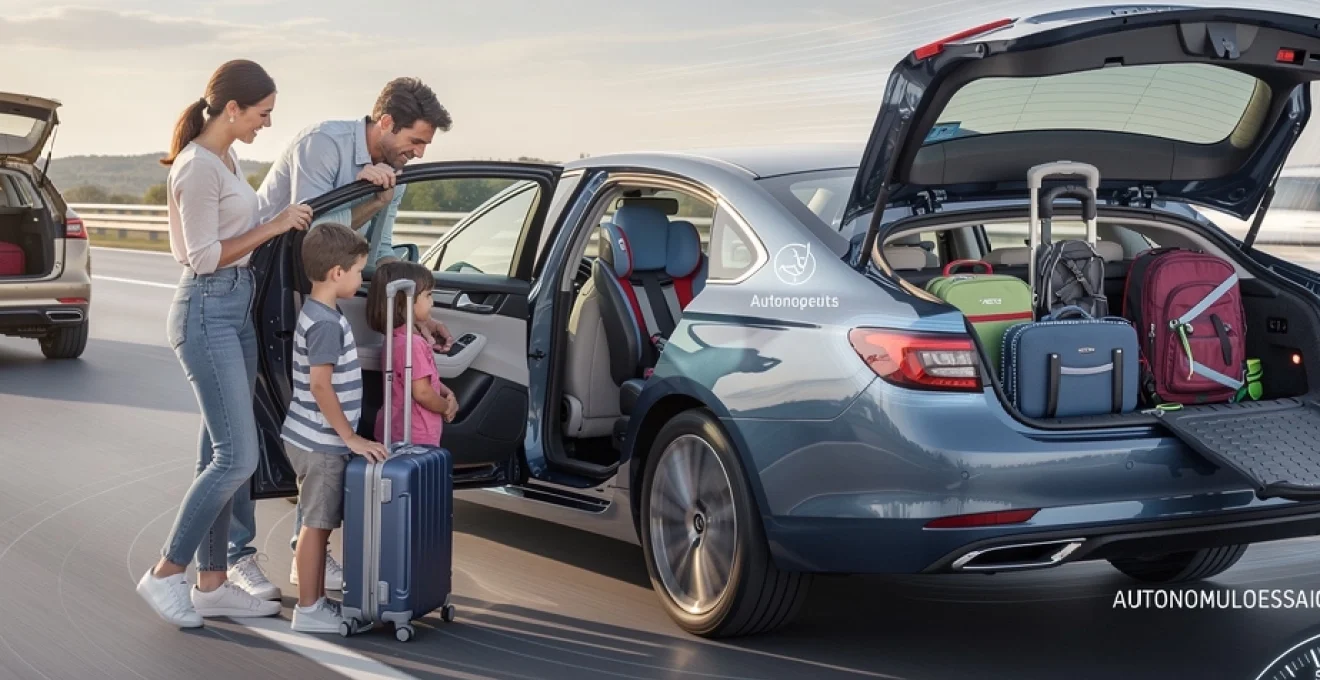
# **Article complet optimisé SEO : Pourquoi opter pour une berline familiale reste un choix intelligent**
The automotive landscape has undeniably shifted towards SUVs and crossovers in recent years, yet family sedans continue to offer compelling advantages that shouldn’t be overlooked. Despite the market trend favouring higher-riding vehicles, sedans remain exceptionally practical for families seeking a balanced combination of space, safety, efficiency, and value. With manufacturers like Toyota, Honda, and Volkswagen continuing to refine their saloon offerings, these vehicles deliver sophisticated solutions to everyday family motoring challenges without the premium price tag or running costs associated with larger alternatives.
Modern family sedans have evolved considerably from their predecessors, incorporating advanced technologies, spacious interiors, and safety features that rival or exceed those found in SUVs. For families carefully considering their next vehicle purchase, understanding the specific advantages of the sedan body style can lead to a more informed decision that better serves both immediate needs and long-term requirements. The benefits extend beyond simple transportation, encompassing everything from fuel economy to handling dynamics and residual value retention.
Superior boot capacity and practical interior dimensions for family requirements
One of the most persistent misconceptions about family sedans concerns their load-carrying capability. Many prospective buyers assume that SUVs automatically offer more usable space, yet the reality often tells a different story. Modern D-segment saloons provide remarkably generous boot capacities that frequently surpass their crossover competitors, thanks to intelligent packaging and the absence of compromised rooflines. The sedan’s traditional three-box design allows engineers to maximise luggage volume without sacrificing passenger comfort or rear headroom.
Comparing boot space: toyota camry’s 524 litres vs SUV alternatives
The Toyota Camry exemplifies this advantage perfectly, offering 524 litres of boot space in its standard configuration—a figure that competes directly with mid-size SUVs costing considerably more. This capacity easily accommodates the weekly shopping for a family of five, multiple suitcases for holiday travel, or the various sports equipment that accumulates with active children. When you compare this with popular crossovers in the same price bracket, the Camry often provides equal or superior luggage volume whilst maintaining a lower loading lip height that makes accessing heavy items significantly easier, particularly for elderly family members or those with mobility considerations.
The Honda Accord similarly impresses with 473 litres, whilst the Škoda Superb raises the bar considerably with an outstanding 625 litres—matching or exceeding many seven-seat SUVs. These figures aren’t merely theoretical; in practical terms, they translate to genuine everyday usability that families will appreciate during school runs, shopping trips, and longer journeys. The regular, uninterrupted floor shape of a sedan boot also means that luggage can be stacked more efficiently than in SUVs, where wheel arches and sloping rooflines often create awkward spaces that reduce usable volume despite impressive headline figures.
Second-row legroom and Three-Child seating configuration
Interior space represents another area where sedans excel beyond expectations. The longer wheelbase typically found on family saloons translates directly into generous rear legroom, with models like the Volkswagen Passat offering 939mm of knee room for second-row passengers. This dimension allows adults to travel comfortably on longer journeys without the cramped conditions that can turn a family holiday into an endurance test. For families with teenagers—who seem to grow exponentially year on year—this additional space becomes increasingly valuable over the vehicle’s ownership period.
The flat rear floor of most sedans also facilitates easier three-abreast seating when necessary. Whilst this configuration works best for shorter journeys, it provides valuable flexibility when transporting additional children for school activities or social events. The absence of a transmission tunnel in many modern sedans, particularly those with front-wheel drive, means that the middle passenger enjoys considerably more foot space and comfort than in comparable SUVs where driveline components often intrude into the rear cabin area. Have you considered how frequently you might need this occasional extra capacity throughout your ownership period?
Split-folding rear seat versatility for school runs and holiday luggage
Split-folding rear seats further enhance the practicality of a family sedan, particularly during busy school runs and holiday departures. Many models in this segment, including the Mazda6 and Honda Accord, offer 60:40 or even 40:20:40 split-folding configurations, allowing you to adapt the rear cabin to suit awkward loads such as pushchairs, scooters, musical instruments, or flat-pack furniture. You can keep two child seats securely installed while folding part of the bench to extend the load length, something that is often less straightforward in SUVs with higher floors and bulkier seat mechanisms.
For everyday use, this flexibility means you can carry a child and a long item—like skis or a folded buggy—without sacrificing all rear seating. Families who regularly travel to sporting events or holiday destinations will appreciate being able to configure the rear of the car like a modular storage system, rather than facing an “all or nothing” choice between passengers and luggage. When combined with a wide boot opening and low loading height, the split-folding rear seat effectively turns the family sedan into a capable long-distance load carrier, ideal for those who want practicality without stepping up to a larger vehicle.
Underfloor storage solutions and parcel shelf accessibility
Modern family sedans are also increasingly clever when it comes to hidden storage. Underfloor compartments in the boot—often found in models like the Škoda Superb and Toyota Camry—provide secure spaces to stow valuables, emergency kits, or dirty items such as muddy boots and sports gear. These compartments help keep the main luggage area uncluttered, which is particularly useful when you are juggling shopping bags, school backpacks, and a pushchair on a busy weekday morning.
The parcel shelf, sometimes seen as a simple trim piece, can also play a key role in day-to-day practicality. Many manufacturers now design shelves that are easily removable or have hinged sections, allowing faster access to items placed towards the back of the boot. This can be especially handy when you need to reach smaller bags or a changing bag without unloading the entire boot. In some sedans, tether points on or below the shelf allow you to secure lighter items, preventing them from rolling around and causing distraction while driving.
Advanced safety technology and euro NCAP performance standards
Beyond space and practicality, one of the strongest arguments for choosing a family sedan lies in its advanced safety technology and consistently high crash-test performance. Many of the segment’s leaders are engineered from the outset to excel in Euro NCAP assessments, with comprehensive active and passive safety packages included as standard rather than costly options. For families, this means you are not forced to trade up to a larger SUV simply to gain access to the latest driver-assistance systems or five-star adult occupant protection ratings.
Manufacturers such as Honda, Mazda, Toyota, and Volkswagen have invested heavily in integrating cutting-edge collision-avoidance technologies into their saloons, often under well-known safety sub-brands like Honda Sensing or Mazda i-Activsense. These suites bring together autonomous emergency braking, lane-keeping assistance, adaptive cruise control, and more—features that directly address the real-world risks we face on congested roads and busy school routes. When you combine this technology with inherently stable sedan handling and a lower centre of gravity, the result is a family car that actively helps you avoid accidents in the first place.
Autonomous emergency braking systems in honda accord and mazda6
Autonomous emergency braking (AEB) has become one of the most important safety technologies for family drivers, and sedans such as the Honda Accord and Mazda6 set high standards in this area. Their systems use a combination of camera and radar sensors to monitor the road ahead, detecting vehicles, cyclists, and in many cases pedestrians. If the driver fails to react to a looming collision, the car can automatically apply the brakes to either avoid the impact entirely or reduce its severity—an invaluable safeguard when children or distractions are present in the cabin.
In independent tests, AEB has been shown to significantly reduce rear-end collisions at low and medium speeds, exactly the kind of incidents that often occur in stop-start urban traffic and at busy junctions. The latest Honda Accord and Mazda6 units work across a broad speed range and in varied weather conditions, with some systems now also recognising oncoming traffic when turning across a junction. As a parent, knowing that your family sedan is actively watching the road ahead—as a second pair of eyes—can make daily driving feel substantially less stressful.
ISOFIX anchorage points and child restraint integration
For families with younger children, the ease and security of fitting child seats is non-negotiable. Most modern family sedans offer ISOFIX anchorage points on the two outer rear seats as standard, and some models extend this to the front passenger seat as well. Clear labelling, easily accessible anchor bars, and removable plastic covers make it quicker and less frustrating to install and remove child restraints, reducing the risk of incorrect fitment—a common problem that can compromise safety in a collision.
Because sedans typically have lower seat bases and door sills than SUVs, physically lifting a child seat into the car can be less strenuous, especially for parents or grandparents with limited mobility. The doors on many D-segment saloons also open to a wide angle, giving you ample room to manoeuvre a bulky ISOFIX base or rotating seat. When evaluating a potential family sedan, it is worth bringing your existing child seat along for a test fit; you will quickly feel the difference between a car designed with families in mind and one where child-seat integration was an afterthought.
Blind spot monitoring and rear cross-traffic alert functions
As traffic density increases in urban and suburban areas, features like blind spot monitoring (BSM) and rear cross-traffic alert (RCTA) have become invaluable for family drivers. Many sedans now include these technologies either as standard or within affordable safety packs. Blind spot monitoring uses sensors in the rear bumper to detect vehicles in adjacent lanes that may not be visible in your mirrors, warning you via a light in the door mirror or an audible alert if you indicate to change lanes when it is not safe to do so.
Rear cross-traffic alert, meanwhile, comes into its own in crowded car parks and narrow driveways—exactly the environments where family cars spend much of their time. When reversing, the system scans for approaching vehicles, cyclists, or even fast-moving pedestrians crossing behind your sedan, sounding an alert or, in some models, applying the brakes automatically. Think of it as having a lookout posted behind the car every time you back out of a parking space: simple, reassuring, and particularly useful when tall hedges, parked vans, or busy school gates obstruct your view.
Five-star adult occupant protection ratings across segment leaders
When you look at Euro NCAP results for leading family sedans, a clear pattern emerges: five-star adult occupant protection ratings are the norm rather than the exception. Models such as the Toyota Camry, Honda Accord, Mazda6, and Volkswagen Passat have all achieved excellent scores in frontal offset, side-impact, and whiplash tests, reflecting robust body structures and advanced restraint systems. For you and your passengers, this translates into a higher likelihood of walking away from a serious collision with fewer injuries.
These ratings also factor in the effectiveness of active safety technology, including AEB and lane-keeping systems, as well as protection for vulnerable road users such as pedestrians and cyclists. For families who regularly drive in built-up areas, this holistic approach to safety is particularly important. Rather than relying purely on size and bulk—as some SUV buyers often do—safety-focused sedans prioritise intelligent engineering and technology to manage crash energy and help prevent accidents altogether.
Cost-effective ownership through fuel efficiency and lower insurance groups
Running costs are a critical consideration for any family, and this is where sedans often deliver a powerful advantage over SUVs and crossovers. Thanks to their lower weight, sleeker aerodynamics, and smaller frontal area, family saloons typically consume less fuel in real-world driving and fall into more favourable insurance groups. Over three, five, or even ten years of ownership, these seemingly small differences can add up to thousands of pounds saved—money that can be redirected towards holidays, education, or home improvements.
In addition to fuel and insurance savings, many sedans benefit from longer service intervals and competitive manufacturer warranty packages. This combination results in predictable, manageable ownership costs that align well with the realities of family budgeting. When you factor in lower tyre costs (due to more modest wheel sizes) and often cheaper replacement parts, the total cost of owning a family sedan can undercut that of an equivalent SUV by a surprisingly wide margin.
Diesel vs petrol economy: škoda superb’s real-world consumption figures
The Škoda Superb provides a useful benchmark when comparing real-world economy between diesel and petrol family sedans. Independent road tests frequently report diesel versions of the Superb achieving over 55mpg on mixed routes, with some drivers seeing figures approaching 60mpg on steady motorway runs. By contrast, the equivalent turbocharged petrol models typically return between 40 and 45mpg in everyday use—still highly respectable for such a spacious family car, and more than adequate for households with lower annual mileage.
Which powertrain is right for you depends largely on your driving pattern. If your family regularly undertakes long motorway journeys or lives in rural areas, a modern Euro 6 diesel sedan can still offer the best combination of torque, efficiency, and cruising comfort. For predominantly urban or short-trip use, a petrol or hybrid sedan may be the smarter choice, reducing NOx emissions and potential issues associated with diesel particulate filters. In both cases, the Superb’s efficient engines illustrate how family sedans can deliver fuel economy that many bulkier SUVs struggle to match.
Insurance group classifications: 15E to 25E range analysis
Insurance costs are another area where sedans often beat their taller counterparts. Many popular family saloons sit comfortably in the 15E to 25E insurance group bracket, reflecting their strong safety performance, moderate power outputs, and relatively low repair costs. For example, a mid-spec Volkswagen Passat or Honda Accord will typically undercut an equivalent SUV in annual premiums, sometimes by several hundred pounds per year, especially for younger or less experienced drivers on the policy.
From an insurer’s perspective, the lower centre of gravity and stable handling characteristics of sedans contribute to fewer rollover incidents and less severe collision damage, which in turn supports more favourable pricing. If you are comparing potential family cars, it is worth obtaining insurance quotes for both sedan and SUV options; you may be surprised to discover how much you can save by choosing the four-door saloon. Over a typical three-year finance agreement, these savings can effectively pay for optional extras such as upgraded infotainment or a driver-assistance package.
Servicing intervals and manufacturer warranty coverage comparisons
Servicing intervals and warranty coverage also play a significant role in the total cost of ownership for a family sedan. Many mainstream manufacturers now offer service intervals of up to 20,000 miles or two years for petrol and diesel saloons, reducing the number of workshop visits required during typical ownership. Combined with fixed-price servicing plans, this makes it easier to budget for maintenance and avoid unexpected bills—something every family can appreciate.
Warranty offerings in the sedan segment are equally competitive. Brands like Toyota provide up to 10 years or 100,000 miles of warranty coverage when cars are serviced within their dealer network, while Hyundai and Kia are known for seven-year packages on many models. This long-term protection not only gives you peace of mind but can also enhance the resale value of your family sedan, since remaining warranty coverage is highly attractive to second-hand buyers. When you spread these benefits across several years, the sedan’s reputation for cost-effective ownership is reinforced yet again.
Lower centre of gravity dynamics and enhanced road handling
One of the defining characteristics of a family sedan is its lower centre of gravity compared with SUVs and crossovers, and this has a direct impact on how the car feels and behaves on the road. With less body roll in corners and more predictable responses to steering inputs, sedans tend to inspire confidence, particularly on wet or winding roads. For family drivers, that translates into a calmer, more reassuring driving experience—exactly what you want when precious cargo is on board.
The lower stance also allows engineers to fine-tune suspension systems for a better blend of comfort and control. Where taller vehicles often have to adopt stiffer springs to keep body lean in check, sedans can use more compliant setups that glide over potholes and expansion joints while still feeling composed at motorway speeds. The result is a ride quality that many owners describe as “big-car smooth” without the associated running costs of a large SUV or luxury 4×4. If you have ever felt slightly seasick in a tall vehicle on a twisty road, you will immediately notice the difference behind the wheel of a well-sorted family saloon.
Depreciation curves and residual value retention analysis
Depreciation may not be the most exciting topic, but it is crucial when evaluating the long-term value of any family car. Sedans have historically been favoured by business fleets and corporate buyers, which helps support strong residual values for popular models. While the surge in SUV demand has shifted some of the spotlight, many family saloons still hold their value impressively well, particularly those from brands with established reputations for reliability and low running costs.
Understanding how quickly a car loses value over time can help you make a smarter purchasing decision, whether you are buying outright, using PCP finance, or opting for a contract hire arrangement. By choosing a sedan with a proven track record of residual value retention, you effectively reduce your real-world cost of ownership. When the time comes to trade in or sell privately, you may find that the sedan’s lower initial purchase price and slower depreciation combine to deliver a better financial outcome than a trendier SUV that has dropped more steeply in value.
Three-year resale performance: volkswagen passat vs nissan qashqai
A useful illustration comes from comparing a Volkswagen Passat sedan with a Nissan Qashqai crossover over a typical three-year period. Industry data from UK trade guides and auction results often shows well-specified Passat models retaining a similar—sometimes higher—percentage of their original list price than mid-spec Qashqais, despite the SUV’s strong retail appeal. In percentage terms, both can hover around the 50–55% retained value mark after three years and 36,000 miles, depending on specification and condition.
However, because the Passat generally starts from a slightly lower purchase price for an equivalent engine and equipment level, the absolute cash lost to depreciation can be lower. For families financing their car on PCP, this can translate into more attractive monthly payments or the ability to step up to a higher trim level without increasing the budget. It also means that, should you decide to buy the car at the end of the term, you may be acquiring a well-equipped, still-valuable asset for a comparatively modest final payment.
Fleet market demand and corporate contract hire implications
Fleet demand plays a significant role in shaping residual values, and here, family sedans such as the Passat, Toyota Camry, and BMW 3 Series continue to enjoy strong support. Corporate buyers favour these models for their fuel efficiency, driver satisfaction, and professional image, often acquiring them in large numbers on contract hire agreements. This sustained demand underpins healthy used-car values when fleet vehicles are de-fleeted and enter the retail market.
For private buyers, this dynamic can work in your favour in two ways. First, strong fleet uptake helps keep lease and PCP rates competitive, as finance companies can confidently predict future values. Second, the steady supply of well-maintained ex-fleet saloons—typically with full service histories—provides a rich source of high-quality used cars at attractive prices. If you are open to buying nearly new rather than brand new, a one- to three-year-old ex-fleet sedan can offer substantial savings without sacrificing specification or condition.
Colour choice impact on residual values within d-segment saloons
Even seemingly minor decisions, such as paint colour, can influence the future value of your family sedan. Within the D-segment saloon market, conservative shades like metallic grey, black, silver, and dark blue tend to perform best at resale time, reflecting broader buyer preferences in both private and fleet channels. Bolder colours—bright reds, yellows, or unusual special-order hues—may attract attention on the forecourt but often appeal to a smaller pool of second-hand buyers.
If maximising residual value is a priority, it makes sense to choose a widely popular exterior colour and pair it with a tasteful, hard-wearing interior trim. Think of this as dressing your car in a classic suit rather than a fleeting fashion trend; while you may personally enjoy something more distinctive, the market as a whole typically rewards understated elegance. This is particularly important if you plan to keep the car for only three to five years, when the impact of colour on residual value is most pronounced.
Aerodynamic efficiency and reduced wind noise at motorway speeds
Finally, one of the less obvious yet highly tangible benefits of a family sedan is its superior aerodynamic efficiency. The traditional three-box saloon shape, with a gently sloping roofline and carefully sculpted boot lid, allows air to flow more smoothly over and around the vehicle than the taller, bluff front of an SUV. Lower drag coefficients—often in the region of 0.25 to 0.28 for modern sedans—contribute directly to improved fuel economy at motorway speeds, where aerodynamic resistance is the dominant force the engine must overcome.
This streamlined design also brings a welcome side effect: reduced wind noise in the cabin. On long journeys, particularly with children on board, the relative quiet of a well-insulated sedan can make the difference between arriving refreshed and stepping out feeling fatigued. Conversations are easier, in-car entertainment systems sound clearer, and you can make better use of voice-activated navigation or phone controls. For many families, these subtle comfort gains—combined with lower fuel consumption—reinforce why opting for a family sedan remains a smart, future-proof choice in an SUV-dominated market.